
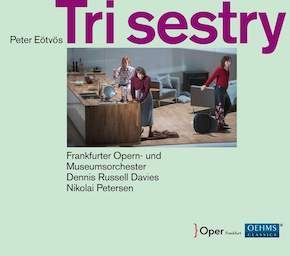
 Peter Eötvös’ 1998 opera Tri sestry is based on the Chekhov play and was recorded live at Oper Frankfurt in 2018. It takes fragments of the original Russian play and recombines them in a non-linear way to create a prologue and three “Sequences” from the points of view of Irina, Andrei and Mascha repectively. The recombination is complex enough for the accompanying booklet to contain a table mapping Chekhov’s scene order to Eötvös’. There’s no libretto in the CD package so even flipping between the (fairly detailed) synopsis and the track listing it’s hard to figure out who is singing or about what. No doubt this was much clearer when watching the stage production.
Matters are not made any easier by giving all the female roles to male singers. The sisters and Natascha are given to counter tenors while the nanny Anfisa is sung by a bass. This is fine except that a non-trivial amount of text is spoken and counter tenors sound just like any other male when speaking which further increases the difficulty of keeping things straight, especially with a cast of thirteen characters! Non-Russian speakers are unlikely to be able to follow much of the text anyway as singers sing over each other for most of the first two Sequences. It does get a bit more open and sparer in the third sequence and someone with a strong knowledge of the language will likely pick up nuances there that I missed.

 Yesterday I went to a Met “live in HD” broadcast for the first time since The Nose two years ago. It was an interesting and ultimately rather depressing experience. This review really falls into two parts; a review of the production and performance, including how it was filmed for broadcast, and a piece on how the Met is “presenting” the work and how that seems to fit in with its overall HD strategy. The latter may turn into a bit of a rant.
 operaramblings