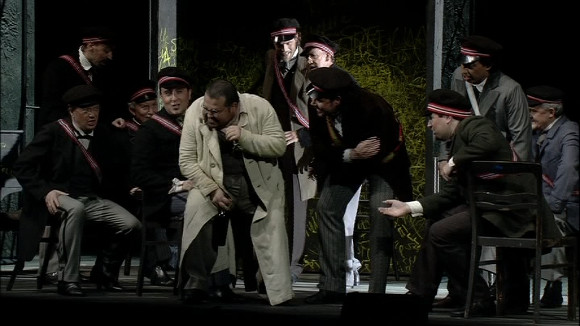
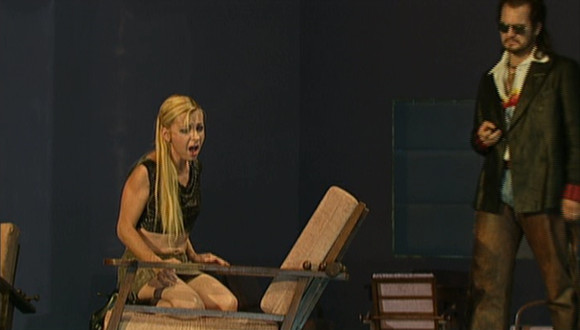
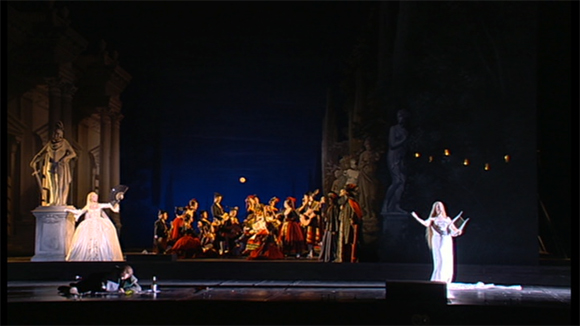
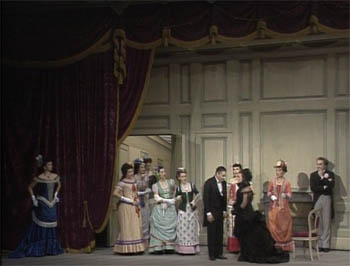
Giancarlo del Monaco’s production of Offenbach’s Les Contes d’Hoffmann recorded in Bilbao in 2006 isn’t nearly as weird as the interviews on the first disk might lead one to expect. It has its moments but in many ways is more “by the book” than the Laurent Pelly production I looked at last week. The interviews talk of a “Sartrian” Hoffmann and a Freudian approach to Antonia. Ok so Hoffmann is portrayed as a hunchback and he’s fairly damaged but he’s basically your standard drunk poet fixated on a woman or women he can’t have. I can’t actually see this dude nailing his hand to a nightclub table with a knife or drowning his cat to prove a point.
Tag Archives: offenbach
Lauren Pelly’s weird, dour Tales of Hoffmann
Laurent Pelly’s 2013 production of Offenbach’s Les Contes d’Hoffmann at the Liceu is one of those productions that’s a bit hard to take in at first go. Part of it is the performing edition used (Michael Kay and Jean-Christophe Keck) which seems to have added a lot of dialogue compared to any version I’ve seen before and includes Hoffmann killing Giulietta in Act 3. This produces a constant sense of “where they heck are we in the piece”. It doesn’t help that the DVD package contains no explanatory material at all. There are no interviews on the disks and the documentation is sub-basic.
La Grand-Duchesse de Gérolstein
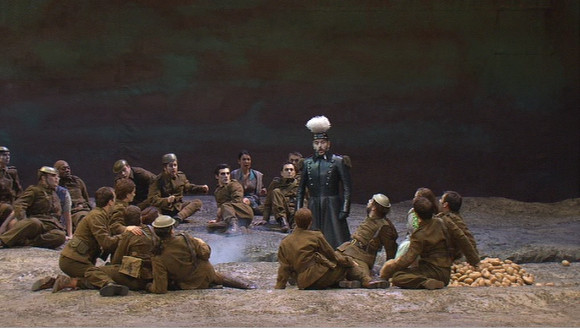
Despite a thin to non-existent plot and music that sounds like a remix of all the other Offenbach operettas, La Grande-Duchesse de Gérolstein, performed by largely French forces and recorded at the Théâtre du Châtelet in 2004 is a highly enjoyable romp. The plot centres on the susceptibility of the Grand-Duchess to fall rather hard for younger men. This makes it a perfect vehicle for Felicity Lott who rather seems to specialise in such roles; whether Strauss’ Marschallin or La Belle Hélène. She’s brilliant. She sings gorgeously except where she doesn’t want to and her comic timing is impeccable. She’s well backed up by Yann Beuron as the young soldier Fritz who she promotes from private to général-en-chef without swaying his affections for his sweetheart Wanda sung by the irrepressible and cute Sandrine Piau. The slapstick element is provided by François Le Roux, as Le Général Boum, Franck Leguérinet as Le Baron Puck and Eric Huchet as Le Prince Paul who are set on getting the Grand-Duchess to marry Paul even if it means murdering Fritz. They get lots of up tempo numbers that sound as if they are singing a Korean restaurant menu.
La belle Hélène from the GGS
The Glenn Gould School’s production of Offenbach’s 1864 operetta La belle Hélène opened at Koerner Hall last night. Overall, it’s an enjoyable show with some strong performances though there are aspects of it that, in my view, rather missed the mark. Certainly it made me realise just what a difficult piece to really bring off really well La belle Hélène is. There are some very difficult singing roles and yet they need to sound effortless. It needs the exquisite comic timing of a bedroom farce. There’s also a difficult to define quality; very French and with a sexiness of the “I know it when I see it” variety. I think it was a shortage of this last that was largely the problem last night.
Opera 5 do Hahn and Offenbach
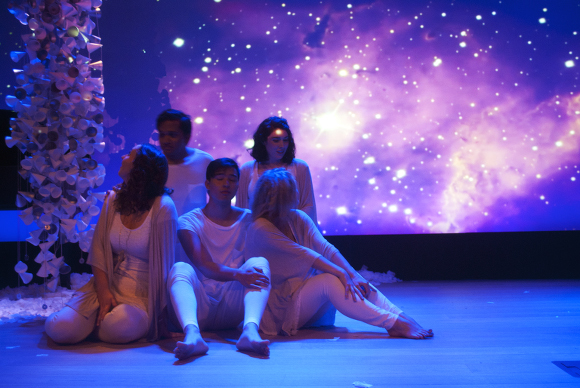
Opera 5’s latest show presents two rarely seen French one act operas. First up was Reynaldo Hahn’s 1897 work L’île du rêve. It’s one of those French officer falls in love with beautiful sixteen year old girl on tropical island and then “duty” calls and he dumps her and she dies of a broken heart pieces. The only twist is that here he offers to take her back to France but the ruling princess advises her that, away from the island, she will lose her charms and he’ll come to despise her so she doesn’t. A touch of French worldliness colouring this rather overdone plot device perhaps? The staging, by Aria Umezawa, is fairly simple though clearly a lot of thought went into how to make the intimate scenes between the principals work. There are also some rather beautiful projections involved.
Natalie Dessay showcase
Le miracle d’une voix is a compilation of scenes from various recordings in which Natalie Dessay featured made between 1993 and 2003. It’s especially interesting in that a couple of pieces feature more than once. There are three Les oiseaux dans les charmilles; Olymia’s aria from Les contes d’Hoffmann and two Grossmächtigen Prinzessin from Ariadne auf Naxos. Thrse demonstarte what I have always believed to be Dessay’s greatest strength; her ability to recreate a character to fit in a particular production. The two Zerbunetta arias illustrate this perfectly. In the first, a Salzburg production from 2001, Zerbinetta is a depressed, heavy drinking, prostitute who celebrates a kind of deeply sad sisterhood with Ariadne before being dragged off by a very sleazy Russell Braun. In the second, from the Palais Garnier in 2003, she’s a bubble headed tourist in bikini and wrap who pesters poor Ariadne all around what looks like a Mediterranean building site. They are completely different characterisations but both highly effective. The same is true of the three Olympias who range from very conventional doll to inmate in some sort of asylum or home.
Inspired by Love
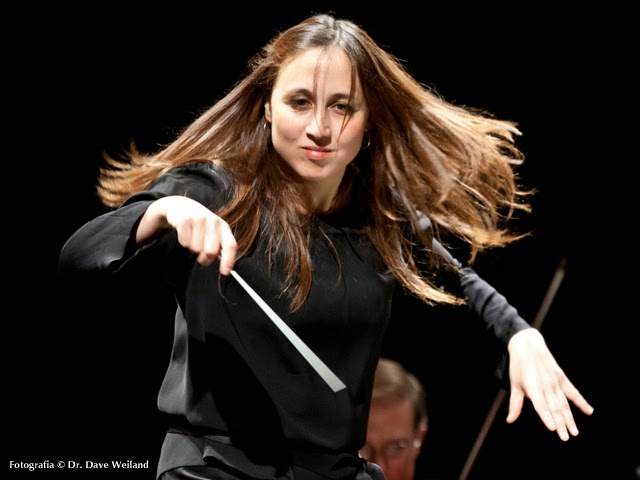
Once in a while it’s fun to go to something almost entirely undemanding (for the audience at least!). So, yesterday afternoon I attended a concert of classical “lollipops” given by the TSO under the baton of young Portugese conductor Joana Carneiro. The chief attraction for me was that recent Ensemble Studio graduates Simone Osborne and Wallis Giunta were also performing. Things got going with the overture from Il Nozze di Figaro. It was a brisk and stylish performance with Ms. Carneiros displaying a very physical conducting style.
Carsen’s Hoffmann riffs off Don Giovanni
Robert Carsen’s production of Offenbach’s Les Contes d’Hoffmann does a very decent job of presenting this rather muddled and overly long piece. He sets it in and around a production of Don Giovanni in which Hoffmann’s current infatuation, Stella, is singing Donna Anna. There are several quite clever DG references scattered around. By and large it works and is one of the better “theatre in theatre” treatments that I’ve seen.
La Belle Helène in Paris
When I reviewed the 1997 Zurich production of La Belle Helène about a week ago the commentariat was strong in the belief that I should take a look at the 2000 Paris-Châtelet production. So I did and they were right. It’s excellent. It also reinforced my belief that operetta; English, French or German, works best when it’s taken seriously by which I mean using the best available singer/actors, a good director and a top notch orchestra, chorus and conductor. All of these are in place in this Paris production. Continue reading
Existence is futile
I think my good luck run with Offenbach just ran out. I really didn’t enjoy the 1991 Opéra National de Lyon production of La Vie Parisienne. The productions of La Belle Helène and Orphée aux Enfers which I reviewed last week were very much performances by operatic forces letting their hair down; comparable, perhaps, to ENO doing Gilbert and Sullivan. The Lyon La Vie Parisienne seems to come out of an entirely different performing tradition. Continue reading