
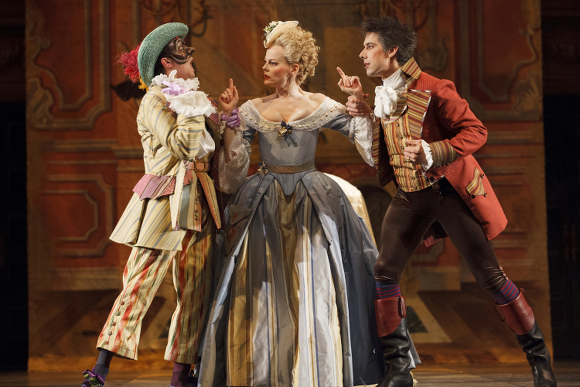
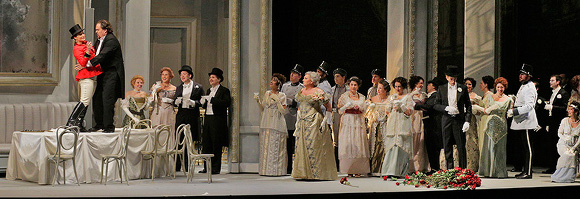
Sven-Eric Bechtolf’s second Mozart/daPonte for Salzburg was Don Giovanni which premiered in 2014. There are some similarities with his Così fan tutte. He uses a symmetrical unit set again and shows a fondness for creating symmetrical tableaux vivants but there the similarities pretty much end. I could find a consistent, believable set of humans in Così but not so much in Don Giovanni. The problem is really the man himself. Bechtolf, in his notes, seems to be arguing that Don Giovanni can make no sense in an age of pervasive accessibility and exposure to all things sexual. Da Ponte’s Don requires a climate of sexual repression for his essence; to Bechtolf a kind of Dionysian force (he cites Kierkegaard), to make any sense as a human. I think I get that but then, I think, the challenge becomes to create a Don Giovanni who does make sense to a 21st century audience as, in their different ways, do Guth and Tcherniakov. Bechtolf seems to treat the character not so much as a human rather than as a kind of energy focus who exists by igniting aspects of the other characters; whether that’s lust or jealousy or hatred. He caps off this idea at the end by having Don Giovanni reappear during the final ensemble as a kind of mischievous presence still chasing anything in a skirt, even if it’s, perhaps, from another world. It’s an idea that I could not really buy into.



 This review first appeared in the print edition of
 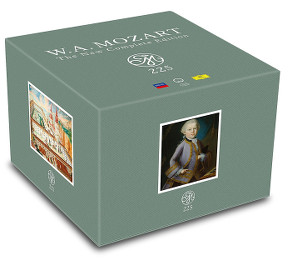 Today marks the 225th anniversary of Mozart’s death. To commemorate it Universal Records (Deutsche Grammophon and Decca basically) have put together a special commemorative edition which I have had a chance to dip into, but not much more than dip into, because it is huge. It’s a cuboid about the size of an LP record and a little over half as deep. It weighs 10kg. Inside are 200 CDs containing the complete works of Mozart including juvenalia, fragments, arrangements and alternative versions. There’s also a copy of the latest Kerchel catalogue, some prints and two very handsome hardback books; a new biography by Cliff Eisen and a second volume containing essays and work by work commentary. What there isn’t is libretti for the vocal works but it actually gets better. One can go to the website
  operaramblings