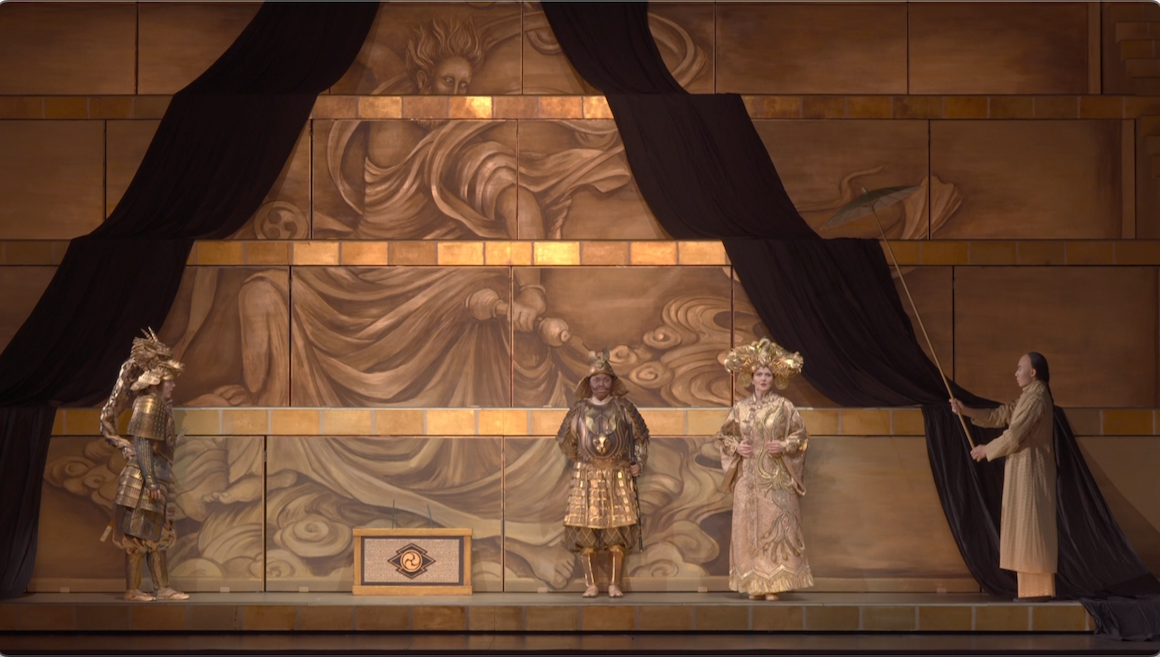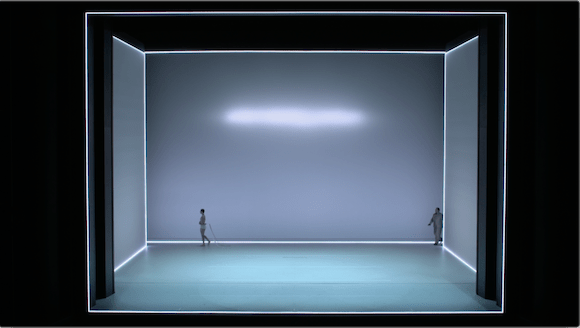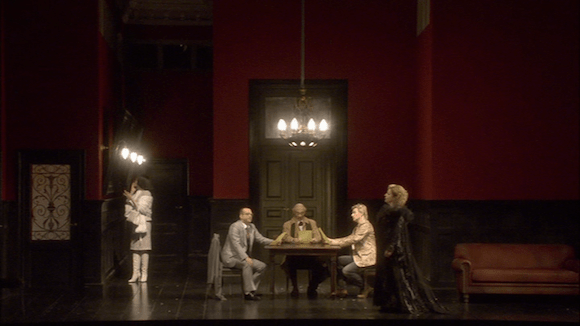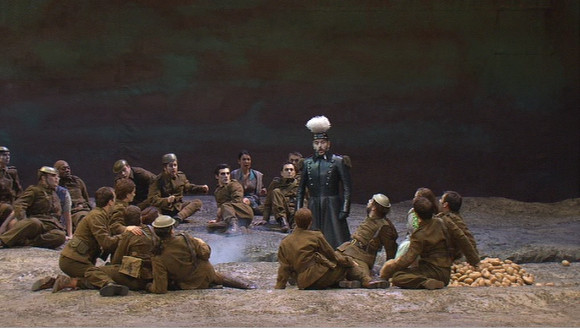
Mariane Clément’s production of Offenbach’s Les contes d’Hoffmann recorded at the 2024 Salzburg Festival is not the sort of production that one dismisses as pointless and/or ill conceived but it is complex and difficult to read; at least on first viewing. That said, being on video rather than live probably doesn’t help.
Tag Archives: minkowski
Metallic Mitridate
Mozart’s Mitridate, re di Ponto is definitely one of his less often performed works even though it’s astonishingly accomplished for a fourteen year old composer. One can see why. It adheres very faithfully to the opera seria model. Far more so than, say, La clemenza di Tito. The libretto is based on a play by Racine which, frankly, lacks dramatic interest and has a contrived ending. The opera wraps all the loose ends up in about three minutes. Structurally da capo aria follows recitative follows da capo aria with little variation and the arias all adhere pretty rigidly to the formal range of baroque emotions. That said there is some spectacular vocal writing; both lyrical and dramatic, which allows the singers to fully display their skills.

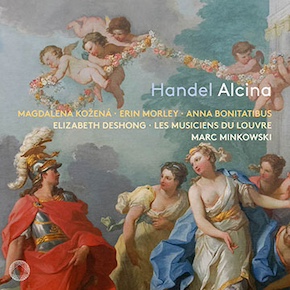
Complete and satisfying Alcina
The new recording of Handel’s Alcina from Marc Minkowski, Les musiciens du Louvre and a rather starry line up of soloists is very good and quite interesting. It’s very complete. As far as I can tell all the ballet/dance music is included and so are all the Oberto scenes and all his arias. In all the staged performances I’ve seen (live or video) one or both are usually heavily truncated and I have seen versions where Oberto doesn’t feature at all.
There was one thing that puzzled me a bit. The relatively large (40 or so) orchestra includes trumpets and bassoons but not horns. I think this is unusual but maybe someone more knowledgeable might comment? In any event there’s some really good playing, quite often at very fast tempi in the instrumental sections. Minkowski also gets a really wide range of colours from the orchestra. A good example is the low strings in “È gelosia”. Continue reading
Does anybody do dance like Opéra de Paris?
The title of this review of a 2022 recording of Rameau’s Platée is prompted by the fact that I’ve rarely seen this much high quality dance included in an opera production. It’s really spectacular. But back to basics. Platée is a comic opera of 1745. The production filmed in 2022 is by Laurent Pelly and was making its fifth run at the Palais Garnier. There’s an earlier video release of the 2002 run.

Der Messias
Der Messias is the German version of Handel’s Messiah as arranged by Mozart. The translation dates from 1775 and is by Klopstock and Ebeling drawing heavily on the Lutheran Bible. My German isn’t good enough to say how “archaic” it sounds to a modern German speaker but it certainly seems to be quite singable. In any event it was presented in Salzburg during this year’s Mozartwoche in a staged version by Robert Wilson. The arrangement adds a substantial wind section and changes the voice parts in places. For example Doch wer mag entraten (But who may abide) is given to the bass rather than one of the high voices.

Abstracting the Dutchman
Olivier Py’s production of Wagner’s Der fliegende Holländer, filmed at the Theater an der Wien in 2015, is quite unusual. Usually opera productions either play the story more or less straight or work with a concept of the director’s that is not obviously contained in the libretto. Py doesn’t really do either of these. What he does is present the narrative as Wagner wrote it but with visuals that act as a sort of commentary on, rather than a literal depiction of, the action being described. One of the things this does is make the viewer realise just how much Wagner is describing! There is much more tell than show.

Il Trovatore meets Huis Clos
Dmitri Tcherniakov is an interesting and controversial director. He’s not afraid to take a very radical approach to a work and that method tends to produce uneven results. At it’s best, as in his Berlin Parsifal, it’s extraordinary and sometimes; his Wozzeck for example, interesting but perhaps not exactly revelatory, and,again, sometimes; as in his Don Giovanni, polarising. That said he never does anything merely to shock or show off. There’s always a logic to what he does and that’s certainly true of his quite radical version of Verdi’s Il Trovatore filmed at Brussels’ La Monnaie in 2012.

Reflecting on Lucio Silla
I just got my hands on the La Scala recording of Mozart’s Lucio Silla. It’s the Marshall Pynkoski production that was done at Salzburg, then La Scala, then in somewhat modified form at Opera Atelier in Toronto, which I saw. It has provoked lots of thoughts about the work itself, how well the OA aesthetic transfers to another house and how seeing a production on video differs from seeing it live.

Equestrian Mozart
Once in a while one comes across a disk that sounds like it could be interesting but turns out to be a bit of a bust. That was certainly my experience with the recording of Mozart’s Davide penitente recorded in Salzburg during Mozart Week in 2015. On the face of it using the Felsenreitschule for something like its original purpose isn’t such a bad idea and the idea of choreographed horse “ballet” to a Mozart cantata is quite intriguing. On the face of it…

La Grand-Duchesse de Gérolstein
Despite a thin to non-existent plot and music that sounds like a remix of all the other Offenbach operettas, La Grande-Duchesse de Gérolstein, performed by largely French forces and recorded at the Théâtre du Châtelet in 2004 is a highly enjoyable romp. The plot centres on the susceptibility of the Grand-Duchess to fall rather hard for younger men. This makes it a perfect vehicle for Felicity Lott who rather seems to specialise in such roles; whether Strauss’ Marschallin or La Belle Hélène. She’s brilliant. She sings gorgeously except where she doesn’t want to and her comic timing is impeccable. She’s well backed up by Yann Beuron as the young soldier Fritz who she promotes from private to général-en-chef without swaying his affections for his sweetheart Wanda sung by the irrepressible and cute Sandrine Piau. The slapstick element is provided by François Le Roux, as Le Général Boum, Franck Leguérinet as Le Baron Puck and Eric Huchet as Le Prince Paul who are set on getting the Grand-Duchess to marry Paul even if it means murdering Fritz. They get lots of up tempo numbers that sound as if they are singing a Korean restaurant menu.