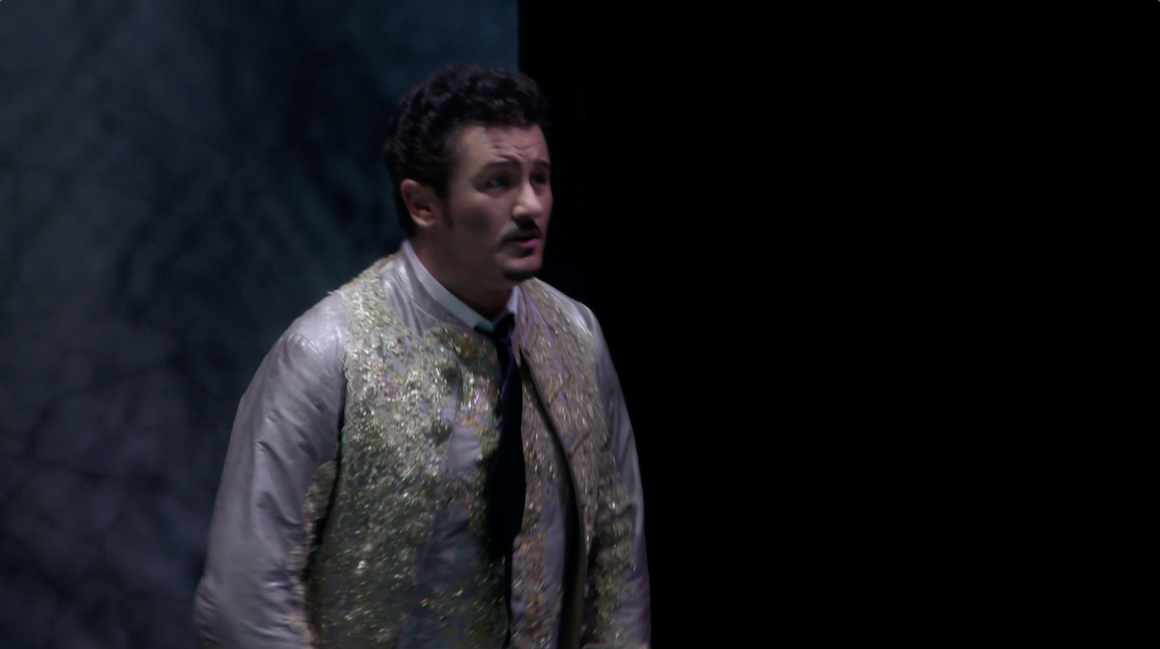
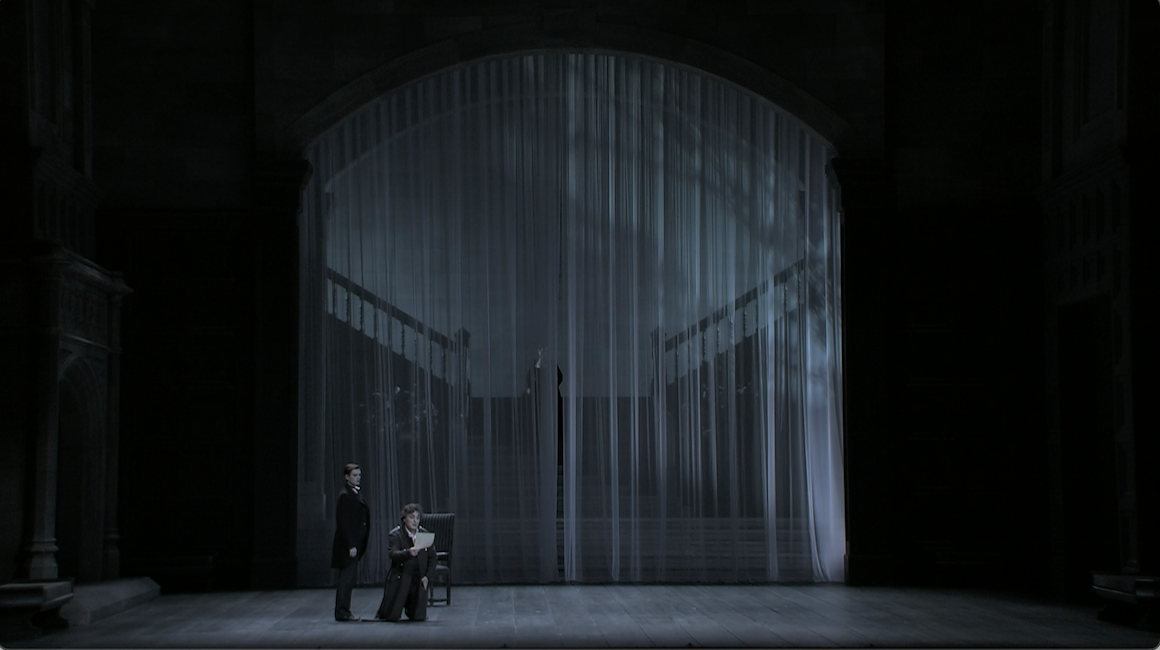
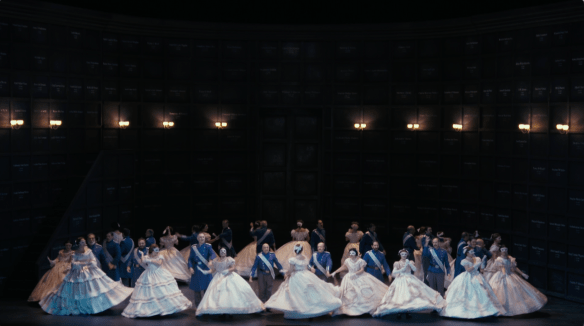
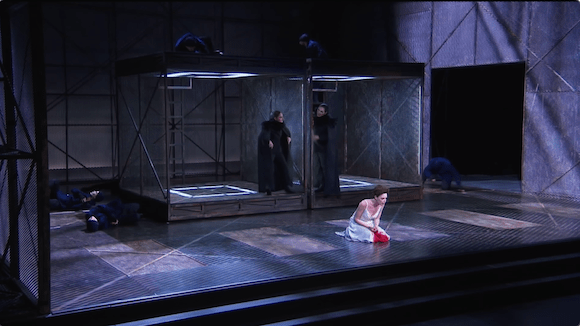
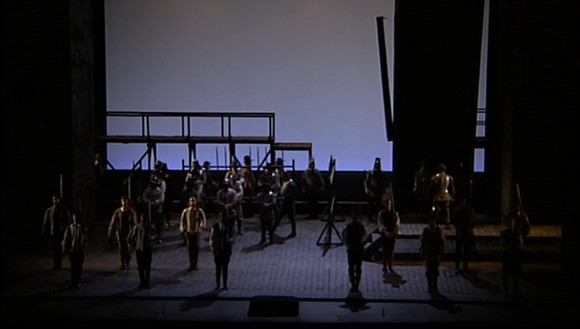
Vincent Boussard’s production of Vedi’s Un Ballo in Maschera staged and filmed at Barcelona’s Liceu in 2017 is dark. Basically there’s a light box in which the characters at front of stage can be seen while others lurk in the darkness. According to the notes Broussard is using light and shadow to bring out the themes of illusion and truth, duty and betrayal. That sounds to me like cleverness masquerading as a production concept and bar a few striking visuals this is hardly a production at all.
Tag Archives: liceu
Greyscale Macbeth
Christof Loy’s production of Verdi’s Macbeth filmed at the Liceu in Barcelona in 2016 is grey, very grey. Costumes and lighting are such that one might think one is watching a black and white film. The first, brief, touch of colour; some lights and bunches of flowers appears at the beginning of Act 4. Beyond the greyness the vibe is essentially late 19th century and it’s pretty sparse. It’s also very dark; at times almost unwatchably so on video (even Blu-ray).
Manon goes to Ellis Island
Davide Livermore’s production of Puccini’s Manon Lescaut, performed and filmed at Barcelona’s Liceu in 2018 moves the setting of the piece from the 1700s to the 1880s and includes a spoken prologue (in English). In the prologue the elderly Des Grieux is visiting Ellis Island just before its closure and is reminiscing. The meaning of this will eventually become clear but what we get from the beginning is this elderly figure as a silent spectator to the action. We may even be seeing the whole thing narrated as a flashback by Des Grieux.

Roméo et Juliette at the Liceu
I’m actually not sure where to start with Stephen Lawless’ production of Gounod’s Roméo et Juliette recorded at the Liceu in 2018. The production is a bit weird but then so is the libretto. It follows the basic plot of Shakespeare’s play but weakens it dramatically in all the wrong places which appears to be why Lawless made some of his, to my mind, less felicitous decisions.

3D Turandot
I’ve been following developments in use of technology in the theatre for a few years now and, to be honest, I’ve seen lots of theory and not a lot of practice though Tapestry’s RUR: A Torrent of Light did use motion capture. The Turandot recorded at the Liceu in Barcelona in 2019 takes it to a whole new level though.

L’enigma di Lea
Discovering a new opera that’s really good is one of life’s small pleasures and my latest is Benet Casablancas’ L’enigma di Lea. It’s a collaboration between the composer and the writer and theorist Rafael Argullol and it premiered at the Liceu in Barcelona in 201`9.

Newbury’s Norma on DVD
Kevin Newbury’s production of Bellini’s Norma made it to Toronto via San Francisco, Barcelona and Chicago with Sondra Radvanovsky singing the title role (at least some of the time) in all four cities. It was recorded for DVD and Blu-ray at the Liceu in Barcelona in 2015. Watching the DVD didn’t change my opinion of the production. Here’s what I said about it on opening night in Toronto:
Kevin Newbury’s production is perhaps best described as serviceable. I have seen various rather desperate efforts made to draw deep meaning from it but I really don’t think there is any. That said, it looks pretty decent and is efficient. The single set allows seamless transitions between scenes which is a huge plus. So, what does it look like? It’s basically a sort of cross between a barn and a temple with a back wall that can raised or moved out of the way to expose the druids’ sacred forest. There’s also a sort of two level cart thing which characters ascend when they have something especially important to sing. Costumes were said to have been inspired by Game of Thrones; animal skins, leather, tattoos (which actually don’t really read except up very close), flowing robes. Norma herself appears to be styled, somewhat oddly, on a Klingon drag queen. The lighting is effective and there are some effective pyrotechnics at the end. All in all a pretty good frame for the story and the singing.
There did seem to be far fewer pyrotechnics in the Barcelona staging though (either that or the video direction pretty much ignores them).
Brueghelland
ETA 6th December 2019:
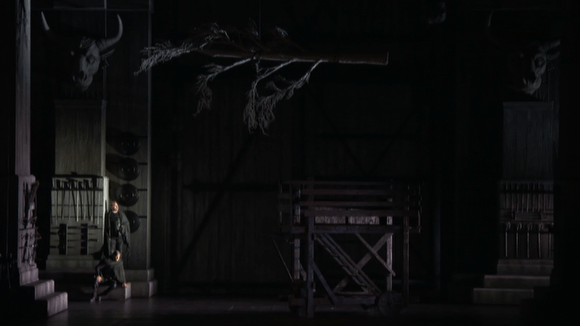
Rewatching Le Grand Macabre after four years has rather changed my opinion. It still seems weird and sometimes hard to watch but I think I see a certain logic in it now that completely escaped me before. So the End of the World is approaching and all the Powers that Be can do is squabble, exchange scatological insults and get very, very drunk while the one sane (if rather weird) character (Gepopo) can’t find a language to communicate the enormity of what’s happening to them. Sound vaguely familiar? (Coincidentally, I’m writing this on the day that Andrew Scheer said that the Federal Government should give more heroin to the addicts in Alberta because otherwise they’ll get in a snit). Of course, in Ligeti’s version Death gets so drunk that he screws up terminating the space-time continuum but we probably won’t be so lucky. So yes the fart jokes and the raccoon on bins orchestra is still there but it now seems to me in service of something rather more profound than I previously gave it credit for. Also, Hannigan is not just brilliant vocally. It’s also, even by her standards, an amazing physical performance. (Original review under the cut).

Lauren Pelly’s weird, dour Tales of Hoffmann
Laurent Pelly’s 2013 production of Offenbach’s Les Contes d’Hoffmann at the Liceu is one of those productions that’s a bit hard to take in at first go. Part of it is the performing edition used (Michael Kay and Jean-Christophe Keck) which seems to have added a lot of dialogue compared to any version I’ve seen before and includes Hoffmann killing Giulietta in Act 3. This produces a constant sense of “where they heck are we in the piece”. It doesn’t help that the DVD package contains no explanatory material at all. There are no interviews on the disks and the documentation is sub-basic.
The other Plymouth pilgrims
I suppose in some ways Bellini’s I Puritani is the perfect bel canto opera. It has lots of great tunes, a wicked coloratura soprano part and an utterly ridiculous plot (my comments on the plot can be found in my review of the Met/Netrebko recording) and, of course, a mad scene. In this recording from Barcelona’s Liceu the soprano role of Elvira is taken by Edita Gruberova, surely one of the greatest ever in this genre. At 54 she doesn’t look ideal for the young bride to be but she can act and she gives a master class in bel canto style. What she has to yield to Netrebko in terms of looks and physical commitment she makes up for in sheer technical prowess.