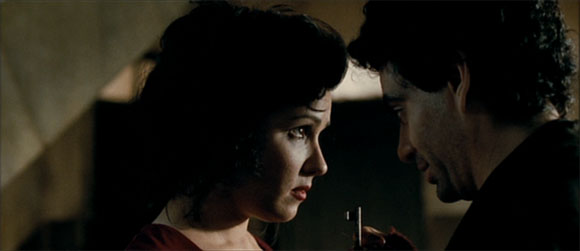
Greyscale Macbeth

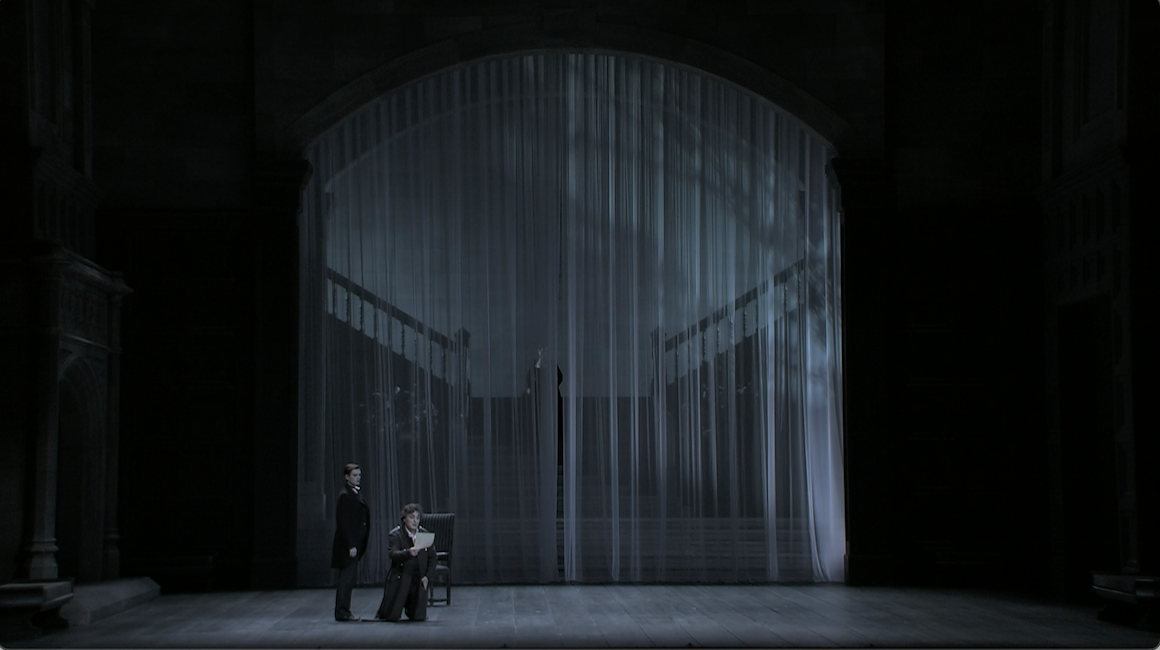
Christof Loy’s production of Verdi’s Macbeth filmed at the Liceu in Barcelona in 2016 is grey, very grey.  Costumes and lighting are such that one might think one is watching a black and white film.  The first, brief, touch of colour; some lights and bunches of flowers appears at the beginning of Act 4.  Beyond the greyness the vibe is essentially late 19th century and it’s pretty sparse.  It’s also very dark; at times almost unwatchably so on video (even Blu-ray).

Continue reading

Ernani

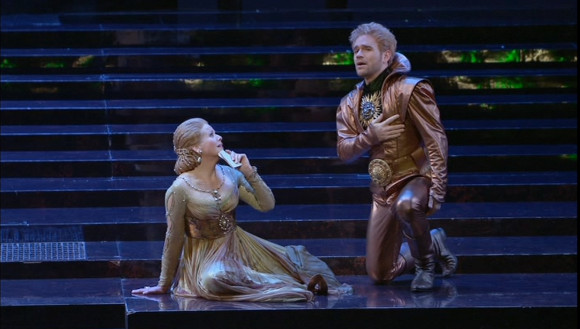
Ernani is an early Verdi opera (1844) and it’s not performed that often (16th most performed Verdi opera according to Operabase).  It was given at the Maggio Musicale Fiorentino in 2022, in a production by Leo Muscato, which was recorded for video release.  How you react to it may partly depend on how you feel about bel canto operas on (more or less) serious themes.  This is an opera about unrequited love and revenge (lots of revenge) but, in typical bel canto style, the music doesn’t always fit the mood.  So here we open on a prelude where Ernani’s bandit gang are sorting out the corpses from their latest skirmish while the orchestra plays a rather jolly tune, then they break into a drinking song and then Ernani enters and sings a rather lovely cavatina.  There are places where the music is darker and some of it is really rather good.  In particular there are some strong duets for Ernani and his (everyone’s) love interest Elvira.  Overall, I rather liked it musically.

1.bandits

Continue reading

Karajan’s Walküre – 50 years on

To quote a quite different opera, “it is a curious story”.  In 1967 a production of Wagner’s Die Walküre, heavily influenced by Herbert von Karajan [1] who conducted the Berlin Philharmonic for the performances, opened the very first Osterfestspiele Salzburg.  50 years later it was “remounted” with Vera and Sonja Nemirova directing.  I use inverted commas because it’s actually not entirely clear how much was old and how much new.  It might be more accurate to describe it as a homage to the earlier version.  In any event, it was recorded, in 4K Ultra HD, no less and released as one of the very first opera discs in that format.

1.tree

Continue reading

Monochrome Nabucco

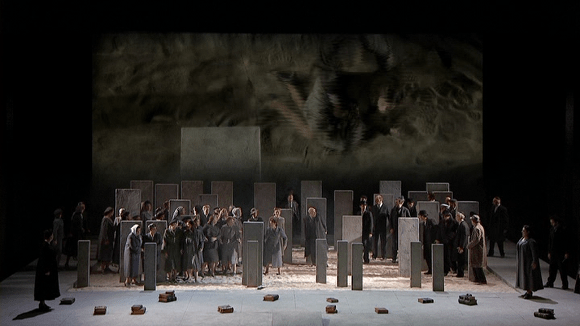
Daniele Abbado’s production of Verdi’s Nabucco, recorded at Covent Garden in 2013 was the vehicle for Placido Domingo taking on yet another Verdi baritone role.  It’s set in the 1940’s because, Jews.  At least it’s costumed that way because nothing else about the production has any kind of sense of time or place.  It’s virtually monochrome and quite abstract.  The Temple is represented by a set of upright rectangular blocks which are toppled at the appropriate moment.  The idol of Baal is a sort of wire frame that comes apart rather undramatically and so on.  There’s also nothing in the direction to suggest any kind of concept.  It’s quite straightforward with rather a lot of “park and bark”.  There’s some use of video projections behind and above the action but it’s rather hard to figure them out on video as they tend to appear in shot rather fleetingly.

1.pillars

Continue reading

Dream team casting

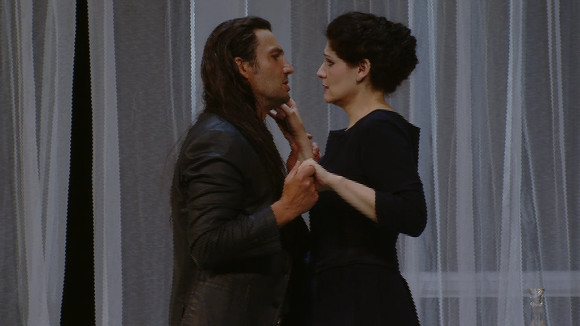
The 2014 recording of Verdi’s La forza del destino from the Bayerischen Staatsoper has the kind of cast one hardly dares dream of.  The elusive Anja Harteros sings Leonora with the almost equally hard to catch Jonas Kaufmann as Alvaro.  Chucking in Ludovic Tézier as Don Carlo and Vitalij Kowaljow doubling the Marchese and Padre Guardiano only improves matters and the rest of the cast is very good indeed.  It was pretty much sure to be a winner and it is.

1.lovers

Continue reading

Are you my mother?

Donizetti’s Lucrezia Borgia is based on one short episode in the storied life of the famous female pharmacist.  In it she twice poisons her son; once at the insistence of her husband, the second time by accident.  The second time her son refuses the antidote preferring to die with his equally poisoned buddies but learns in his dying breath that Lucrezia is indeed his mother.  It’s pretty unusual for a bel canto opera in that the leading female role (a) has agency, (b) doesn’t go mad and (c) doesn’t die.

1.mumson Continue reading

Maybe opera is not made for film… shit!

So says Rolando Villazón towards the end of the “Making of” documentary that accompanies Robert Dornhelm’s 2008 film of Puccini’s La Bohème.  Fortunately for us Dornhelm, Villazón and the rest of those involved provide another piece of evidence that films of operas can indeed be made, and made very successfully.  This one is a curious hybrid.  It uses just about every technique that I’ve seen used in such a venture.  The whole thing was originally recorded in the studio and most of the film is lip-synched using a mixture of the singers and actors who weren’t art of the singing cast but some of the arias were sung on set to a taped orchestral track.  I’m not sure why and I couldn’t tell which was what.  It all works pretty well anyway.

Continue reading