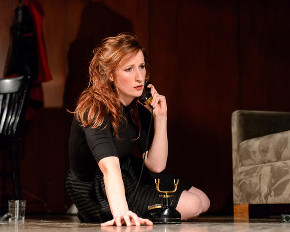
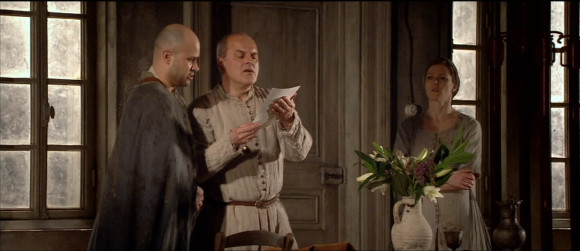
It’s another pretty busy week. There are two student shows today, both free. At 2.30pm in the MacMillan Theatre there’s a performance of a new opera based on EM Forster’s The Machine Stops. It’s by Patrick McGraw, Robert Taylor and Steven Webb. Sandra Horst conducts and Michael Albano directs. Then at 8pm in Mazzoleni Hall, Christina Campsall is performing Poulenc’s La Voix Humaine with Brahm Goldhammer providing piano accompaniment.
Tag Archives: hannigan
My week with Barbara
I’ve spent a fair chunk of time this week following Barbara Hannigan’s stint as Stratton Visiting Artist in Music at the University of Toronto. I went to a lecture on Tuesday, a masterclass on Thursday and a concert yesterday. Twice already I have sat at the keyboard to try and document my impressions and failed miserably. It’s rare that I’m lost for words but Ms. Hannigan is really hard to describe. This time I shall apply myself with the sort of iron will that she exudes.
Iron will? It’s the thing that seems most striking about the woman but it’s iron will coupled to something approaching an absence of ego and coupled to an essential kindness I think. It’s a really rare combination. I’ve worked with many strong willed people; CEOs, ministers of the crown and the like. There “will” is almost always coupled with a planet sized ego and a near total indifference to people who aren’t useful to them. Classic sociopathy in fact. It’s at the core of our political and economic systems. Hannigan is not a sociopath.
Heating up
Next week things get rather busy. There’s all the Hannigan shenanigans at UoT ; lecturing, masterclassing, concerting, walking on water, details here. There are a couple of lunchtime concerts in the RBA. Tuesday sees Gordon Bintner and Charles Sy perform Schumann’s Liederkreis and Britten’s Les Illuminations while on Thursday Jean-Philippe Fortier-Lazure appears with the members of the COC Orchestra Academy and their mentors.
Hannigan and more
The amazing Barbara Hannigan is in town next week teaching at the UoT. There are a number of events open to the public and free. Here’s a list:
Tues, Jan 19, 10:30 am, Walter Hall
Lecture – Show and Share: Living and Surviving as a Singing Artist
Tues, Jan 19, 12:10 pm, Walter Hall
Master Class with U of T Opera students – featuring excerpts from the contemporary operatic repertoire centering on The Machine Stops, a new opera by the Faculty’s student composer collective.
Wed, Jan 20, 3:10 pm, Room 330 @ 80 Queen’s Park
Interactive session – Dare to Compare: session with composers, pianists and instrumentalists from U of T’s contemporary music ensemble.
Thu, Jan 21, 12:10 pm, Walter Hall
Master Class with U of T Voice students – featuring songs and chamber music of the 20th and 21st centuries.
Fri, Jan 22, 5 pm, Walter Hall
Concert – Performances by Faculty of Music singers and pianists after their training with Barbara, as well as from Barbara herself with pianist Professor Steven Philcox.
ETA: She’s also appearing with the TSO on Jan 27 and 28 singing Correspondances by Henri Dutilleux. There’s no stopping her!
The Hannigan show
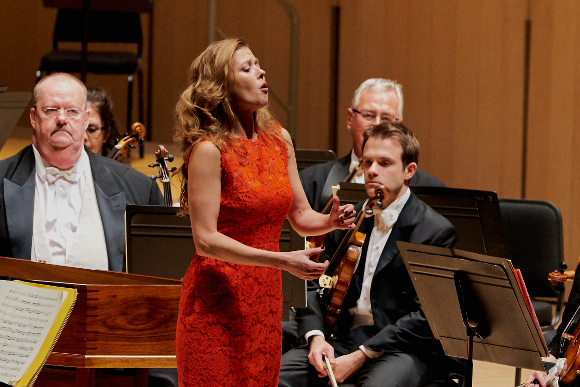
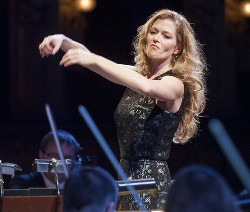
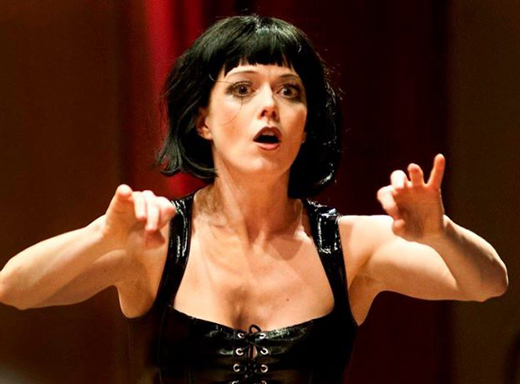
Last night at Roy Thomson Hall Barbara Hannigan made her North American conducting debut with the TSO. And, of course, she sang too. She kicked off with Luigi Nono’s Djamila Boupacha for solo voice. It’s a short but haunting piece inspired by a woman activist from the Algerian War. I don’t think I’ve ever heard a solo, unaccompanied, voice in that hall and the effect is eerie. It’s also a hell of a sing and to navigate it with utter precision is quite some feat. As the last note died away (precisely on pitch) the violins came in with the opening Haydn’s Symphony no. 49 “La Passione”. It starts off with an Adagio that’s curiously similar in mood to the Nono piece and Hannigan was conducting without score or baton. In fact it was more like an interpretive dance than conventional conducting. She has amazing arms and hands; the arms and hands of a ballerina in fact and as she summoned the strings to a sort of shimmering sound I couldn’t help but reminded of Swan Lake. Corny perhaps but very real and quite disturbing. And the orchestra, quite a small subset of the TSO, responded. This was four movements of really lovely, chamber music like playing.
Phantom of Lilith
Krzysztof Warlikowski’s production of Berg’s Lulu (it’s the three act version with the Cerha completion) recorded at Brussel’s La Monnaie in 2012 is so stuffed full of symbolism it’s really hard to fully unpack. There’s a sense that Lulu represents Everywoman, for some rather twisted definition of “woman”. She’s Lilith. She’s Pandora. She’s the Black Swan and the White Swan. She’s lost or corrupted childhood and she’s love gone wrong. Maybe she’s even the phantom of Berg’s estranged daughter. All these symbols recur again and again in various combinations. In fact, on DVD, it’s pretty much impossible to keep track of them.
Next week
There are a couple of biggies coming up next week. On October 7th and 8th the amazingly talented and apparently fearless Barbara Hannigan is singing with and conducting the TSO. For all I know she’ll be tap dancing and doing hand stands as well. It’s her conducting debut with this orchestra. The programme features works by Nono, Haydn, Mozart, Ligeti and Stravinsky. 8pm Roy Thomson Hall.
Brueghelland
ETA 6th December 2019:
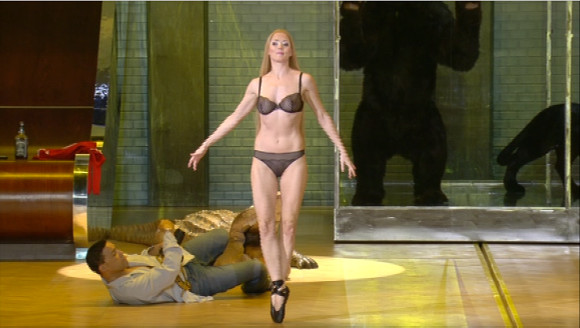
Rewatching Le Grand Macabre after four years has rather changed my opinion. It still seems weird and sometimes hard to watch but I think I see a certain logic in it now that completely escaped me before. So the End of the World is approaching and all the Powers that Be can do is squabble, exchange scatological insults and get very, very drunk while the one sane (if rather weird) character (Gepopo) can’t find a language to communicate the enormity of what’s happening to them. Sound vaguely familiar? (Coincidentally, I’m writing this on the day that Andrew Scheer said that the Federal Government should give more heroin to the addicts in Alberta because otherwise they’ll get in a snit). Of course, in Ligeti’s version Death gets so drunk that he screws up terminating the space-time continuum but we probably won’t be so lucky. So yes the fart jokes and the raccoon on bins orchestra is still there but it now seems to me in service of something rather more profound than I previously gave it credit for. Also, Hannigan is not just brilliant vocally. It’s also, even by her standards, an amazing physical performance. (Original review under the cut).

Addicted to purity and violence
In George Benjamin’s Written on Skin The Man, The Protector, is described as “addicted to purity and violence”. One could perhaps say the same about the score. Seeing it presented in a minimally staged version at Roy Thomson Hall last night perhaps emphasised those aspects compared to watching a fully staged version (review of Katie Mitchell’s production at the ROH here). Being able to see the conductor and orchestra made the combination of a traditional orchestra with older instruments; viola da gamba, glass harmonica etc (and lots of percussion) more obvious. The music can be very violent but it can also be incredibly quiet and it’s a measure of Benjamin’s skill as a conductor that through these extreme changes of dynamics he rarely, if ever, covered his singers.
Barbara Hannigan in the RBA
OK so who noticed that Barbara contains RBA twice? A perfect fit one might say and so it proved. In a short late afternoon concert Ms. Hannigan, joined by the TSO Chamber Soloists (Jonathan Crow, Peter Seminovs, Teng Li and Joseph Johnson) and Liz Upchurch, showed her chops as one of the day’s best interpreters of modern vocal music. First up was the String Quartet No.2 by Schoenberg. This is a most unusual quartet in that the players are joined by a soprano soloist for the third and fourth movements. It’s also unusual in that, although it predates Schoenberg’s full blown serialism, the first three movements are tonal (just) but the last is a full on experiment in atonality. None of this makes it easy to play or sing!