UoT 2016/17

UoT Faculty of Music have just announced their 2016/17 season.  It’s the usual broad range of performances so I’ll highlight the opera and vocal music contributions.

UoT Opera is offering four shows.  The fall main production is Offenbach’s Orpheus in the Underworld with new English dialogue and stage direction by Michael Patrick Albano.  Choreography i by Anna Theodosakis and Russell Braun makes his podium debut.  There are four performances November 24th to 27th.  Spring sees a Handel rarity; Imeneo.  Tim Albery directs and Daniel Taylor is in charge of the music.  This one runs March 16th to 19th.  Both shows are in the MacMillan Theatre.

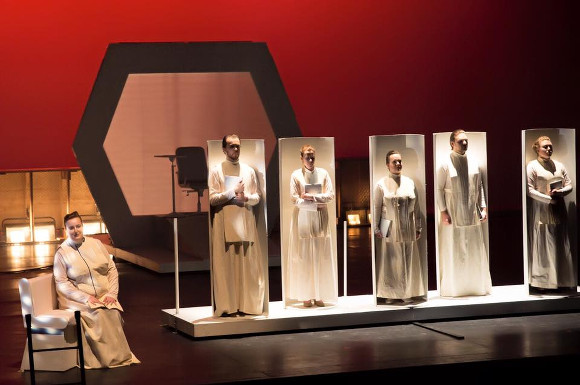
machinestops

Last year’s student composed opera; The Machine Stops

Continue reading

Alma Oppressa

alma oppressaThis review first appeared in the print edition of Opera Canada.

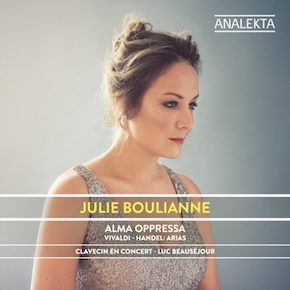
Mezzo-soprano Julie Boulianne’s new CD Alma Oppressa, recorded with the Clavecin en Concert and Luc Beauséjour, features arias by Vivaldi and Handel as well as a few short instrumental pieces taken from their operas. It’s a pleasing combination of the dramatic and the more lyrically relaxed, though as pretty much all these arias were written for star castrati it’s also highly virtuosic. The first two numbers give a very good sample of what’s to come. The title track, from Vivaldi’s La fida ninfa is dramatic and allows Ms. Boulianne to use the darker colours of her voice to good effect as well as providing coloratura hijinks. “Sovvento il sole” from the same composer’s Andromeda Liberata is much more lyrical. Indeed, it’s very beautiful with a haunting melody line and an interesting dialogue between voice and violin. It shows off both the brighter tones of the voice and her very attractive lower register. The Vivaldi pieces will likely not be too familiar to most opera goers but there are much better known Handel pieces on the CD including “Lasci ch’io pianga” from Rinaldo and “Cara speme questo core” from Giulio Cesare. The latter shows off the brighter side of the voice as befits an aria for a juvenile character. The twelve piece band, with Beauséjour directing from the harpsichord is quite excellent. They provide a brisk and transparent accompaniment to the arias and sound really excellent in their three short instrumental pieces. I think this is a sensible sized ensemble for this music and probably not far away from what the composers would have expected.

Continue reading

Crowning George II

The one thing Daniel Taylor did not explain in his introduction to The Coronation of King George II, presented by Toronto Summer Music Festival, last night was how on earth he, and whatever friends and substances were involved, came up with the concept.  It’s not immediately apparent that interweaving some of the music from the 1727 coronation service with snippets from the liturgy while throwing in some earlier music that might have been used in earlier coronations and, to cap it all, Tardising in some Parry and Tavener makes any sense at all but in a weird way it did.  There was even a real priest brought in to play the Archbishop of Canterbury (looking disturbingly like the Bishop of Bath and Wells) and an actor playing the king.  Oddly it made for an hour or so of rather good music mixed with just enough levity to offset the mostly extremely lugubrious text of the liturgy.

Coronation-48

Continue reading

Another fine Cesare

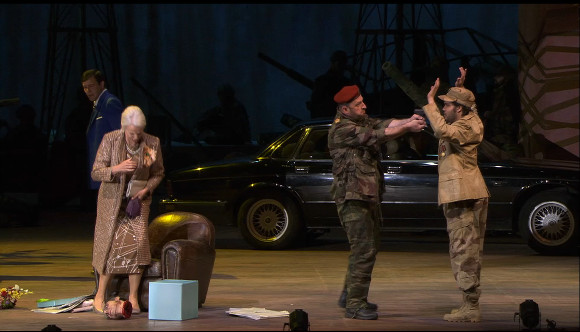
Handel’s Giulio Cesare is pretty well served in terms of video recordings.  The very fine Glyndebourne and Copenhagen versions get some serious competition from the 2012 production that inaugurated Cecilia Bartoli’s reign as director of the Salzburg Whitsun Festival.  The production is by Moshe Leiser and Patrice Caurier.  It’s set in somewhere like Iraq in an immediately post-war period.  It’s quite dark, probably darker than Negrin’s in Copenhagen and world’s away from McVicar’s almost RomCom version.  There’s a lot of violence and some pretty sleazy sex.  A lot of this centres around Tolomeo who is portrayed as beyond revolting.  There’s a scene where he rips guts out of a statue of Caesar and starts to gnaw on them and there is a fair bit in that vein.  Caesar and Cleopatra are portrayed ambiguously too.  Sure they are the “heroes” of the piece but Cleopatra’s delight in flogging off her country’s oil wealth to the Romans shows a degree of cynicism.  This is not a production for the Konzept averse but I think all the choices made have a point and the overall effect is coherent.  It’s not without humour either.  Cleopatra sings V’adore pupille in a 70s blonde wig while riding a cruise missile with Caesar watching through 3D glasses.

1.head

Continue reading

Toronto Summer Music Festival

There’s quite a lot for the vocal music fan in this year’s Toronto Summer Music Festival though the only operatic opening is getting a bit Twilight Zone.  How often does an opera like Britten’s Rape of Lucretia get done in Toronto?  Well for now the answer is twice in quick succession because besides the MYOpera production later this month we are also getting a “semi-staged” version on July 22nd at 7.30pm at the Winter Garden Theatre.  It is a transplant from Banff originally created by Joel Ivany and Topher Mokrzewski but to be directed here by Anna Theodosakis.  The cast includes Emma Char (Lucretia), Peter Rolfe Dauz (Junius), Beste Kalender (Bianca), Jasper Leever (Collatinus), Iain MacNeil (Tarquinius), Ellen McAteer (Lucia), Owen McAusland (Male Chorus), and Chelsea Rus (Female Chorus).  That’s a pretty good cast but it does seem an odd choice.  Is the King Street streetcar contagious?

last-night-of-the-_1480908c

Continue reading

Underdone Alcina

There’s not that much Handel on offer in Toronto so it seems really rather odd that Alcina should get two productions within eighteen months.  The attraction of the piece for Opera Atelier was obvious.  It’s Handel’s only opera that incorporates dance.  Why the Glenn Gould School at the Royal Conservatory should think it’s a good choice for a student production is less clear.  Dance aside, it’s classic Handel; written for an audience who expected great virtuosity from the star singers (in this case Giovanni Carestini and Anna Maria Strada) plus the very latest in analogue SFX.  Neither of these could reasonably be expected at Koerner Hall.

Photo: Nicola Betts

Continue reading

The week in prospect

alcina_365sqBack to relative quiet!  The main event in the coming week is the GGS spring production.  They are doing Handel’s Alcina.  The cast includes Meghan Jamieson, Irina Medvedeva, Christina Campsall, Lillian Brooks, Joanna Burt, Asitha Tennekoon and Keith Lam.  Leon Major directs and Ivars Taurins conducts.  The publicity material suggests a 1920s setting.  Anyway it’s at Koerner Hall at 7.30pm on Wednesday and Friday.
There are a couple of kid friendly March break concerts in the RBA.  Tuesday sees what seems to have become an annual event; Kyra Millan’s Opera Interactive.  This year she is joined by Tina Faye and Charles Sy.  Then on Thursday Cawthra Park Chamber Choir and conductor Bob Anderson, one of the GTA’s leading school choirs, present various choral traditions and styles from the Renaissance to contemporary Canadian works.  Charles Sy, a Cawthra Park alumnus also features in this one.  Both at noon of course.

Then at the  Newmarket Theatre on Saturday at 7:30pm and Sunday at 2pm opera Luminata are performing.  This is a rather odd spectacular thing with taped orchestra and pyrotechnics.  I haven’t seen them but they got a rather more positive reception than I expected last time around.  www.operaluminata.com for details.

Christopher Purves in the RBA

British baritone Christopher Purves was the lunch special at the Four Seasons Centre today.  Along with the amazing Liz Upchurch he gave us a most enjoyable program of Handel, Duparc and Mussorgsky.  The two Handel arias were drawn from Handel’s two very different takes on Ovid’s Acis and Galatea.  The first from the later (1718) English version “I rage, I melt, I burn!… O ruddier than the cherry tree” is a mostly comic furioso recitative and aria sung with great drama and not a little comedy by Chris but it was rather eclipsed by the next number taken from the earlier (1708) Aci, Galatea e Polifemo.  Polyphemus’ aria “Fra l’ombre e gl’orrori” is just nuts but very beautiful.  It ranges from the D below the bass staff to the A above it and is a continuous series of insane intervals accompanied by a really simple and very beautiful piano part.  It’s amazing anybody can sing it all let alone as well as it was done here.

purves

Continue reading

Tafelmusik vocal competition

Winner - Kim Leeds

Winner – Kim Leeds

This was a vocal competition with a twist.  The repertoire was all baroque and the prizes were the soloist spots in upcoming performances of Zelenka’s Missa Omnium Sanctorum.  To some extent that dictated the format with three bass-baritones, three tenors and three altos (two mezzos and a countertenor) competing and a prize winner in each triad.  Each singer had to offer the appropriate piece from the Zelenka Mass plus a piece of their choice by each of Bach and Handel.  I did wonder whether I would get through an afternoon of twenty seven baroque vocal pieces but aided by free pizza and cookies I made it.  At least, for once, I was at a singing competition where nobody would be singing Pierrot’s Tanzlied.

Continue reading

The Word made Flesh or Is Nothing Sacred?

jennensIn reviewing Against the Grain’s staged version of Handel’s Messiah I alluded to having had some thoughts about staging Messiah. That’s because, although I realised that the AtG production was quite excellent it was also making me a bit uncomfortable and I needed to think through why that was. I also wanted to think about in relation to a very different approach to staging the piece; that taken by Claus Guth at the Theater an der Wien in 2009. There also seems to be a fashion for this sort of thing emerging with a St. Matthew Passion, also in Vienna, and the TSO about to stage Mozart’s Requiem. What can we say about staging a work that was never intended to be staged and doesn’t even tell a story as Handel’ other oratorios do? Some of the thoughts that follow might apply to staging any non-narrative religious text but most will be very specific to Handel’s Messiah and specifically rooted in the text selection by Charles Jennens.

Continue reading