Have you got your tickets? You really should.
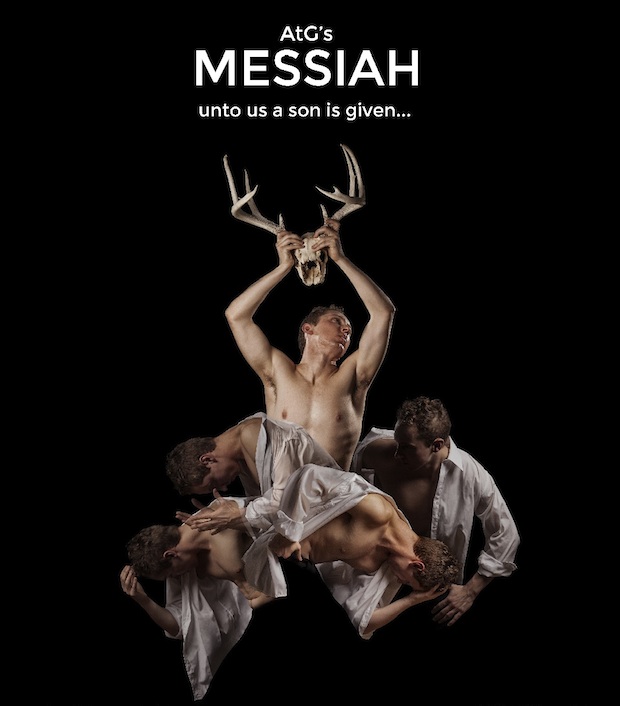 Saturday 14th and Sunday 15th at the Opera House on Queen East it’s the Against the Grain Messiah.

Have you got your tickets? You really should.
Saturday 14th and Sunday 15th at the Opera House on Queen East it’s the Against the Grain Messiah.
 The line up for the annual Messiah fest is becoming clearer. Traditional heavyweights, the Toronto Symphony and Tafelmusik go head to head. The Symphony’s line up of soloists is Klara Ek, soprano; Lawrence Zazzo, countertenor (which may not please the traditionalists or the mezzo fanatics); John Tessier, tenor and John Relyea, bass-baritone. The chorus is the Toronto Mendelssohn Choir and Christopher Warren-Green conducts. Dates are the 17th, 18th, 20th, 21st and 22nd December at Roy Thomson Hall. Tafelmusik field Dame Emma Kirkby, soprano (buy now while stocks last?); Laura Pudwell, mezzo-soprano; Colin Balzer, tenor and Tyler Duncan, baritone. Ivars Taurin conducts. Performances are 18th, 19th, 20th and 21st December at Koerner Hall. On the 22nd Tafelmusik also have their traditional singalong Messiah at Massey Hall.
Continue reading
Handel’s Belshazzar, written as an oratorio, was staged at the Aix-en-Provence festival in 2008. It works really well as a stage work. The plot is straightforward but dramatic. Impious Babylonian king Belshazzar is being besieged by the virtuous Cyrus of Persia. Babylon is impregnable but a combination of Babylonian impiety and divine intervention on behalf of Cyrus(*) leads to Cyrus’ capture of the city, the death of Belshazzar and, almost incidentally, the liberation of the Jews.
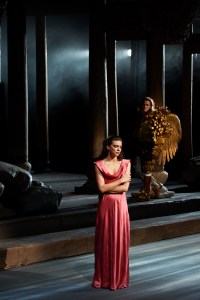 I’ve been watching a few staged versions of Handel oratorios recently and I’ve come to the conclusion that, in general, I prefer them to his Italian operas. It’s not just that they have really good plots they are also musically much more interesting than the operas. For the stage Handel stuck pretty firmly to the conventions of opera seria. Da capo aria succeeds da capo aria and only occasionally does a chorus or a duet break out and that bit is often the musical highlight of the piece, to my mind at least. Think of Io t’abbraccio in Rodelinda; surely the highlight of the whole work. In the oratorios Handel seems to feel much freer to use multiple forms and, of course, he writes magnificent choruses. Continue reading
Robert Carsen doesn’t seem disposed to treat Handel too reverentially. Although there is some of the trademark Carsen cool minimalism in his 2011 Glyndebourne production of Rinaldo (not to mention symmetrically arranged furniture) there’s also a degree of humour, as there is in his Zürich Semele. I find it very effective and, judging by the audience reaction, so did the people who saw it at Glyndebourne.
Peter Sellars’ 1996 Glyndebourne production of Handel’s Theodora just gets better with every viewing. I utterly retract my original view that the music isn’t Handel at his finest. It’s very good indeed and the production and performances on this disk are fantastic. Despite not being the best recording ever (though the recent Blu-ray release is an improvement) it remains a “must see” for any fan of Baroque opera or challenging music theatre.
What makes it so compelling? I think it’s two factors. The first is the production. The contemporary American setting works with very little violence to the libretto or music and yet speaks directly to very contemporary concerns. It’s particularly effective that current reality is inverted with respect to mainstream Christianity. Added to this are some extraordinarily intense performances led by the late Lorraine Hunt as Irene, the leader of the Christians. “As with rosy steps the morn” and “Lord to thee, each night and day” bring me out in goosebumps every time. The chemistry between David Daniels and Richard Croft is also palpable and Dawn Upshaw could hardly be bettered in the title role. Even Christine Schäfer in the only competing recording doesn’t come close.
One of the notes I made while watching this the other night reads “anybody not moved by this is an emotional cripple”. It’s a fair summary.
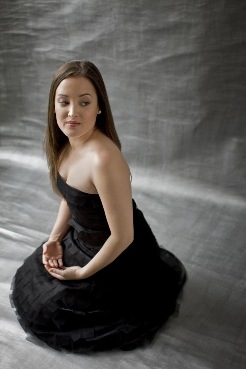 It’s one of the nicer things about Toronto that from time to time a visiting star at the COC will agree to do a free lunchtime recital in the Richard Bradshaw Amphitheatre. Today was the turn of American coloratura Anna Christy who is currently singing the title role in Lucia di Lammermoor. It was an exceptionally fun sixty minutes.
I was a little worried when she and accompanist Liz Upchurch just took their places and started. I need not have been. We got a set of three bel canto art songs that were full of virtuosity and personality. The sheer technical skill was obvious but so was the range of tone colour. Those doomandgloomists who think modern singers can’t act with the voice should listen to Ms. Christy. It’s all there. After that opening she did open up and explain the middle part of her set; pieces by Bolcom and Copland that she sees as natural successors to bel canto. Sung with exquisite attention to the texts one can see her point. She was also very funny and very human. I do like modern divas so much more than the one’s who get in a snit because the caviar isn’t the right temperature.
She finished up with arias by Rossini, Handel and Donizetti, all sung stylishly and with tasteful ornamentation. It was really classy. And to round things out her parents were there and it was her dad’s seventieth and there are no prizes for guessing how things finished up.
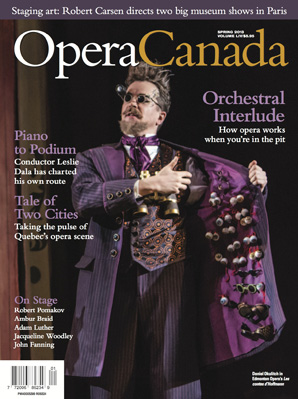 The latest edition of Opera Canada is out and I have an article in it. This is not exactly my first foray into print but it is the first time I’ve published anything about opera. (Previous articles have appeared in various political and business journals and the current WIP is aimed at the Journal of Oncology Practice). Anyway, my piece is a review of a semi-staged performance of Handel’s Orlando. The real reason to buy the thing though is Lydia Perović’s (She of Definitely the Opera) article on the Canadian Opera Company Orchestra.
 Click on the thumbnail for my article.
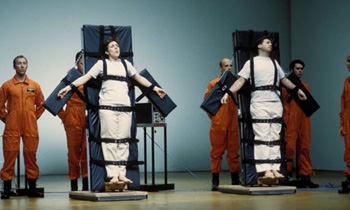 Peter Sellar’s production of Handel’s Theodora has long been one of my favourite video recordings of opera. It’s brilliant in so many ways and I don’t think I’ve ever made it through the whole thing without tearing up. It’s now been remastered from the original tape and reissued on Blu-ray. The video and sound quality are distinctly better than previous DVD releases though not, inevitably, in the same class as the best modern recordings. It’s also still a depressingly bare bones release with no extras and minimal documentation but don’t let that put you off.
My original review is here. I thought about rewriting it but for the most part I stand by my original comments. The only judgement I’d change is that, on greater experience, I do think this is one of Handel’s best works.
Christof Loy’s production of Handel’s late oratorio Theodora was a critical and popular success at the 2009 Salzburg Festival and deservedly so. That said, certain decisions seem a bit perverse. The G minor organ concerto HWV 310 is interpolated in Part 3, which is fine, but why cut a fine number like “Bane of virtue” in Part 1 or “Whither, Princess,do you Fly?” in Part 3? There are a bunch of other, rather odd, cuts in Part 3. Still it doesn’t do serious damage to a fine performance of an interesting production.


 operaramblings