 My review of Matthias Goerne singing the orchestral version of Shostakovich ‘s Suite on Verses by Michelangelo Buonarroti is now published at myscena.org.
Michelangelo Sonnets
Reply

My review of Matthias Goerne singing the orchestral version of Shostakovich ‘s Suite on Verses by Michelangelo Buonarroti is now published at myscena.org.
 It’s an interesting idea for a CD; couple the well known (and original) orchestral version of Richard Strauss’ Vier letzte Lieder with the less well known piano version (the first three songs are arranged by Max Wolff and Im Abendrot by John Gribben). It’s exactly the sort of bold, slightly off the wall idea one might expect from Asmik Grigorian. So how well does it work?
I’m just not convinced by the piano version; where Gregorian is partnered by Markus Hinterhäuser. The vocal part, especially when compared with Strauss’ other songs for voice and piano just seems to be written for singing with an orchestra. It’s not as intricate and subtle as some of the other songs and with piano it seems a bit one dimensional and over dramatic. It’s not helped on this record by very slow tempi (for example, the piano version of Im Abendrot here runs 8m44 versus 7m16 for the orchestral version) and a “boomy” acoustic. The singing is OK but the overall effect is ponderous.
 A couple of years ago I produced a series of “best of” lists for video recordings, which I’ve updated from time to time. One can find them on the Index of DVD reviews page. So, for fun, I thought I’d put together a “weirdest” list. Mostly this captures operas that are intrinsically weird but I’ve included the odd recording where the director has gone a bit nuts in an attempt to get something out of non too promising material. So, in alphabetical order by composer, here is the “weird list”. Continue reading
So sings the heroine of César Franck’s early piece Stradella, Léonor, during her abduction and imprisonment by the Duke of Pesaro. I felt pretty much the same watching the 2012 production from L’Opéra Royale de Wallonie. The company has a well deserved reputation for reviving neglected works from the French repertoire. I suppose once in a while if one does that one is pretty sure to come up with a complete turkey and, frankly, that’s how I’d classify Stradella. Franck left it in piano score and it was orchestrated recently by Marc van Hove so the 2012 Liège production is the premiere. The plot is essentially trivial. Stradella, a singer and protegé of the Duke of Pesaro is in love with Léonor, an orphan. They plan to marry secretly but the duke is also obsessed by the girl and has her kidnapped. Stuff happens and they both end up dead and the duke repents. Stradella and Léonor are united in Heaven. The music is rather dull and highly sentimental. The sentimentality is reinforced both by the injection of a bunch of morbid religiosity into the plot and the overuse of a children’s chorus. In fact I ended up wondering whether “Stradella” wasn’t the brand name for a Belgian artificial sweetener.
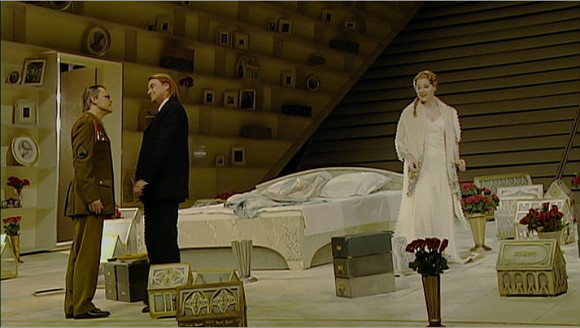
Kasper Holten shows his customary inventiveness in his production of Korngold’s Die Tote Stadt, recorded at Finnish National Opera in 2010. He places the whole opera inside Paul’s “Marie museum” with a chaotic, higgledy, piggledy model of the the city of Brugge as a back wall. He emphasises the dream elements of acts 2 and 3 through devices such as having the troupe of players and their boat emerge through Paul’s bed or assorted ecclesiastics popping up randomly in the “city model”. He also inserts a non-speaking Marie who is present throughout the piece, often to very interesting effect.
 operaramblings