We the sheeple

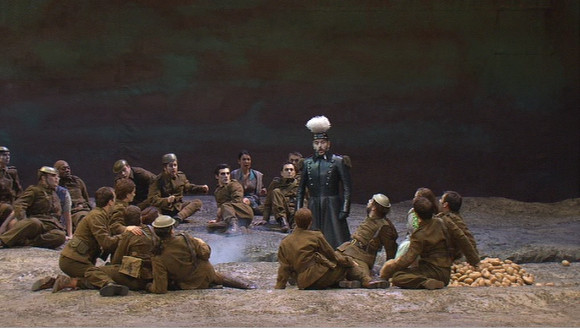
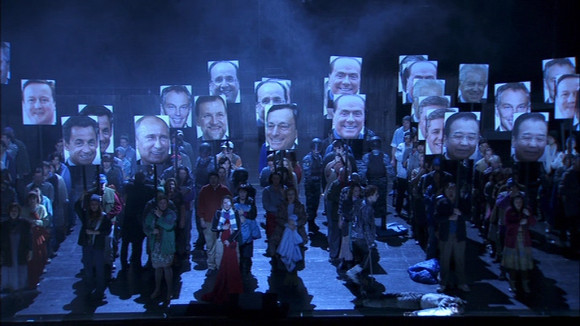
Calixto Bieito’s production of Mussorgsky’s Boris Godunov recorded at the Bayerische Staatsoper in 2013 is, unsurprisingly, strong stuff.  The central concept is that the political classes “don’t give a fig” for ordinary people and that’s as true , or truer, now than in early modern Russia.  In such a world, where the people are manipulated into acting as their “betters” demand, is it possible for a person like Boris, who has risen to supreme power through manipulation and violence, to have a conscience?
1.placards

Continue reading

Phantom of Lilith

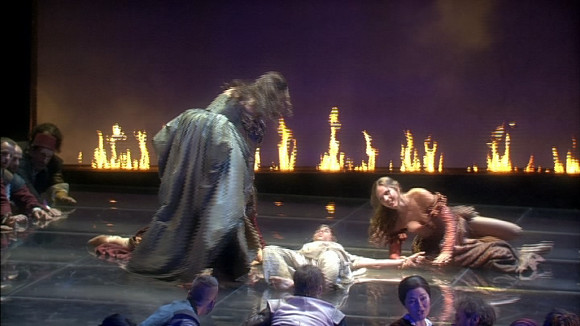
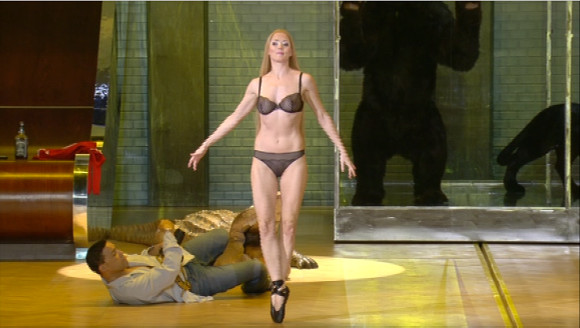
Krzysztof Warlikowski’s production of Berg’s Lulu (it’s the three act version with the Cerha completion) recorded at Brussel’s La Monnaie in 2012 is so stuffed full of symbolism it’s really hard to fully unpack.  There’s a sense that Lulu represents Everywoman, for some rather twisted definition of “woman”.  She’s Lilith.  She’s Pandora.  She’s the Black Swan and the White Swan.  She’s lost or corrupted childhood and she’s love gone wrong.  Maybe she’s even the phantom of Berg’s estranged daughter.  All these symbols recur again and again in various combinations.  In fact, on DVD, it’s pretty much impossible to keep track of them.

1.point Continue reading

La Comtesse Cecilia

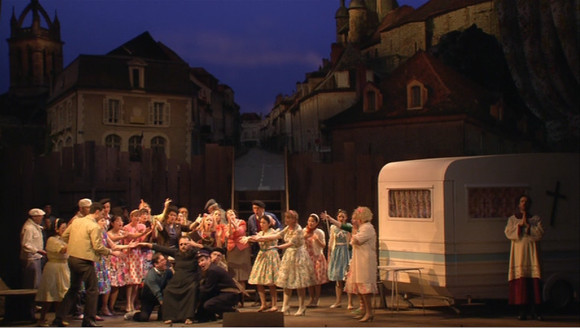
Rossini’s Le Comte Ory is extremely silly.  It’s a crazy, gender bending romp with no real substance but plenty of rather crude humour and good tunes.  I suspect it’s beyond the wit of any director than do more than make sure the mad cap elements are mad enough but one is, I suppose, bound to try.  For their 2012 production in Zürich, Moshe Leiser and Patrice Caurier chose to set the piece in immediately post war France.  It works well enough and allows for a few visual gags but it doesn’t really add much to the piece.  Nor, though, does it detract.

1.caravan Continue reading

Brueghelland

ETA 6th December 2019:

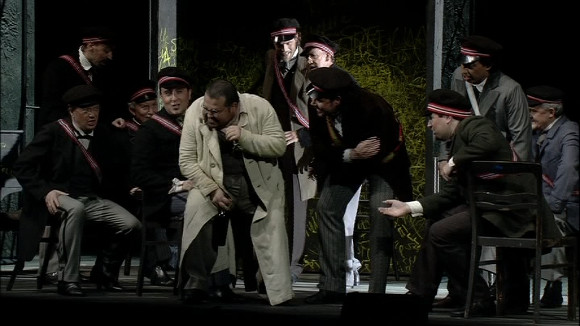
Rewatching Le Grand Macabre after four years has rather changed my opinion.  It still seems weird and sometimes hard to watch but I think I see a certain logic in it now that completely escaped me before.  So the End of the World is approaching and all the Powers that Be can do is squabble, exchange scatological insults and get very, very drunk while the one sane (if rather weird) character (Gepopo) can’t find a language to communicate the enormity of what’s happening to them.  Sound vaguely familiar?  (Coincidentally, I’m writing this on the day that Andrew Scheer said that the Federal Government should give more heroin to the addicts in Alberta because otherwise they’ll get in a snit).  Of course, in Ligeti’s version Death gets so drunk that he screws up terminating the space-time continuum but we probably won’t be so lucky.  So yes the fart jokes and the raccoon on bins orchestra is still there but it now seems to me in service of something rather more profound than I previously gave it credit for.  Also, Hannigan is not just brilliant vocally.  It’s also, even by her standards, an amazing physical performance. (Original review under the cut).

gepopoprince

Continue reading

Hunchback Hoffmann

Giancarlo del Monaco’s production of Offenbach’s Les Contes d’Hoffmann recorded in Bilbao in 2006 isn’t nearly as weird as the interviews on the first disk might lead one to expect.  It has its moments but in many ways is more “by the book” than the Laurent Pelly production I looked at last week.  The interviews talk of a “Sartrian” Hoffmann and a Freudian approach to Antonia.  Ok so Hoffmann is portrayed as a hunchback and he’s fairly damaged but he’s basically your standard drunk poet fixated on a woman or women he can’t have.  I can’t actually see this dude nailing his hand to a nightclub table with a knife or drowning his cat to prove a point.

1.kleinzach Continue reading

Lauren Pelly’s weird, dour Tales of Hoffmann

Laurent Pelly’s 2013 production of Offenbach’s Les Contes d’Hoffmann at the Liceu is one of those productions that’s a bit hard to take in at first go.  Part of it is the performing edition used (Michael Kay and Jean-Christophe Keck) which seems to have added a lot of dialogue compared to any version I’ve seen before and includes Hoffmann killing Giulietta in Act 3.  This produces a constant sense of “where they heck are we in the piece”.  It doesn’t help that the DVD package contains no explanatory material at all.  There are no interviews on the disks and the documentation is sub-basic.

1.weird Continue reading

Grumpy Otello

Verdi loved Shakespeare and tried to reflect the psychological depth of his characters in the operas he based on the bard.  You really wouldn’t know that watching the 2008 Salzburg Festival production of Otello.  There’s a lot to like in both production and performance but the emotionally monochromatic performance of the title role by Aleksandrs Antonenko, who can do every mood from fairly grumpy to furious, and the moustache twirling Jago of Carlos Álvarez rather reduce the piece to pathologically jealous nutter with anger management problem kills wife.

1.orgy Continue reading

La Grand-Duchesse de Gérolstein

Despite a thin to non-existent plot and music that sounds like a remix of all the other Offenbach operettas, La Grande-Duchesse de Gérolstein, performed by largely French forces and recorded at the Théâtre du Châtelet in 2004 is a highly enjoyable romp.  The plot centres on the susceptibility of the Grand-Duchess to fall rather hard for younger men.  This makes it a perfect vehicle for Felicity Lott who rather seems to specialise in such roles; whether Strauss’ Marschallin or La Belle Hélène.  She’s brilliant.  She sings gorgeously except where she doesn’t want to and her comic timing is impeccable.  She’s well backed up by Yann Beuron as the young soldier Fritz who she promotes from private to général-en-chef without swaying his affections for his sweetheart Wanda sung by the irrepressible and cute Sandrine Piau.  The slapstick element is provided by François Le Roux, as Le Général Boum, Franck Leguérinet as Le Baron Puck and Eric Huchet as Le Prince Paul who are set on getting the Grand-Duchess to marry Paul even if it means murdering Fritz.  They get lots of up tempo numbers that sound as if they are singing a Korean restaurant menu.

1.boum
Continue reading

The Solti show

The recording of Richard Strauss’ Die Frau ohne Schatten made at the Salzburg Festival in 1992 is very much Sir Georg Solti’s show.  The conducting is superb and the Vienna Philharmonic, of course, respond for Solti.  From the opening, shattering cords through the various orchestral interludes to the final ensemble and chorus Solti is utterly convincing in his command of tempi and dynamics.

1.ammekaiserin Continue reading

Eine Frau von Heute

I don’t usually associate Arnold Schoenberg with comedy but he did write a one act comic opera Von Heute auf Morgen which premiered in 1929.  It was an attempt to cash in on the vogue for satirical operas on modern themes characterised by Brecht and Weill and , if a bit slight and lacking Brechtian punch, it works well enough.  A bourgeios husband and wife have returned from an evening out where they have met an iold friend of the wife who has become something of a femme fatale.  There’s also a singer, inevitably a tenor, involved.  The husband is rabbiting on rather gormlessly about the charms of the “other woman” so his wife decides to teach him a lesson.  She apes the manners of a “modern woman”, neglects their child, plans assignations etc.  There’s a long phone conversation inwhich the “friend” and the singer invite them back to the bar.  By now the husband is beginning to realise what he stands to lose.  The wife realises she has won.  The other couple show up and there’s a “modern” vs. “traditional” quartet after which the “moderns” leave in disgust and the husband and wife revort to bourgeois domesticity.

1.couch Continue reading