Debussy’s Pelléas et Mélisande is not an opera I’m especially familiar with. It’s a strange piece based on a libretto by Maeterlinck. For much of the time it’s wordy without much action. There is a lot of philosophising. When the action does break out; Golaud’s mad jealousy in Act 3, the killing in Act 4, it gets musically and dramatically quite violent. The music is tonal and mostly quite dreamy. It’s almost mood music. All of this reminds me quite strongly of Poulenc’s Dialogues des Carmélites hence the title of this post. Also it’s French. Actually it’s very French.
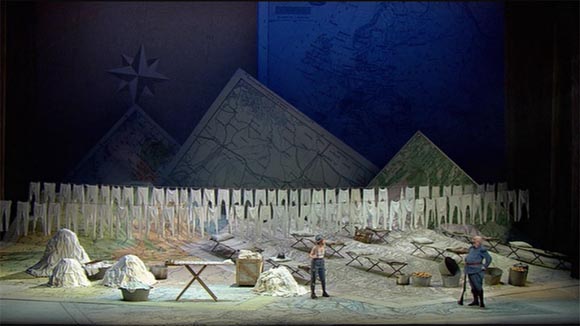
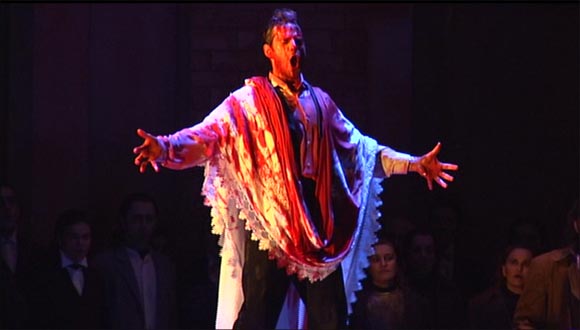
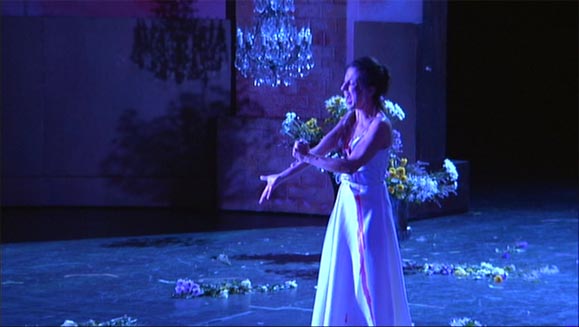
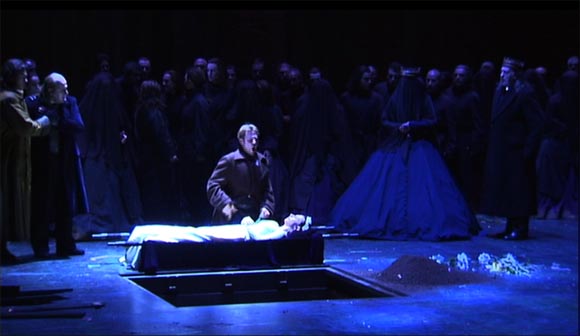
 Laurent Pelly’s 2009 production for Theater an der Wien is also very French; French director, French conductor, almost entirely French cast. In an opera where the words and the relationship between the music and the words matter a lot that’s a distinct advantage. The sets are semi-abstract and placed on a rotating turntable so that scenes can follow on with a minimum of interruption. The forest, the tower, the cave are all suggested rather than made entirely explicit. Even Mélisande’s extra long hair is not depicted explicitly. This fits the indirect nature of both the libretto and the music rather well. The costumes suggest somewhere around 1900 and the colour palette doesn’t stray far from “forest floor”. Lighting is quite dark but evocative. The sense of a gloomy castle in a gloomy (Breton?) forest is quite strong.
 With the exception of a few outbursts from Mélisande’s husband, Golaud, and one fairly lyrical love scene between Mélisande and Pélleas the singers have few opportunities for vocal pyrotechnics. They do need to sing stylishly and articulate well though and this cast excels in that department. Natalie Dessay as Mélisande does the fragile Natalie thing which works really well in this role. Perhaps she could create more mystery around her character but her interpretation seems quite valid. Stephane Degout as Pélleas is a good physical actor and is lyrical where he needs to be. I’m not sure that there is much depth to be got out of the character anyway. Perhaps the most interesting role is the insanely jealous Golaud, sung here by the admirable Laurent Naouri. He has a fairly major emotional arc to go through and is strong in the scene of crazy jealousy where he gets his young son, Yniold (well sung and acted by Beate Ritter), to spy on the lovers. It’s a fine all around performance. The part of the old king, Arkel, is sung by Philip Ens. He conveys wisdom, sympathy and a kind of philosophical detachment in an extremely dignified but weary way. It’s a fine job of portraying a very old man without the voice sounding past it. Good supporting performances too from Marie-Nicole Lemieux as Geneviève and Tim Mirfin as the doctor.
 Bertrand de Billy is in the pit with the ORF Radio-Symphonieorchester Wien. He seems to be thoroughly at home with the score and gets some lovely, transparent, sound out of the orchestra. The chorus, the Arnold Schoenberg Chor, does what little it has to do perfectly adequately.
 The video direction, by Landsmann and Landsmann, is pretty sympathetic. A lot of the time not much is happening and they close in on the singer(s) which is fair enough. When there is a stage to be shown they show it. It’s nowhere annoyingly gimmicky. The picture is top DVD quality 16:9 and the DTS 5.0 sound is mellow rather than punchy which seems appropriate. AV quality is pretty much as good as it gets without going to Blu-ray. There are English, French, German, Spanish and Italian subtitles. Despite being split over two disks there are no extras. The documentation too is limited to credits (there’s not even a track listing). It;s quite a major omission for a work like this. An interview or an article about the director’s reading of the piece and his approach would be very useful.
 There’s some stiff competition for this release, notably from Zurich and WNO, so I’ll certainly be trying to get my hands on some alternative versions in an attempt to deepen my understanding of the work as much as anything.



 operaramblings