Russell Braun and friends

The free concert series that the COC puts on in the Richard Bradshaw Amphitheatre at the Four Seasons Centre often has interesting programs and frequently the performances are very good indeed. It’s also pretty good value for money. It’s not often though that the line up is as starry as today’s gig. Baritone Russell Braun was joined by his L’Amour du Loin costars Erin Wall (soprano) and Krisztina Szabó (mezzo) plus Ensemble Studio tenor Chris Enns.  On the piano were COC Music Director Johannes Debus and Carolyn Maule.
They kicked off with Brahms’ Liebeslieder-Walzer.  They were performed with verve and skill and quite a bit of humour but I’m afraid it was still Brahms.  In my book Brahms should be loved from afar.  I much preferred the selections from Schumann’s Spanische Liebeslieder which followed.  I particularly liked Russell’s rendering of Flutenreicher Ebro which showed great feeling for the words and real skill in articulating different moods through voice colour.  Krisztina also gave us a ravishing version of Hoch, hoch sind die Berger.

The revelation for me though was John Greer’s settings of Canadian folk songs; All Around the Circle.  Looking at the words I thought this was going to be really hokey but in fact both the vocal arrangements and piano accompaniments are really pretty sophisticated and right up there with better known English and Australian folk song settings for voice and piano.  The quartet gave them all they had.  Lots of attack, good ensemble work and tons of humour.  (One needs humour with a line like “She’ll be waiting for me there with the hambone of a bear”!).  Terrific piano playing here too from Johannes and Carolyn.  It was fun!  (And great value for money)

Kaija Saariaho’s L’Amour du Loin at Canadian Opera

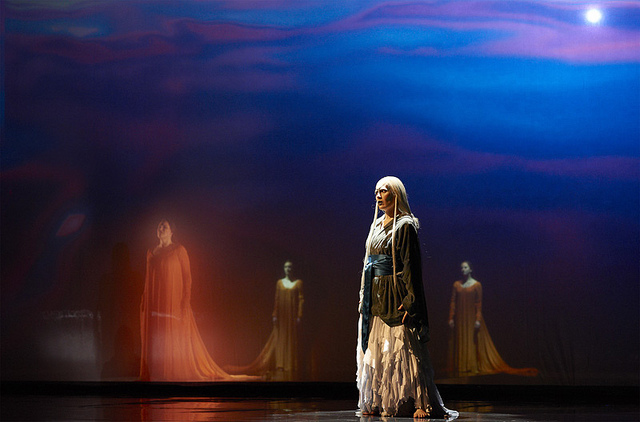
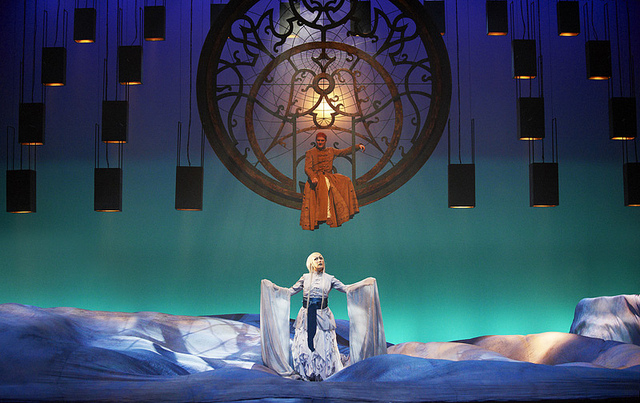
Last night we saw Kaija Saariaho’s L’Amour du Loin at the Four Seasons Centre. It was really, really good. It’s a very unusual piece. There’s not a lot of action in the libretto, despite, or perhaps because of, which Daniele Finzi Pasca devised a most spectacular production (more below). It’s an opera about ideas; love, duty, honour, death, faith, God. The characters spend far more time debating what to do and why than doing it. The plot is very simple. Jaufré Rudel, prince of Blaye, tired of a life of meaningless pleasure, yearns for real love. The Pilgrim tells him of an ideal woman, a countess in Tripoli. devotes Jaufré devotes his life to writing love songs to his “Love from Afar”. The Pilgrim tells Clémence of Jaufré and she falls under his spell. Jaufré decides he must cross the sea and meet Clémence but in doing so falls mortally ill. They meet and throw caution to the winds but Jaufré dies. Clémence decides to take the veil but her attitude to God is ambiguous at best. To who is her finally ecstatically beautiful prayer directed; the deity or her “Love from Afar”? It’s not the easiest piece to engage with. It has something in common with other meditative operas like Dialogues of the Carmélites and Pelléas et Mélisande and it’s rewarding in the same sort of way.

The music really impressed me. It haunted my dreams last night. It is an extraordinary score. In the last couple of weeks I’ve heard quite a few smaller scale works by Saariaho but this was the first time I had heard what she could do with a full orchestra. Her tachnique here seems influenced bu European minimalists like Górecki but the end result is utterly individual. She create waves of sound, often with one section of te orchestra picking a phrase up from another. The effect is almost architectural as textures interplay to create a thing of real beauty. Often, despite the wealth of visuals i found myself wanting to close my eyes and just listen. The solo vocal writing is more straightforward than in some of her chamber works. Each character has a distinct musical signature. The Pilgrim for example has any number of the trills common to medieval vocal music (which I think of as moorish but that’s just my association). The choral writing combines elements of the orchestral and solo vocal styles. It’s all really quite compelling.

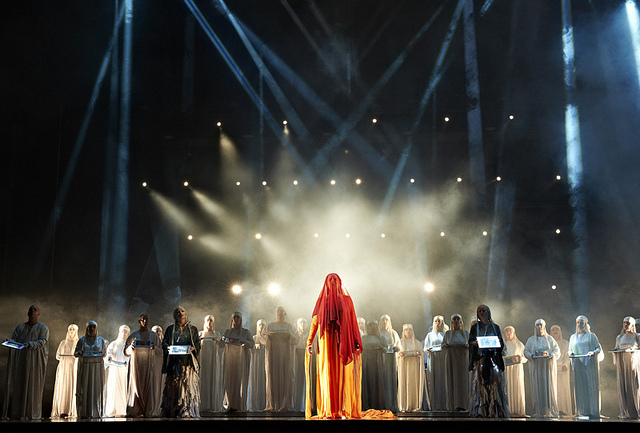
The performances were terrific. All three solo parts are long difficult sings and all three soloists were quite excellent. Russell Braun as Jaufré is on stage for four out of five acts. He was not as smoothly lyrical as he can be but his tougher, more muscular tone suited his line. Kristzina Szabó, as the Pilgrim, also has a lot to do. In many ways her acting must hold the piece together. This she said while sounding very idiomatic in the most ‘medieval’ sounding of the roles. Erin Wall almost stole the show at the end. Much of her part lies cruelly high and includes the sustained f and ff high notes that Saariaho likes to give sopranos. She coped admirably with those to close out the piece with a hauntingly beautiful rendering of the final, despairing prayer. The COC Orchestra and Chorus, were as ever, wonderful and conductor Johannes debus seemed to be right inside the music. Super stuff all round.

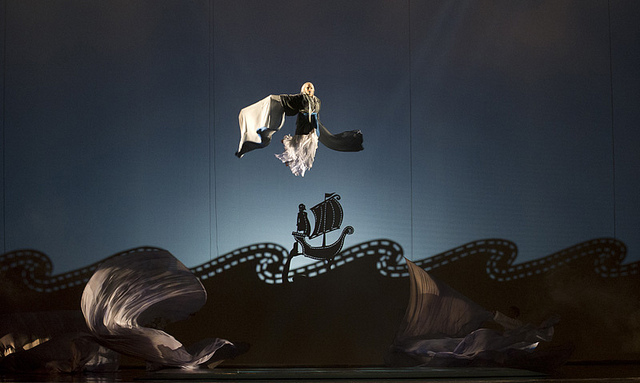
The production is very interesting. Gabriele Finzi pasca and his design team; Jean Rabasse – sets, Kevin Pollard – costumes and especially, Alexis Bowles – lighting and Roberto Vitalini – video, evoke the various settings of the piece extraordinarily vividly using cloth, light and video projections. The evocation of the sea in Act 4 is breathtaking and the ambiguous use of light shone into the auditorium at the beginning and end of the piece ask questions about the stage world and that f the audience. The story telling is embellished with shadow puppets, body doubles, acrobats and aerialists. It’s spectacular in the manner of a rather cerebral Cirque du Soleil performance. It might even be a little over the top to the point of distraction but there’s no denying the beauty of it.

I thought it was a terrific modern opera, beautifully performed and I’d go see this in preference to traditional warhorse productions any time but what I saw last night suggests I may still be a bit unusual in that regard. The house wasn’t full and seats which I’m pretty sure are subscription seats were empty. A significant number of people, young and old, left at the interval. This disturbs me on all sorts of levels. This is quite an accessible piece and it was presented in a production that emphasised that and despite that some people obviously didn’t get it. This worries me far more than people who get offended by blood or nudity in a new production of some over performed Puccini piece. There’s a catch 22 here. A new audience is put off by the idea of opera as a boring museum piece and a section of the traditional audience boycotts anything that isn’t stuffed and mounted. Anyway, if anyone at COC is listening my vote is for innovation, risk and life.

There are four more performances ending on February 22nd.  Go see it!

All photos © All rights reserved by Canadian Opera

Canadian Opera Company season announcement 2012/13

So this morning I was at the Four Seasons Centre for the press conference to announce the COC’s 2012/13 season.

Board President Philip Deck started off with a strong statement about continuing to improve the quality of the product on the Four Seasons Centre stage and striving for “uncompromising and inspiring” programming with a goal of becoming “one of the world’s great opera houses”. There are crucial words here. If General Director Alexander Neef is to meet these goals he will need a supportive Board. It looks like they are there with him at least for now and that’s very good to hear.

There was a very good “teaser video” with contributions from the many Canadians who will feature next season. I guess this will be available on line at some point. Then we got to the main business with Alexander presenting the line up. It’s pretty exciting so here it is in all its glory and with my commentary.  Continue reading

Rigoletto revisited

Last night I went back to the Four Seasons Centre to take another look at Christopher Alden’s Rigoletto. I was up in Ring 5 this time so quite a different viewpoint and it was the opening night cast singing. I now have a better understanding, I think, of what Alden is driving at and some of the stage action that was just puzzling first time around made more sense. Certainly the role played by Giovanna (Megan Latham) makes much more sense seen as the count’s procuress. The interpretation of Sparafucile is also interesting; part commedia perhaps and reminiscent of the quack in L’Elisir d’Amore with a sinister twist. If we take as valid Alden’s assertion that Rigoletto’s separation of personal and public life is a delusion then having all the action played out in “public” makes a certain kind of sense, though then I have to ask why, uniquely, the scene where Gilda confesses to her father what we (and he) already know, that she has been debauched by the duke, has to be between the two of them is a bit of a mystery. So, all in all, I still think it’s an interesting and very beautiful but not quite “of a whole” production. I much prefer that the COC take some chances even if not everything comes off 100% and I shall look forward to Mr. Alden’s next production here.

Musically there wasn’t a lot to choose between this cast and the one I saw on Friday. Quinn Kelsey is a very powerful Rigoletto and he was a little more restrained in the acting department than Lester Lynch. All in all a very fine performance. Dmitri Pittas was solid as the duke but I think David Lomeli has a more Italianate sound. Ekaterina Sadovnikova is a rather different Gilda to Simone Osborne. Her voice is lighter coloured and perhaps more classically suited to this role and there were none of the top end insecurities that some commented on on opening night. She did seem a bit underpowered in the duets with Kelsey but was fine singing solo. Once again I was pleased/surprised by how good the sound is up in the nosebleeds.

Bottom line, I still think this is a production worth seeing. The house wasn’t full either night I went and, in particular, there were plenty of seats last night in Ring 5. I got a second row dead centre seat as a “rush” ($22) and there were still OK seats available for that price half an hour before curtain.

Lynch, Lomeli and Osborne rock Rigoletto

Last night was the second performance of the COC’s new Rigoletto and the first featuring the alternate leading role trio of Lester Lynch (Rigoletto), David Lomeli (Duke of Mantua) and Simone Osborne (Gilda). The rest of the cast was as on opening night.

Musically this was a really splendid evening. Everybody sang really well. I like Lester Lynch’s idiomatic playing of the title role and he managed to combine a not inappropriate amount of scenery chewing with being thoroughly musical. Lomeli lived up to the “dragged from obscurity by Placido Domingo” hype. I think there is a true Italian tenor emerging here. He nailed his arias with lovely ringing high notes and plenty of swagger. Osborne, on role debut, was lovely. Caro nome was one of the highlights of the evening and ,in general, she sounded very secure across some pretty tough music. The chemistry between the three was pretty good although the production maybe put more emotional distance between Gilda and Rigoletto than is sometimes the case. In any event the voices blended well and seemed well balanced. Among the other roles I was particularly impressed by Kendall Gladden’s Maddalena. She has a really smoky mezzo that created a pleasing contrast with the brighter voices. She’s a pretty fine actor too so it’s easy to see why she gets cast as Carmen! I also liked Philip Ens’ Sparafucile. He was a sinister presence and a genuine bass with a thoroughly solid lower register. All in all, the casting managed to combine very good individual singers into an ensemble that had a really good balance of tone/timbre. The orchestra and chorus were at their usual high standard and Johannes Debus kept things together very nicely and didn’t distract from the singing and I do think this is very much a singers opera.

The production and design (Christopher Alden and Michael Levine) was very decorative. All the action plays out in a lavishly panelled and furnished “gaming room” looking something like the smoking room at one of the better London clubs in the mid/late 19th century. It does duty for the duke’s court, Rigoletto’s home and Sparafucile’s inn. In a sense this creates a kind of unity; all of these spaces are misogynistic theatres of corrupt power and delusion. On the other hand it requires the audience to suspend disbelief more often and more willingly than usual. It’s an odd kind of secret that can be sung mezzoforte in front of the people it’s supposed to be secret from! The male dominated Victorian aesthetic seems to produce a kind of emotional coolness too. We never quite get enough emotional charge in the Gilda/Rigoletto dynamic to fully feel his loss (i.e. I didn’t cry at the end). The final scene though is splendidly and very effectively done.(*)

So summing up, I enjoyed the show.  Musically it is first rate.  The production was interesting but I don’t think the concept was quite able to carry the piece emotionally.  It’s not a disaster and there’s nothing to shock the traditionalist.  Maybe if I had seen Rigoletto a million times before I’d be more positive.  Go see the show and judge for yourself!

The production runs until October 22nd and there is a choice of the cast we saw or Quinn Kelsey, Dmitri Pittas and Ekaterina Sadovnikova as Rigoletto, the duke and Gilda.

(*)Spoiler follows… Continue reading

Zwei Zauberflöten

Thursday night I attended the COC Studio Ensemble’s performance of Mozart’s Die Zauberflöte and last night lemur_catta and I were back to the see the main cast. For context, the Studio Ensemble is the COC’s training programme for young professional singers so the cast members on Thursday are mostly under 25 and I doubt that anyone outside Canada would recognize any of the names. Yet! The main cast was a typical COC cast with established international singers playing the main roles with current and former Ensemble Studio members taking the lesser parts. In both cases the full COC orchestra and chorus was used and Johannes Debus conducted.

The stage production and design was the same for both shows so let’s start there. The production concept is that the opera is being given in a temporary theatre in the garden of a Viennese aristocrat as part of the celebrations for his daughter’s name day. As things go on, the aristocratic audience and their servants are drawn in as actors in the drama. The daughter is Pamina, the father Sarastro etc. In Act 2, the stage on a stage has gone and the action plays out in the garden with hedges being rearranged at intervals to create the Temple of the Initiates etc. In keeping with the setting, costumes are more or less 18th century though decidedly Disneyfied. In particular Pamina wears a flouncy pink dress throughout and Tamino is all in white except for a teal frock coat. When they are together one almost expects animated love birds to circle around them. The Queen of the Night looks straight out of Snow White but the Three ladies look more like a post apocalyptic women biker gang or scary clones of zingerella. There are some effective touches; the animals are whimsical without being too whimsical and effective use of dancers is made in the trials scene.

Overall, I felt the play within a play element didn’t add anything much and it didn’t take much away either. The costumes and sets were OK for the work that Die Zauberflöte is. They didn’t try too hard to be “this is srs opera” like the current ROH production equally they didn’t capture the blend of fairy tale whimsy and menace that the 2006 Salzburg production achieved. Of course, this is the personal view of a somewhat jaded opera goer who has seen the work many times. From what I heard of the audience reaction of, especially, children and first time and occasional opera goers, the whole thing was a big hit. In the overall scheme of things I’d rather a production of Die Zauberflöte helped bring a new audience to opera than made my highly enjoyable evenings into truly memorable ones.

So what about the singing? The two nights were different and had a very different vibe. The Ensemble Studio show was youthful and energetic and felt like everyone was having terrific fun. The main show cast felt like a polished performance towards the end of a longish run. None of that a surprise really.

The differences were perhaps best exemplified by the respective Taminos and Paminas. On Thursday Tamino was sung by Chris Enns who looked the part and sang heroically, giving it his all and achieved the feat of making Tamino believable and likeable. No mean feat. Last night the role was played by 46 year old Michael Schade who has sung this role 250 times in just about every house of consequence. He was immensely stylish and polished and it was almost a master class in what a Mozartian tenor should sound like but, inevitably, he lacked the freshness of Enns, who is half his age.

It wasn’t quite the same with the Paminas. Thursday gave us Simone Osborne, who is an Ensemble Studio member but is also singing four performances with the main cast. She’s right on the edge of becoming an established singer with bookings for the next year that one would expect from a rising young soprano. She sang with confidence, enough heft for the role and a very sweet youthful tone, especially in her high register. It was very affecting. Friday gave us one of the COC’s established favourites; the lovely Isabel Bayrakdarian. She sang and acted with great skill but one really wonders whether Pamina is what she should be doing these days. She has always had a big voice for a lyric soprano and it’s darkened, especially at the top end, over the years. Her website doesn’t give much information about her future plans but it will be interesting to see where she goes from here.

The other key roles are the Queen of the Night, Papageno and Sarastro. In the first of these we got the impressive young coloratura Ambur Braid on Thursday and the established Canadian Aline Kutan on Friday. Ambur looks the part in a Diana Damrauish sort of way and did a pretty good job on her two arias. If I’m being picky I’d say she nailed the high coloratura but didn’t really articulate the tricky legato runs as clearly as needed. Kutan seemed to be holding back in “O Zitt’re nicht, mein lieber Sohn” which was distinctly sonically and emotionally underwhelming though accurate. Maybe she had a bit of a cold and was saving herself for Act 2 because she gave an excellent full throttle rendition of “Der Hölle Rache”. The same may have been true of Friday’s Papageno, Rodion Pogossov, who was definitely stronger in the second act. He was good. He got the physical comedy right and went from pretty good to better than that vocally as the night went on. On Thursday we had Adrian Kramer in the role. he’s a very good comic actor and a stylish singer but sounded just a bit underpowered when heard from Ring 5 of the Four Seasons Centre. Sarastro is always going to be a problem for a young cast. Young basses with gravitas aren’t much more common than unicorns. That said, Michael Uloth was much better than I expected and did a very competent job if, inevitably, a little lighter than Fridays Mikhail Petrenko, who isn’t Rene Pape either, but sang and acted the part well.

The other parts were all perfectly adequate. On both nights The Three Ladies camped it up nicely. Maybe their ensemble was a little crisper on Friday and the physical comedy more evident on Thursday but fine differences. Both nights saw the excellence we have come to expect from the COC orchestra and chorus and Johannes Debus.

I’m glad I saw both performances. The differences were interesting and if I hadn’t gone on Thursday I would have missed Simone Osborne’s Pamina which would have been a shame. It also meant I could have a look at a performance at the Four Seasons Centre from a different angle. On Thursday I was up in Ring 5 which is definitely ice axe and crampons territory and very different from my usual seat in the Orchestra Ring. The sound up there is excellent and with opera glasses it’s OK visually. (Plus $22 ticket so who’s complaining!).

Just to finish on a sour note, I am going to commit homicide in that theatre if people don’t stop their inane chatter during the performance. Also, is it asking too much that if you have a cough you take medication and cough lozenges with you to an opera? The one drawback of a house with excellent acoustics is that every cough reverbs around the theatre and once again, the frequency and volume of coughing was bordering on the absurd.