Coming of Age in the Hebrides

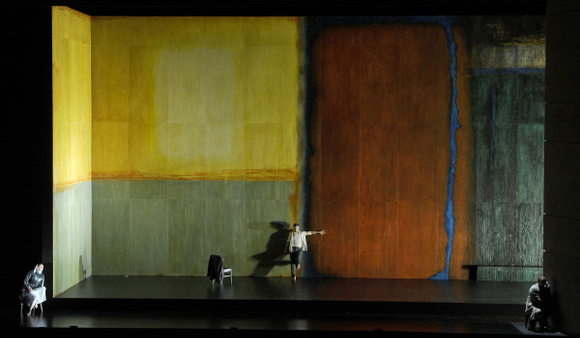
What are we to make of Handel’s Ariodante?  The plot centres on the notion that female chastity is the be all and end all of life.  It’s not a notion that would find much support in 21st century Toronto, even among a Sunday afternoon audience at the Four Seasons Centre.  Ginevra, princess of Scotland and heir to the king, is  betrothed to Ariodante.  Ariodante has a rival, Polinesso who is loved in a besotted kind of way by Ginevra’s maid, Dalinda.  Polinesso claims to have slept with Ginevra and offers to prove it to Ariodante.  He drugs Ginevra and gets Dalinda to put on Ginevra’s clothes and invite him into her room.  Ariodante disappears, apparently having committed suicide in a fit of despair.  On the flimsiest of evidence Ginevra, who has no idea what happened, is condemned to death.  Her accusers, including her father, don’t even bother to ask who the man in her room was.  Polinesso tries to remove the now inconvenient Dalinda from the scene but fails and when Ariodante shows up again she spills the beans.  Polinesso is killed by Ariodante’s brother in a duel but not before confessing.  All is forgiven and everyone carries on as if nothing in the least traumatising just happened.  So, what to do with this?

ariodante-mc-0093

Continue reading

Ensemble Studio Marriage of Figaro

Once a season the young artists of the COC’s Ensemble Studio get to perform one of the company’s productions on the main stage of the Four Seasons Centre.  Last night it was the Claus Guth production of The Marriage of Figaro.  I’ve said enough about the production already here and here so let’s cut to the chase.

15-16-04-E-MC-D-4111

Continue reading

And on stage at the Met 2016/17

rosenkavmetI took a quick look at the Metropolitan Opera’s recently announced 2016/17 and while for the most part it’s business as usual there’s maybe one surprise.  There are 26 productions; 6 new, 20 revivals for a total of 225 performances.  The first thing that struck me was how little Puccini there is.  Only two Puccini works (La Bohème and Manon Lescaut) are being performed for a total of 23 shows (10.2%).  There’s nothing pre Mozart and only one opera written post WW1; L’Amour de Loin which gets 8 performances (ETA: Apparently Cyrano dates from 1936 though you wouldn’t guess that to hear it.  Still only 4 performances so it doesn’t affect the stats much).  There are only two other works which could, at a stretch, be called “modern” stylistically; Salome and Jenůfa, but they were written in 1905 and 1903 respectively, and get only 6 performances each.  Then there’ Rusalka (1901) and Rosenkavalier (1911) which are 20th century but not by any stretch “modern”.  So, even on generous definitions of “modernity”, over 85% of the Met’s output is, essentially, 19th century.
Continue reading

Guth’s Figaro at the COC

Claus Guth’s production of Mozart’s Le Nozze di Figaro, first seen at Salzburg in 2006, opened last night at the COC.  I was curious to see how it would be received because, while by no means an extreme production by European standards, it’s well beyond the 1970s aesthetic beloved by sections of the Toronto audience.  The aesthetic is Northern European; a Strindberg play or a Bergmann film perhaps.  It’s monochromatic, quite slow and focusses on the darker side of the characters’ psyches.  It’s the antithesis of Figaro as Feydeau farce.  There’s also a non-canonical character, Cherubim.  He’s a winged doppelganger of Cherubino and seems to be a cross between Cupid and Puck.  Pretty much omnipresent he manipulates scenes and characters though with a power that falls well short of absolute.  Perhaps the whole production is best summed up in the final ensemble.  Cherubim visits each couple in turn and is brusquely rejected.  Only Cherubino is still subject to his power and that seems to have become destructive.  Perhaps the message is “Now we are married forget this love nonsense and let us get back to our drab lives of quiet despair”.

Figaro-MC-1107

Continue reading

Heil dir, Sonne!

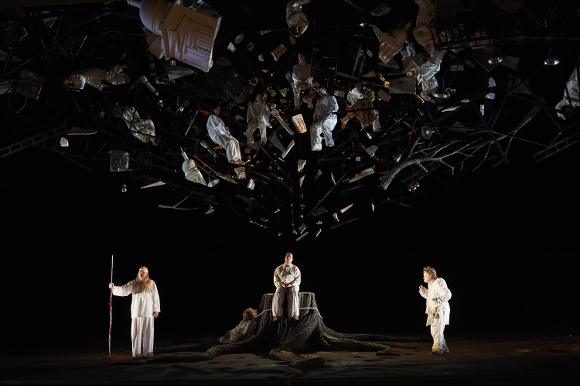
François Girard’s Siegfried, a revival of his 2006 production, opened last night at the COC.  Despite using the same basic set concept as Atom Egoyan’s Die Walküre, Girard’s Siegfried, has a rather different look and feel.  The fragments of Valhalla and the remains of Yggdrassil are still there but they are supplemented in imaginative fashion by a corps of supers and acrobats who play a key role in shaping the scenes.  For example, in the opening scene we have Yggdrassil festooned with bodies, as if some enormous shrike were in residence.  Some of these are dummies and some aerialists who come into the drama at key points.  The flames in Siegfried’s forge are human arms.  Acrobats make a very effective Fafner in the Niedhöhle scene and the flames around Brünnhilde’s rock are human too.  Most of the characters are dressed in sort of white pyjamas which makes for a very monochromatic effect on the mostly dark stage.  The one visual incongruity is the “bear” who is present, tied to Yggdrassil, throughout Act 1.  Frankly it looks less like a bear than John Tomlinson after a night on the tiles.  Still, all in all, the production is effective without being especially revelatory.

Siegfried-0629

Continue reading

Night of the living mezzos

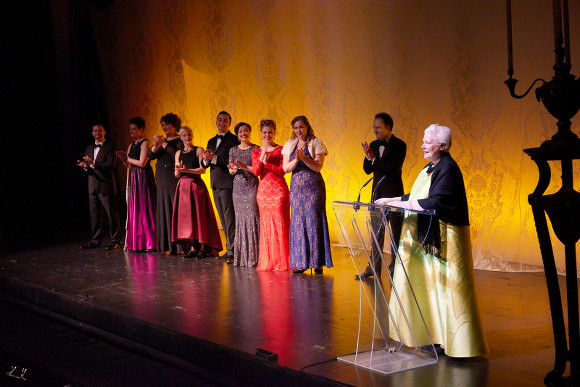
As previously revealed the line up for last night’s Centre Stage; the COC’s gala competition cum Ensemble Studio final audition featured four mezzos, two sopranos and two baritones.  Not a tenor to be had.  As was the case two years ago the competition was split into two parts; a late afternoon session for an invited audience and an early evening public session separated by a cocktail reception.  Each singer presented one aria in each session.  Accompaniment was provided by the COC Orchestra with music director Johannes Debus.

The Lieutenant Governor with the contestants

The Lieutenant Governor with the contestants

Continue reading

Pyramus and Thisbe – a world premiere

The new COC creation Pyramus and Thisbe with music by Monteverdi and Barbara Monk Feldman opened last night at the Four Seasons Centre.  I was expecting abstract and cerebral, which it is, but I was rather expecting that I might admire it more than enjoy it.  As it turned out it was a remarkably satisfying show on many levels.

PT-GB-95 Continue reading

A new program from the COC

MAO_0790aThis just in from frequent Operaramblings commenter and COC Adult Education Programs Manager Gianmarco Segato.  The COC is launching Opera Insights, a series of free adult education events linked to the productions of the 2015/16 season.  It’s a pretty broad range of programming ranging from scholarly discussions on reconstructing the score of Maometto II and the history of the ball gown to Traviata singalongs and Carmen themed dance lessons.  Participants include composers Barbara Monk-Feldman and Norbert Palej, conductors Johannes Debus, Harry Bicket and Sandra Horst and singers like Christine Goerke plus, inevitably, lots of academics (we love them really we do).  Looks like a lot of fun.  The events are all free but are ticketed.  Full details can be found here.

Bluebeard’s Castle/Erwartung

Robert Lepage’s 1993 double bill production of Bartok’s Duke Bluebeard’s Castle and Schoenberg’s Erwartung was the iconic director’s first foray into opera and it has been argued tht it put the COC “on the map” as a serious international opera company.  It was revived last night with François Racine directing.

Blubeard-MC-0573 Continue reading

Siegmund II

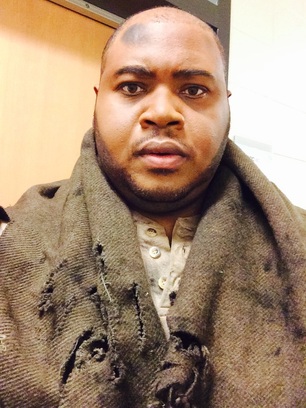
746660I was back at the Four Seasons Centre last night to have another look at the COC’s Die Walküre.  The big news, which I heard pretty much as soon as I arrived, was that cover Issachah Savage would be singing Siegmund in place of an indisposed Clifton Forbis.  This time, unlike last Saturday when he also sang, this was very much a last minute call.  The reviews and the word on the street, and from my companion for the evening who had seen him in Seattle when he won the International Wagner Competition last year had been very positive so I was very interested to hear him.  Clearly word had got out about his Saturday performance because when the announcement was made in the hall there was a curious ambiguous noise not at all like the collective sigh that usually greets such news.

Continue reading