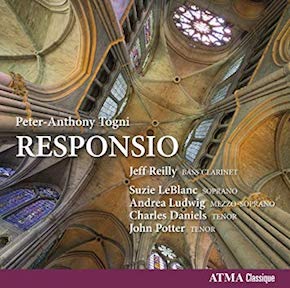
The New American Art Song

okulitchThe New American Art Song is a CD of, unsurprisingly, American art songs.  Canadian bass-baritone Daniel Okulitch is accompanied by the composers in four contrasting sets.  The first set is Quiet Lives by Ricky Ian Gordon; eight songs setting texts by various poets.  The music is tonal with occasional elements of minimalism but overall a bit of a retro “piano lounge” feel that didn’t particularly excite me.

Second up were two songs, Of Gods and Cats, by Jake Heggie to texts by Gavin Geoffrey Gillard.  These are sly, witty, jazzy and much more contemporary sounding.  Much more musically inventive too.  It’s easy to see why Heggie is in the upper tier of contemporary American composers.  The disc also has a bonus Heggie song; a setting of Browning’s Grow Old Along With Me, that I really liked.

Continue reading

Rautavaara – Rubáiyát etc

Rautavaara_Rubaiyat_ODE12742This review first appeared in the print edition of Opera Canada.
This CD contains four recent works by Finnish composer Einojuhani Rautavaara. With the recent announcement of his death they are no doubt among his last and are representative of his final stylistic period in which he abandoned earlier experiments in dodecaphony, use of bird song etc to return to a high romantic style reminiscent at times, inevitably, of Sibelius and even more, perhaps, of Dvořák, though always, always sounding like Rautavaara.

Continue reading

Responsio

responsioThis review first appeared in the print edition of Opera Canada.
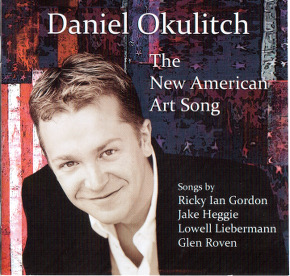
Peter-Anthony Togni’s Responsio is sub-titled “A contemporary response to Guillaume de Machaut’s Messe de Nostre Dame” and that is exactly what it is. It weaves sections of Machaut’s 14th century mass with sections designated “Response one”, “response two” etc. which are a kind of commentary on Machaut’s music. What’s really interesting though is the way Togni arranges the source material. It’s scored for soprano, mezzo, two tenors and bass clarinet. The use of high voices seems to emphasise the originality of Machaud’s music, which must have sounded pretty radical to its original audience, and facilitates him somewhat twisting and shaping the vocal line to bring out some fairly weird rhythms and harmonies. So unmediaeval did some of these textures sound that I went off in search of the source material. There’s no doubt that Togni has arranged to bring out the strangeness but it is very much there in Machaut’s original score. Then alongside the vocals there is the bass clarinet which, part scored, part improvised provides a rather compelling, even disturbing commentary in a more obviously contemporary vein. The Gloria and the Hosanna sections in particular juxtapose the vocals, already making the familiar words of the mass seem strange, with an insinuating clarinet line in ways that are almost physically jarring. It is a piece of great originality; beautiful, thought provoking and even weird, and quite fascinating.

Continue reading

Cold Mountain

CD-Cold-Mountain-CDThis review first appeared in the print edition of Opera Canada.
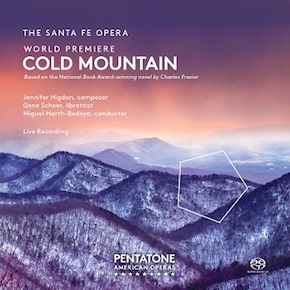
Jennifer Higdon’s Cold Mountain, which premiered at Santa Fe in 2015, is an example of what seems to be becoming the standard American formula for new opera. It takes a story from a best selling book that has already been made into a Hollywood film and turns it into an opera. Add to that that it’s a melodrama set in the currently fashionable Civil War South. Melodramatic it certainly is. Within five minutes Owens (Robert Pomakov) has been stabbed and buried alive and his son (Adrian Kramer) bound, gagged and dragged off to the army. A little later our hero, a Confederate deserter played by Nathan Gunn, rescues Laura (Andrea Nūnez) from being thrown from a cliff by her preacher boyfriend (Roger Honeywell). He ends up as part of a heap of chained together corpses. This production is rough on Canadian singers. There’s much more in the same vein with summary executions, baby torture, a choir of dead soldiers and the hero dying with the last shot of the piece. All of this is spun around the romance between the hero, Inman, and his classy but clueless girlfriend Ada (Isabel Leonard) who is busy dodging the attentions of the creepy and repulsive Teague (Jay Hunter-Morris) with the help of the sassy but practical Ruby (Emily Fons).

Continue reading

James Rolfe – Breathe

Breathe - Front Cover_300This review first appeared in the print edition of Opera Canada.
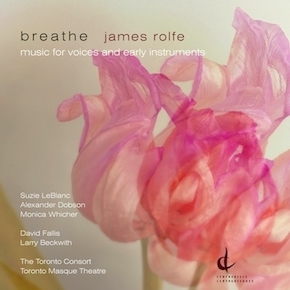
This new CD of music by James Rolfe on the Centrediscs label contains three works for voices and a small “early instruments” ensemble. Two; Europa and Aeneas and Dido, were written as companion pieces for Toronto Masque Theatre performances of the similarly titled works by Pignolet de Montéclair and Purcell. The third, Breathe, was written for Trio Mediaeval and the Toronto Consort.

Breathe is a setting of words by Anna Chatterton and Hildegard of Bingen on the theme of the four elements. It feels quite meditative with high voices (Suzie LeBlanc, Katherine Hill and Laura Pudwell) weaving patterns with the band. It’s rhythmically inventive, almost jazzy in places but always quite ethereal.

Continue reading

The Vagabond

vagabondI usually only review CDs on first release but I came across one on the weekend that I need to rave about.  I guess it’s not exactly a secret that I’m a huge fan of early 20th English art song.  So, when I found a CD with most of favourites sung by one of my all time favourites it was pretty much bound to be a hit.  It’s a 20 year old recording by Bryn Terfel and Martin Martineau and it’s called The Vagabond and other songs.  The disc includes Vaughan Williams Songs of Travel, Finzi’s Let Us Garlands Bring, both of Butterworth’s Housman cycles and three settings of John Masefield texts by John Ireland. The young Bryn’s voice is a touch lighter than today but it’s still a brooding dark thing though with delicacy enough for, say, Is my team ploughing?  Martineau is a most skilled accompanist and the recording, made in Henry Wood Hall, is very good indeed.  I can see this getting played a lot!

Innocence/Experience

innocenceAmerican mezzo-soprano Jennifer Rivera, with pianist Myra Huang, has recently released a CD of songs by contemporary American composers titled Innocence/Experience.  There are four , fairly contrasting, sets of songs by different composers.  The first group are settings of texts by Garrison Keillor with music by Robert Aldridge.  The texts are predictably sentimental and the music is rather retro.  It sounds like it might have come from a musical comedy in the 1940s.  It’s not inappropriate for the texts but seems a little out of time.  It suits Rivera’s voice though.  Her strength is definitely in the lower register where there is a pleasing smokey tone.

Continue reading

New Voices

newvoicesNew Voices is the latest CD from the Brooklyn Art Song Society.  It features songs by Glen Roven, Michael Djupstrom, James Kallenbach and Herschel Gerfein.  What most struck me was the retro feel of all four composers’ works.  We are in a tonal sound world with occasional jazz/folk inflections and the piano line is clearly written to support the voice.  One might be listening to, say Ned Rorem.  I say this because it’s such a contrast with the songs being written by contemporary Canadian composers with their chromaticism, experimental and frequently changing time signatures and often almost adversarial relation between voice and piano.  Which one prefers, of course, is a matter of taste.

Continue reading

I Dilettanti

dilettantiI Dilettanti is an album from Catalan countertenor Xavier Sabata accompanied by members of the Greek baroque group Latinitas Rostra  with Markellos Chryssicos at the harpsichord.  The works on the disk are all from the late 17th and early 18th century and are by, as the title might suggest, people who aren’t primarilyknown as composers such as the singer  Vincenzo Benedetti and the nobleman/adventurer Emanuele d’Astorga.  The format of the pieces too is relatively unfamiliar.  All but two tracks are chamber cantatas, probably intended for domestic entertainment rather than theatre or concert hall.  The exceptions are two arias from Ruggieri’s Armida Abbandonata though as they are presented here, like all the other works, just basso continuo accompaniment they don’t sound obviously different.

Continue reading

Jabberwocky

jabThis is maybe the first time a classical CD “single” has come my way.  There are just two tracks, each clocking in at six minutes and sixteen seconds and both are versions of Elliot Goldenthal’s 1975 work Jabberwocky.  The first is a setting of the the well known Lewis Carroll poem for bass-baritone and woodwind quartet (bassoon, clarinet, oboe and horn).  In the second the singer is replaced by a second bassoon.

Continue reading