
 Suzanne Farrin’s Dolce la morte sets poems by Michelangelo inspired by his relationship with Tommaso de’ Cavalieri dealing with the joy and complexity of desire and spiritual fulfillment. They are really intense poems and Farrin has scored them for counter tenor and seven piece chamber ensemble. The music is complex and intriguing. The vocal line consists mainly of long, high legato lines that play around with pitch in a variety of ways. The instrumental accompaniment is often also quite high and somewhat drone like with percussive insertions and places where the strings sound uncannily like another voice. It’s haunting and quite disturbing and definitely the sort of music one doesn’t fully “get” on first hearing but which makes one want to come back to it.
Dolce la morte
Reply
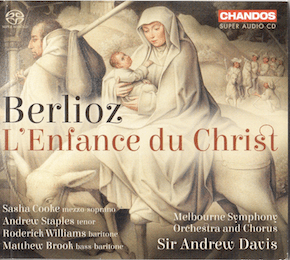 I got hold of the recent Chandos recording of Berlioz’ L’Enfance du Christ largely because I wanted to take a look at the Super Audio CD format. On that subject my thoughts are
  Heimweh is a CD of Schubert songs from young German soprano Anna Richter and pianist Gerold Huber with a bit of help from clarinettist Matthias Schorn. It’s an interesting combination of the familiar and the less familiar with a bit of a leaning to the more lyrical, less dramatic end of the Schubert canon. Familiar material includes Der Hirt auf dem Felsen and the three parts of Ellens Gesang but there’s material that I’m much less familiar with too like Der Zwerg and Viola. I guess thirteen minute long songs about snowdrops just don’t get programmed that often. There’s also the slightly odd Abschied; where the piano accompanies spoken text.
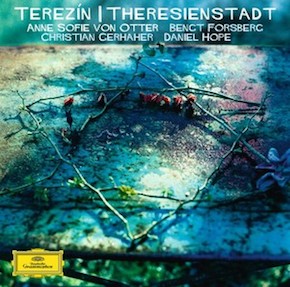 Terezín/Theresienstadt is a CD of music composed in the concentration camp at Terezín in what was then Czechoslovakia. Virtually the entire Czech intelligentsia; certainly those of Jewish or Communist persuasion, were imprisoned in a kind of “show camp” to demonstrate to the world that the Nazis weren’t as bad as made out. Nine of the ten composers featured on the disc ended up on a “Polentransport”; a one way ticket to Auschwitz. No story is more poignant than that of Ilse Weber, a nurse in the hospital. She chose to accompany the sick children of the camp on their final journey and reportedly sang to them in the gas chamber.
 I was fortunate, back in November 2016, to be at the Aga Khan Museum when Miriam Khalil gave an
  I’m not sure how I’ve not come across the music of Howard Skempton before but it took a flyer for a disk with a setting of The Ancient Mariner to get my attention. I’m fascinated by what contemporary composers do with the broadly defined field of art song and Skempton’s piece is really interesting. He sets a mildly abridged version of the Coleridge but there’s enough to last past the half hour mark. The vocal writing is tonal, rhythmic and declamatory; hardly song at all in a way, but it supports the text rather well. It’s sung here by baritone Roderick Williams, for whom the piece was written. He has a clear, bright voice and the setting tends towards the upper end of the baritone range. He also has superb diction in the manner of the best of the “English school”. The result is complete comprehensibility for the text and full value for every word.
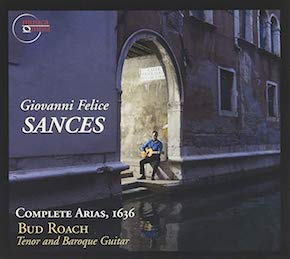 This review first appeared in the print edition of
  This review first appeared in the print edition of
 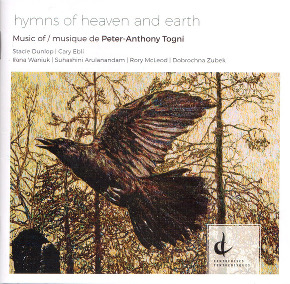 hymns of heaven and earth is a Centrediscs CD featuring three works by Halifax based Peter-Anthony Togni. I have limited experience with Togni. I thought his Responsio (reviewed for Opera Canada) was inspired but was less impressed with his
 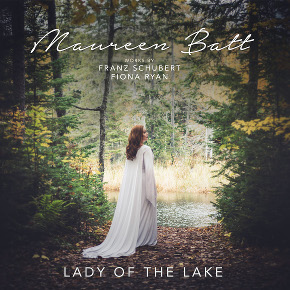 This is an interesting CD. It couples the rather rarely performed Schubert cycle to texts by Sir Walter Scott with a new Fiona Ryan cycle on the same theme. The reason the Schubert is a bit of a rarity is that, besides high and low voice and piano, one number requires a female chorus and another a TTBB quartet. In fact here those two pieces were recorded separately in different locations but I don’t think it’s apparent listening to the disc. The Schubert also includes the well known Ave Maria, the sixth song in the cycle, given here in the German originally used by Schubert rather than the Latin version usually heard. It’s a very decent performance. Maureen Batt is the soprano (and the evil genius behind the whole enterprise). Her voice is light and clear and her diction is excellent. Even a piece like the Ave Maria sounds fresh. Jon-Paul Décosse is the baritone. It’s a firm, confident voice, again with every word clearly audible. Simon Docking provides excellent accompaniment. The Bootgesang is performed by Leander Mendoza and Justin Simard; tenors with Robert O’Quinn and James Levesque; baritones, again with Docking at the piano. This might be the most fun piece of the cycle. For the elegiac Coronach we get The Halifax Camerata Singers conducted by Jeff Joudrey with Lynette Wahlstrom at the piano. They sound very pleasant.
 operaramblings