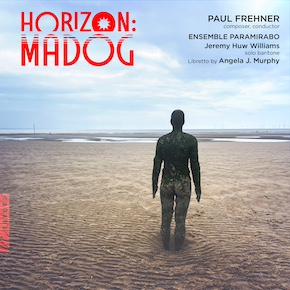
HORIZON:MADOG is a new chamber opera with music by Paul Frehner and a trilingual libretto by Angela J. Murphy. In a not too distant future where the world has been devastated by flooding and electro-magnetic storms, Madog; a descendant of the legendary Welsh prince, leads a movement for a more eco-friendly, less tech dependent future. He hears (scratchily) a radio broadcast from Wales promising, essentially, a tech fix, which he regards with scorn, and, in his dreams, his ancestor urging him to action. A plan emerges. Continue reading
Tag Archives: cd
María de Buenos Aires
Astor Piazzolla’a opera-tango María de Buenos Aires has been recorded, perhaps surprisingly, many times. The latest version comes from the Orchestra Filarmonica della Calabria and conductor Filippo Arlia with Ce Suarez Pas as María.
It’s a strange piece full of the sort of weird imagery one associates with South American magical realism and then some. The plot concerns a poor young girl in a very gritty Buenos Aires. She becomes a singer then a prostitute, Then she dies and her ghost wonders the city until she forced to give birth ti a daughter, also María, and so ending her role in the eternal cycle (“Forgotten are you among all women”) that will be carried on by her daughter. Her journeys and her resurrection are directed in some strange way by a spoken word character El Duende (The Goblin). Along the way she meets all kinds of strange people and others; a sparrow, a thief, a psychoanalyst, noodle kneaders, wizard bricklayers and much more. It’s really creepy. Continue reading
Microtonal music for string quartet
The first release from new record label Mnémosyne Records contains three microtonal pieces for string quartet by young Montreal based composers played by Quatuor Mémoire; Bailey Wantuch and Meggie Lacombe (violins), Marilou Lepage (viola) and Audréanne Filion (cello).
The first piece is by Florence M. Tremblay and is titled Insides. It’s slightly under twelve minutes and uses a fairly wide range of sonorities without, I think, going into any of the weirder types of extended technique. Most of what I was hearing hear were a drone like ground at varying pitch and volume on which more solid segments of both bowed and plucked notes were superimposed. The dynamics are quite complex and one section even sounded weirdly like what you hear inside a plane when it’s taking off. Plenty there to maintain interest across a fairly short piece. Continue reading
In Search of Youkali
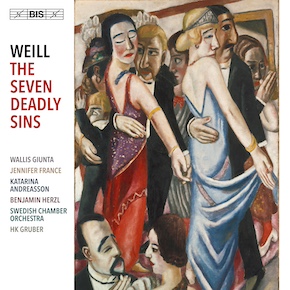
In Search of Youkali is a sort of journey through the theatre music of Kurt Weill performed by soprano Mary Bray supported by Murray Grainger (accordion), Marianne Schofield (double-bass) and William Vann (piano). For me, it’s a bit of a mixed bag. The German songs; “Barbarasong” and “Berlin im Licht” are quite nicely done but with (mainly) a bright, operatic kind of sound where I would prefer something more cabaret style. The accompaniments work well though.
Calamus
Calamus is a work for soprano and cello by Andrew Staniland based on poems from Walt Whitman’s Leaves of Grass. My review of the recent CD release is now available at La Scena Musicale.
Catalogue information: Leaf Music VR2025
Invented Folksongs
Invented Folksongs is a set of four pieces by Anna Pidgorna inspired, rather than based on, traditional Ukrainian folk songs collected by her in the field and recorded by her with the Ludivico Ensemble. My review is now available at La Scena Musicale.
Catalogue information: Redshift Records TK557
Composers who fled the Nazis
Äneas Humm and Renata Rohlfing’s new album Sehnsucht features songs from four composers whose careers were derailed by Nazi persecution of the Jews. Three of them; Arnold Schoenberg, Alexander von Zemlinsky and Eric Zeisl were Viennese composers who left for the United States though none of them managed to make the kind of success (financially at least) that Korngold and Weill achieved, though Schoenberg’s reputation was sufficiently established that he survived the transition pretty much intact. The fourth composer is Henriette Bosmans who was half Jewish and survived the war in Amsterdam though unable to perform after 1942. The songs by the Germans are settings of German texts. Bosmans’ songs are in French. Continue reading
Like Flesh
So another rather interesting chamber opera from Europe has come my way. It’s Like Flesh; music by Sivan Eldar and English language libretto by Cordelia Lynn. It’s 80 minutes long and uses three soloists, a chorus of six and an eight piece instrumental group plus electronics. It’s sort of a modern ecological take on Ovid’s idea of a woman turning into a tree. Here the woman is unhappily married to the Forester who buys into the basic idea that Nature exists to serve humans and is a willing accomplice in environmental degradation. There’s also a female student who is studying the forest and is discovering much that isn’t covered in the classroom. The transformation takes place against a back drop of destructive wild fires and the wanton felling of woodland to make way for concrete. Given the subject matter, the libretto is really quite poetic. Continue reading
Judita
Frano Parać’s opera Judita is unusual in at least one respect. The libretto is in Old Croatian and is based on a 1501 epic poem by Marko Marulić, in turn based on the Book of Judith so the story is the familiar one about Judith and Holofernes. It’s quite short; around 70 minutes, and it follows the biblical story pretty closely.
It premiered in Split in 2000 (both Parać and Marulić are/were from the city) but the recording was made at a live concert performance in Munich in 2023. It’s a pretty interesting piece. The music is clearly modern but essentially tonal. It’s got lots of energy and is sometimes quite grand and dramatic but also with quieter moments. There are elements of minimalism, especially in the rather declamatory and percussive music given to the Assyrian soldiers. Continue reading
Sky of My Heart
New York Polyphony are a quartet of singers; Geoffrey Williams – counter-tenor, Steven Caldicott Wilson and Andrew Fuchs – tenors and Craig Phillips – bass. On Sky of My Heart they mostly sing unaccompanied but are joined by the LeStrange Viols (Loren Ludwig and John Mark Rozendaal – treble viol, Kivie Cahn-Lipman – tenor viol, Zoe Weiss and Douglas Kelley – bass viol).
The album is a mix of Renaissance and contemporary pieces; most of the latter composed for NYP. They are very good singers with terrific control and a very clean largely vibrato free sound that works well for most of the music on the disk. Some of the material is religious; William Byrd’s setting of Ecce quam bonum, Becky McGlade’s setting of Prudentius’ Of the Father’s Love Begotten and Ivan Moody’s settings of three excerpts from the Song of Songs. All of these are unaccompanied in a churchy sort of style. Continue reading