Brecht and Weill’s Rise and Fall of the City of Mahagonny is an awkward work for an opera company. It’s been said, rightly I think, that one can/must situate it in a triangle of which the vertices are opera, musical theatre and Brechtian theatre. John Doyle’s 2007 production for Los Angeles Opera is strong on the opera and musical theatre dimensions but decidedly unBrechtian. Despite a good idiomatic translation by Michael Feingold this production seems unwilling to skewer capitalism in the manner Brecht intended. It’s the polar opposite of the Salzburg recording that left no Marxist cliche unexplored. Maybe it’s a failure of nerve. Maybe capitalism in LA is already such a parody of itself that further skewering is impossible. Who knows? Even Act 2, which is all about the commoditization of basic human pleasures doesn’t really fire. 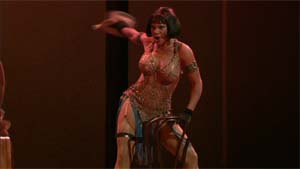 Sure we get excess and commoditized sex but there’s no sense that the commoditization is dehumanising or transgressive. Sex for sale? Of course! It does get a bit darker in the final act with the trial and execution of Jimmy and finishes strongly on “Still we only built this Mahagonny” but by then it’s very much too little, too late. The lack of edge is reinforced by the orchestra under James Conlon. It’s all just too civilized. There’s none of the spiky dissonance one is used to in the score and the brass, in particular, sound like they are playing in the Palm Court of the Hilton.
It’s a shame because the singing performances are mostly very good. The leading female roles are played by Patti LuPone and Audra McDonald who both have Broadway backgrounds. LuPone sounds like that’s where she’s from too though McDonald manages a much wider range and pretty much steals the show. It helps that she is very good looking and practically naked. 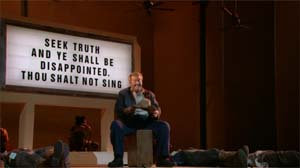 The guys are mostly from opera backgrounds; notably Anthony Dean Griffey as Jimmy McIntyre and Donnie Ray Albert as Trinity Moses. Both sing well and idiomatically. The sets are sort of Vegas lite with none of the inexplicable weirdness of the Salzburg production but not much interest either.
 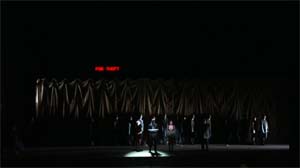 Again things look up a bit in the last act with effective use of a giant video screen in the trial scene and moving slogans over the finale. Blocking is very Broadway, especially the big chorus numbers that look more Rodgers and Hammerstein than Brecht and Weill.
Video direction is by Gary Halvorson and it’s judicious. There’s often not much set to look at so we might as well have close ups of Ms. McDonald. The technical package is solid. The picture is high quality 16:9. The sound choices are PCM stereo, DD 5.1 and DTS 5.1. The last is nicely balanced and clear There are French, German and Spanish subtitles. There’s a useful essay in the booklet which gives full track listings and a 20 minute interview with the director.

 I guess it’s a good thing when one’s emotional and intellectual reactions to a program threaten to overwhelm one’s ability to listen analytically and evaluate. That’s what art is for isn’t it? Anyway that’s pretty much what happened to me today listening to a program called Songs of Love and War in the Richard Bradshaw Amphitheatre. The songs were all pieces more or less inspired by the catastrophes of the first half of the twentieth century; the wars, the rise of Nazi power, the occupation of France. These are all events that have many layers of meaning for me. I have studied them and the music and literature they generated for decades. I have known, often well, people who played roles in these events. I have deeply held views. You have been warned!

 operaramblings