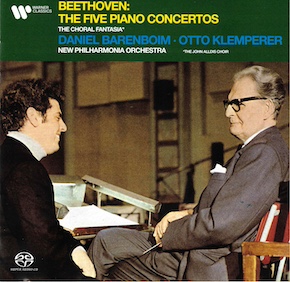
Following on from the du Pré cello concerto recordings I was also fortunate enough to get my hands on another Warner Classics remaster of old EMI recordings. This one consists of the Barenboim/Klemperer recordings of the five Beethoven piano concertos and the Choral Fantasia recorded with the New Philharmonia Orchestra and the John Allis Choir back in 1967. I used to own these on vinyl decades ago. Now they are available as a three SACD set.
Tag Archives: barenboim
The complete du Pré
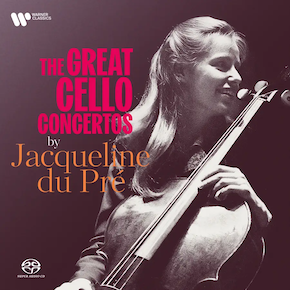
I first started to think seriously about the late Jacqueline du Pré when I saw the Woolf/Vavrek opera Jacqueline in 2020 at Tapestry. Subsequently I listened to the CD release and attended the remount at Tapestry in February this year. Then I saw that all of her concerto recordings for HMV (back catalogue now owned by Warner Classics) made between 1965 and 1970 had got a major facelift along the lines of the Solti Ring. The original analogue tapes have been digitized at 192kHz/24 bit using the latest technology and then remastered for SACD. The result is a four hybrid SACD box set called The Great Cello Concertos. Continue reading
Shattering Parsifal
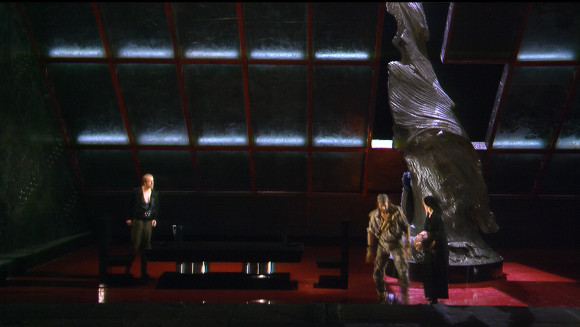
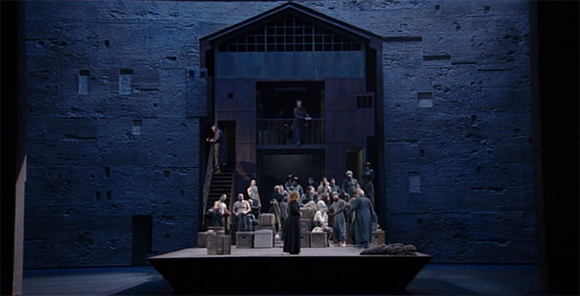
Dmitri Tcherniakov’s 2015 production of Wagner’s Parsifal recorded at the Staatsoper in Berlin in 2015 left me emotionally drained as I don’t think I’ve ever been after watching a recording. I can only imagine what it must have been like to experience this live. The combination of the production, exceptional singing and acting and Daniel Barenboim’s conducting is quite exceptional. It’s not going to be easy to unpack it all coherently but here goes…

Transcendent Tristan
There may be better video recordings of Tristan und Isolde than Daniel Barenboim and Heiner Müller’s 1995 Bayreuth collaboration but I haven’t seen one. It combines a deeply satisfying production, outstanding conducting and brilliant performances from the principals; Siegfried Jerusalem and Waltraud Meier. The only downside, and it’s not serious, is that, as a 1995 recording, it’s a bit short of the latest and greatest in audio and video quality.
Kupfer/Barenboim Ring – 4. Götterdämmerung
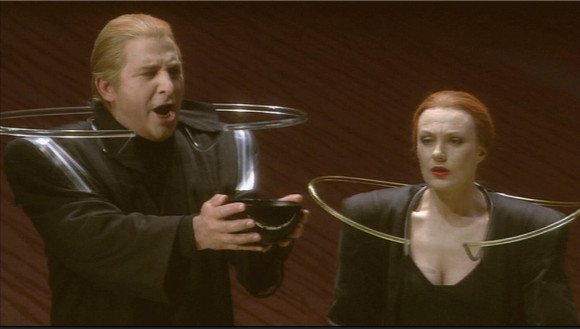
I think it’s only with the final instalment of the Kupfer/Barenboim Ring that its true power is apparent. The first three instalments are very fine but Götterdämmerung is devastating. All the elements that have been progressively introduced are seamlessly combined. Add to that extraordinarily intense performances from Siegfried Jerusalem (Siegfried), Philip Kang (Hagen) and, above all, Anne Evans (Brünnhilde) and one has something very special indeed.
Kupfer/Barenboim Ring – 3. Siegfried
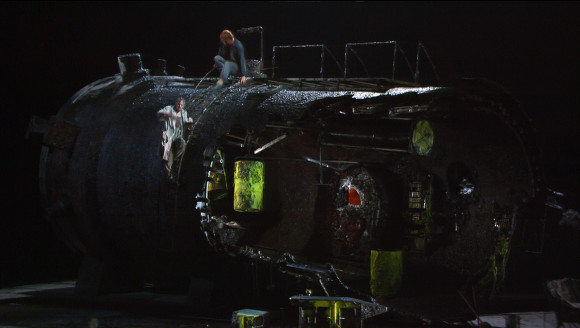
We seem to be in some kind of post apocalyptic wasteland. Mime’s hut looks like a re-purposed storage tank but the bear and the forest are more or less realistic. It’s all very dark and there’s quite a lot of use of pyrotechnics. This is also our first look at Siegfried Jerusalem’s Siegfried and he is very good indeed. He captures the hero’s youthful vigour and arrogance extremely well. There is a strong performance too from a rather manic Graham Clark as Mime and John Tomlinson continues as a reckless and wild Wanderer.
Kupfer/Barenboim Ring – 2. Die Walküre
The Kupfer/Barenboim Ring continues very strongly with the second instalment, Die Walküre. It opens in quite a straightforward, more or less realistic way. Hunding’s hall is slightly abstracted with a recognizable tree. It’s quite spare though which creates space for the strong interpersonal dynamics between Siegmund and Sieglinde. Poul Elming is a very physical, almost manic Siegmund and Nadine Secunde’s Sieglinde is almost as physical. It’s all very intense and beautifully sung. Matthias Hölle as Hunding is no slouch either.
Kupfer/Barenboim Ring – 1. Das Rheingold
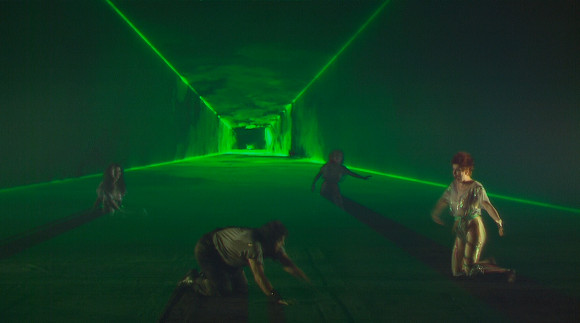
The 1991 Bayreuth Ring cycle is one of those productions that has become a historical landmark, as much as Chereau and Boulez’ 1976 effort, or maybe even more so. For many people it is the Ring. So what is it like? The staging is very bare and much reliance is placed on effects like lasers and smoke. It also makes considerable acting and athletic demands on the singers. It is, in many ways, a very modern production for 1991.
Musically satisfying Tristan from La Scala
I’ve been looking really hard for a video recording of Tristan und Isolde that I felt I could recommend because, frankly, nothing is worse than a badly executed Tristan as those who suffered through the Met HD broadcast a few years ago will know. In the 2007 La Scala recording I have found one I feel confident about. Is it perfect? No. A perfect Tristan is probably beyond mere mortals. I’m never sure whether I find it more astonishing that anyone can sing this music or that a composer might have imagined that he could find people who could. That said, the La Scala recording is very close to an ideal Gesamtkunstwerk.
Chill out dude
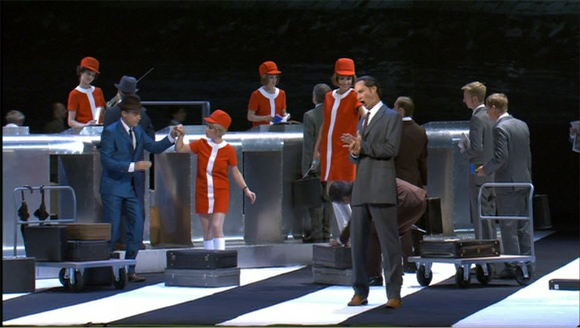
The problem with reviewing Doris Dörrie’s 2002 Berlin production of Così fan tutte is that pretty much everything that can be said about it already has been. It’s like trying to write about Willy Decker’s “red dress” Traviata. So I’ll try and be brief and to the point. On the surface the idea is a bit outlandish. Mozart and da Ponte’s satire about sexual fidelity is updated to the 1970s though to me, who grew up in the 70s, it seems much more like the 60s. That said, it works. It’s lively, funny, musically top notch and the presentation on DVD is very decent.