I looked at the cast list for the 1999 Wiener Staatsoper Don Giovanni and almost drooled. Carlos Alvarez, Franz-Josef Selig, Ildebrando d’Arcangelo, Adrianne Pieczonka, Anna Catarina Antonacci, Michael Schade, Angelika Kirchschlager and Lorenzo Regazzo. Add to that Riccardo Muti in the pit and musically it’s going to be hard to miss. So, unsurprisingly it turns out musically excellent across the board. I particularly enjoyed Michael Schade’s Don Ottavio. His supremely stylish singing and excellent acting added up to perhaps the best interpretation I’ve seen of perhaps opera’s dullest character. One might have reservations about Pieczonka’s Donna Anna but I think it’s a matter of taste. She can sing very prettily as she shows in her final duet with Schade but when she ups the volume she has great power but significantly less beauty of tone. It really boils down to one’s personal feelings about casting a genuine dramatic soprano in the role. I guess casting a mezzo as Zerlina is a bit unusual too but Kirchschlager is very good indeed. All in all it’s as well sung a Don Giovanni as I have heard.
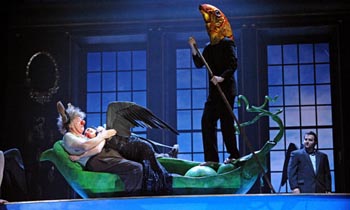
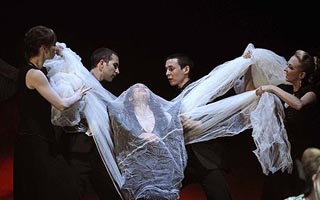
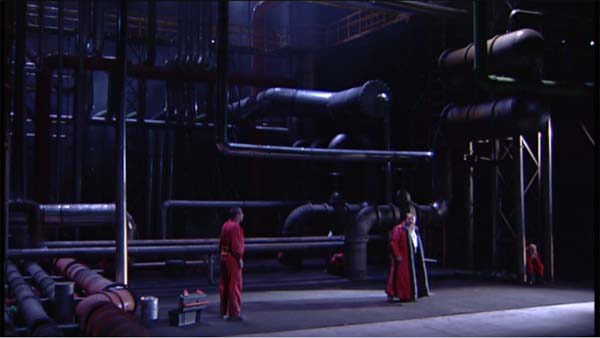
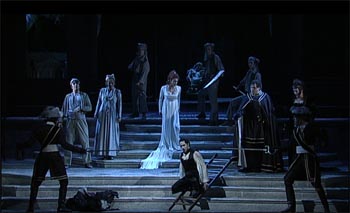 So, what about Roberto de Simon’s production and, supporting it, the acting? First, this production was performed at the Theater an der Wien so space on stage is tight and there’s a tendency for the singers to migrate to front centre stage for their big numbers giving a bit of a “park and bark” feeling. This is reinforced on the DVD by excessive use of close ups. If there is anything else going on we mostly don’t see it. This is a problem because there are some potentially interesting ideas in the production that don’t seem to be fully developed and that may be because the DVD viewer doesn’t see them develop. The first “big idea” is that as the piece progresses the costumes get more modern. Characters update roughly a hundred years on each appearance starting in the 16th century and going up to around 1900. The progression though is uneven and even my resident costume historian had trouble decoding some of the statements. It has to be said too that the early costumes in particular are sometimes bizarrely stylized. Don Giovanni gets visibly younger as the action progresses too. Add to that that there are two statues of the Commendatore; a 16th century one and a 19th century one. The former accepts Don Giovanni’s dinner invitation but the latter shows up. What are we to read into these elements and are they connected? To say that the characters are “timeless archetypes” seems to be a total “so what?” but I don’t have a deeper explanation. The second element is a flirtation with commedia. It’s never full on but we see glimpses of Harlequin in Leporello. In the opening scene he’s wearing what looks like a Harlequin costume that’s been desaturated in Photoshop as well as clown face. Don Giovanni’s acting too has some commedia elements. In particular there’s heavy use of the right-hand-shielding-left-side-of-the-face gesture in the opening scene with Donna Anna and it recurs in the final scene with the statue of the Commendatore. It gives Don Giovanni a sort of cheeky chappy quality at two of the most serious moments of the opera. Why? I don’t know. There are other, more or less isolated, visual references to the commedia sprinkled through the piece.
 The final element of commedia is that Masetto is played as a complete clod. He’s the stock dim peasant rather than someone who recognizes Don Giovanni for what he is, the class enemy, from the get go. This is then set against an even more knowing than usual Zerlina.
 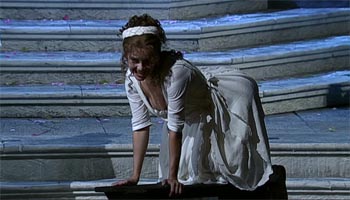 Certainly in “Batti, batti” she appears to be offering far more than poor old Masetto can begin to grasp. Whatever it’s all supposed to mean, the cast give it their all and are clearly acting their hearts out and at least it’s never dull.
 The biggest problem with the disc though is the video direction. Once again it’s Brian “close up” Large. With such a small stage it ought to be quite easy to show us what is happening but instead we get super close up on super close up. I particularly hate it when several people are singing and the director is just showing us a headshot of one of them. It interferes with my ability to hear the rest apart from anything else. Besides I don’t have a tonsil fetish. This comes to a final utterly annoying climax in the confrontation between the Commendatore and Don Giovanni. Large keeps cutting back and forth between full screen head shots of the pair of them. Ugh!
Technically it’s OK for a 1999 DVD recording. The picture is decent 16:9 and the LPCM stereo soundtrack is OK but not stunning. There are English, French, German, Italian and Spanish subtitles. There are no extras which is no surprise as it’s all squashed onto one DVD9 disc.
All in all, definitely worth a look but if you figure out what the director is driving at please let me know!