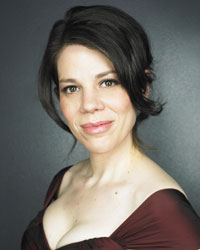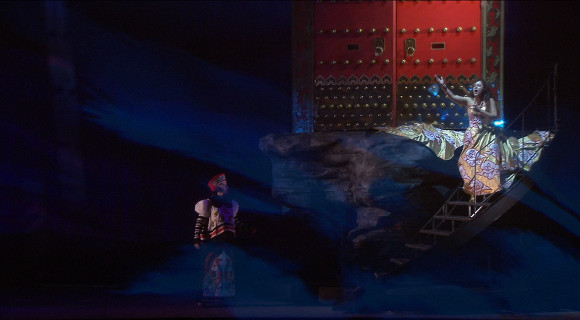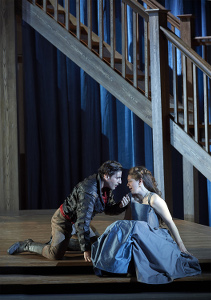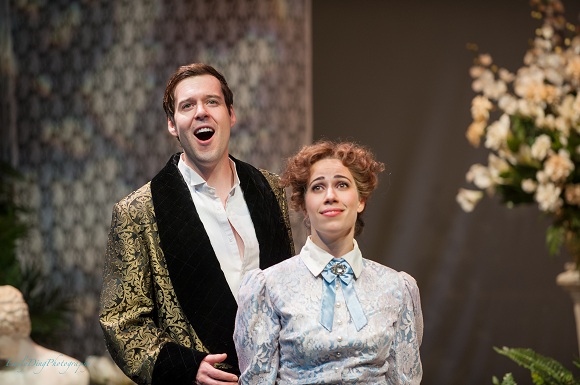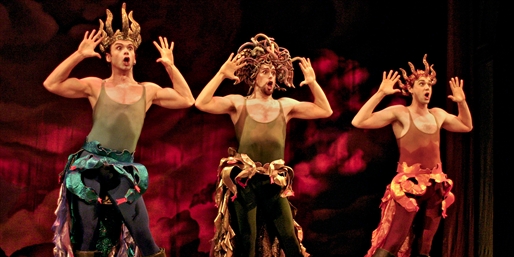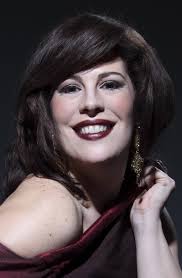
Once a year the COC Ensemble Studio get to show their talents on the big stage with a fully staged performance of a current production. This year’s choice of Atom Egoyan’s production of Così fan tutte was a good one. It showcased the talents of the singers really well and by using a different quartet of lovers in each act they were able to provide substantive roles for all the singers of the ensemble. I won’t dwell on the production as I have already reviewed it. The only changes I noted were a few change ups on the visual gags and that the “Albanians” kept their disguises on for quite a lot longer than with the main cast. So, how about the performances?
Kennedy era Un ballo in maschera works on many levels
The Canadian Opera Company’s new production of Verdi’s Un ballo in maschera is based on an intriguing concept that adds insight in many places but comes a bit unstuck in others. Coupled to some superb performances, it makes for an enjoyable and intriguing night at the theatre that will have the more adventurous busily and happily dissecting the piece for hours and the die hards reaching for their Zeffirelli pills.
Lunchtime with Tracy Dahl
I’ve attended many very good concerts in the Richard Bradshaw Amphitheatre but I’m not sure I’ve ever attended one as intense as Tracy Dahl and Liz Upchurch’s Songs from the Heart recital today. Tracy really is a rather extraordinary artist. She is the antithesis of the lieder singer who stands demurely by the piano and Schuberts mellifluously. She throws every fibre of her being into the performance. It’s not campily histrionic but voice, facial expression and gesture are all used to the full whether she’s hiccupping a drunken Harlequin or sibilantly suggesting a slithery singing snake.
Not the Met Live in HD
Finally a cinema in Toronto is screening opera in cinema broadcasts that are not from the Met. Bloor Hot Docs (Bloor and Bathurst) is showing a number of Royal Opera House offerings. They aren’t live and the line up makes even the Met seem adventurous but the theatre is said to have good sound, comfy seats and encourages food and drink. Here’s the screening schedule so far:
| SAT | Feb 15, 2014 | 1:30 PM | ROYAL OPERA HOUSE – DON GIOVANNI | ||
| SAT | March 15, 2014 | 1:30 PM | ROYAL OPERA HOUSE – TURANDOT | ||
| SAT | April 19, 2014 | 12:30 PM | ROYAL OPERA HOUSE – PARSIFAL | ||
| SAT | May 17, 2014 | 1:00 PM | ROYAL OPERA HOUSE – LES VEPRES SICILIENNES | ||
| SAT | June 14, 2014 | 1:00 PM | ROYAL OPERA HOUSE – LA BOHEME | ||
| SAT | July 12, 2014 | 1:00 PM | ROYAL OPERA HOUSE – MANON LESCAUT |
Hat tip to Lydia at Definitely the Opera for the spot.
Hippolyte et Aricie
While the rest of Toronto was preparing for that odd ornithological event the Superb Owl, or possibly attending the opening of the COC’s Un ballo in maschera, I went to see a semi-staged version of Rameau’s Hippolyte et Aricie at Voicebox: Opera in Concert. Perhaps surprisingly it was very well attended with a particularly strong showing from the bloggerati. You will have to wait for the next Opera Canada to read my review but Leslie Barcza’s may be found here.
Beggars in York
I managed to catch the end of the run of York University’s production of The Beggars Opera this afternoon. It’s a hugely ambitious concept with a couple of hundred people involved. The basic concept is that John Gay’s piece is being performed by inmates in a prison as part of their rehabilitation. Layered onto this is an obnoxious talk show host who is commenting on the proceedings from a sort of gutter conservative perspective. Add to this interpolations based on Lady Gaga, blues harmonica, ukulele and even a bit of Britten. Fights break out between the cast and have to be dealt with by the prison warden and staff. Equally, they intervene in over enthusiastic sexual encounters. It’s brave but it rather tends to overwhelm the piece at the centre.
Continue reading
A bit of a rant about “modern” music
It’s received wisdom in the opera (and, more generally, classical music) world that “modern” works are a hard sell. “Modern” appears to mean anything post Puccini plus anything from the early 20th century that’s perceived as “difficult”, like Bartok or Janacek. This is reflected in programming. In the last five years COC has programmed precisely one work written this century and in the last two seasons the most recent works were written in 1957 and 1945. Next year is even worse with nothing written after 1914. It’s no wonder people say the opera house is becoming a museum.
Embroidered by blind nuns in Tuscany
Encounters was a one hour programme of short opera scenes by student composers to libretti by Michael Albano. It’s the latest in a series of fully staged shows by student composers from the UoT Faculty of Music’s composition programme which has been running since 1997 and has included, for example Rob Ford, the opera. It’s quite shocking that when that showed two years ago, as Dean Don McLean reminded us, the big Rob Ford story was about library closures. Anyway, only one of yesterday’s five pieces featured Mr. Ford.
Così preview
Today’s lunchtime concert in the Richard Bradshaw Amphitheatre featured members of the COC Studio Ensemble performing extracts from Act 1 of Così fan tutte as a teaser for their performance of Atom Egoyan’s production on February 7th. This promises to beeven more confusing than usual as the young lover roles are all being shared to accommodate everyone. Today, Clraence Frazer and Danielle MacMillan being sick we had but one Guglielmo, Cameron McPhail, and one Dorabella, Charlotte Burrage. Andrew Haji and Owen McAusland alternated as Ferrando and Sasha Djihanian and Aviva Fortunata doubled Fiordiligi (those two, at least, are easy to tell apart). Gordon Bintner sang Don Alphonso and Claire de Sévigné played Despina.
Adelaide di Borgogna
Adelaide di Borgogna is one of those rather odd “serious” Rossini works where bel canto collides with opera seria. The plot is fairly accurately based on an episode from 10th century history and is most definitely not a comedy. The form has progressed well beyond a succession of da capo arias with multiple ensemble numbers and quite a few choruses. But there’s a throwback to an earlier tradition in the use of high voices for heroic male roles though it seems that by 1817 castrati were rather rare and the crucial role of Ottone, the German emperor, was from the beginning sung by a female contralto.