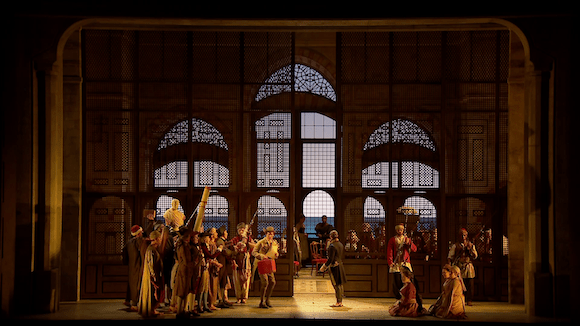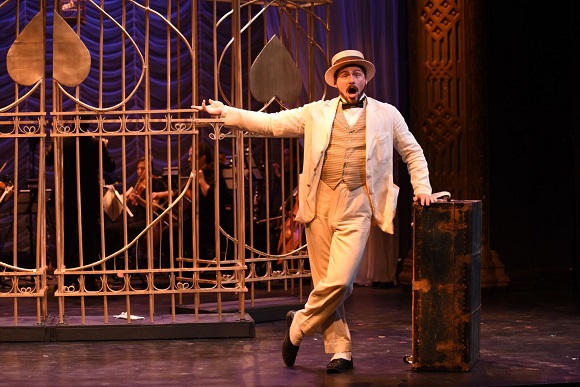
Here’s what’s coming up in the first part of March. Thursday 1st is Opera Pub Night at the Amsterdam Bicycle Club at 9pm. On Friday March 9th Soundstreams are presenting Tan Dun’s Water Passion at Trinity St. Paul’s at 8pm. On Wednesday 14th and Friday 16th the Glenn Gould School is presenting Die Fledermaus in a production by Joel Ivany. That’s at 7.30pm in Koerner Hall. It’s a good looking cast and recommended. Thursday 15th through Sunday 18th the UoT Opera is presenting Gershwin’s Of Thee I Sing in the MacMillan Theatre. The production is by Michael Patrick Albano and start times are 7.30pm except for Sunday at 2.30pm.
Handel’s Alexander’s Feast
Handel’s Alexander’s Feast is an oratorio to a text by Newburgh Hamilton based closely on an earlier Dryden St. Cecilia’s Day ode. The basic plot is that Alexander is feasting in captured Persepolis with his mistress Thaïs. Inflamed by the music of Timotheus he decides to burn down the city in revenge for his fallen soldiers. Cecilia descends from Heaven and substitutes music for the king’s barbarous intentions. There are solo and choral numbers and a couple of duets and there are two concerti; one for triple harp representing Timotheus’ lyre playing and an organ concerto for St. Cecilia. It’s all quite tuneful and interesting if not as inspired as some of the better known oratorios.
CMIM
The line up for the vocal section of the Montreal International Music Competition has been announced. There are 38 singers; all under 35. They are drawn from 22 countries and include 8 Canadians. There are two competitions; art song and aria. The former is, of course, with piano accompaniment, the latter, at least in the latter stages, with orchestra. I’m hoping to be in Montreal for the closing stages of the aria competition in the first week of June so watch this space. Here is the line up:

More details can be found here.
Feast free with Alexander!
So this Thursday (Feb 22nd) at 8pm Tafelmusik are presenting Handel’s Alexander’s Feast at Koerner Hall. Chances to see Handel oratorios, other than Messiah, don’t come around that often and this one has a very decent line up of soloists; Amanda Forsythe, Alexander Dobson and Thomas Hobbs. And we have a special giveaway offer. Tafelmusik have provided a pair of tickets for readers of this blog. Comment below or email me (j DOT gilks AT rogers DOT com) with contact details and I’ll put your name in the hat. I’ll announce the winner tomorrow evening. The winner will be able to pick the tickets up at the box office before the show. If you can’t make Thursday there are also performances on Friday, Saturday and Sunday but no freebies for those!

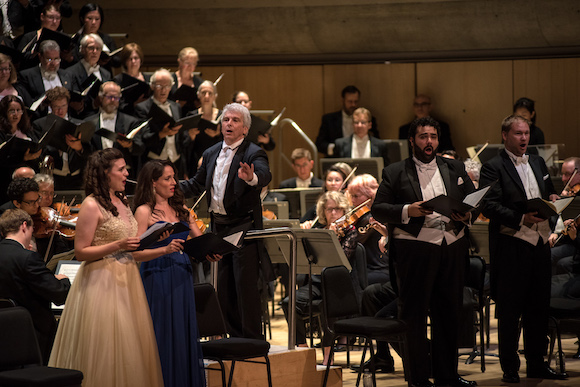
Tafelmusik Baroque Choir – Photo: Sian Richards
Europa Riconosciuta
It’s sometimes a bit of a mystery why some works disappear from the opera repertoire while other, not obviously superior, works enjoy lasting success so it’s always a pleasure to discover an obscure work that is really good (1). Salieri’s Europa Riconosciuta fits that description in my view. It’s basically an opera seria much along the lines of Mozart’s opere serie (opera serias? – who knows?(2)) except that there’s a longish ballet at the end of Act 1. There are long, florid, arias with, for the two female leads, very high tessitura. Two of the three male roles were written for castrati and the one intact male role is for that sort of heroic tenor who crops up in Idomeneo or La Clemenza di Tito. It’s not as formulaic as works of 50 years earlier. There are far more ensemble and choral numbers than in any of Handel’s Italian works. It’s also just plain rather good. Salieri understands singers and he writes really good melodies. I guess he was just a bit unfortunate to have that pesky Salzburger as competition.

Cogent Parsifal
Wagner’s Parsifal has been served rather well on Blu-ray and DVD in the last few years. The 2016 Bayreuth recording is another interesting addition to the list. Uwe Eric Laufenberg’s production is not exactly traditional but it’s not “in your face” conceptual either. The setting is contemporary and various visual clues locate it where Europe meets Asia; perhaps the Southern Caucasus. The grail temple is run down. There are soldiers and refugees and tourists, as well as the Grail knights. There’s plenty of Christian symbolism around. The “swan scene” is played straight. The “communion scene” uses Amfortas as the source of the communion blood; an idea which seems common enough. Here he’s wearing a crown of thorns (and not much else) and there’s lots of blood.

Trivia trivia
Certain people will probably be amused that our team for Opera Trivia last night christened itself “Berenice’s Potato”. We won too… just!

Russian Romance
The full Ensemble Studio was on display yesterday for an all Russian lunchtime concert. First up was Megan Quick with a couple of Rachmaninov songs. Megan’s timbre is very dark and it seems to be a natural fit for those Russian vowels. She was followed by Bruno Roy with a couple of Tchaikovsky numbers. He’s come on a lot in his time in the Studio. There’s some heft to the voice now and some quite impressive top notes. Good stuff.

The Truth About Love
Yesterday’s lunchtime recital in the RBA featured Claire de Sévigné and Rachel Andrist with Huw Montague Rendall chipping in with readings. The theme, naturally enough, was Love. It was a carefully curated program taking us through Passion, The Bond, Pain, Memory and, finally, The Truth. Along the way we got Poulenc, Fauré and Debussy; Wolf and Liszt; Schubert and Schumann; even some Strauss and Weill before The Truth was revealed in English language texts set by Hughes, Previn, Copland and Bridge. Make of that last what you will.

Alagna and Gheorghiu in L’elisir d’amore
Shortly after their marriage in 1996 Angela Gheorghiu and Roberto Alagna appeared together in Donizetti’s L’elisir d’amore at Opéra de Lyon. At the time she was 31 and he was 33 so pretty much ideal for the roles. The production was directed by Frank Dunlop. It’s straightforward, set in the 1920s and essentially traditional though there are a few nice touches. It’s what the recent COC production might have been if the asinine attempts to be “relevant” had been ditched.