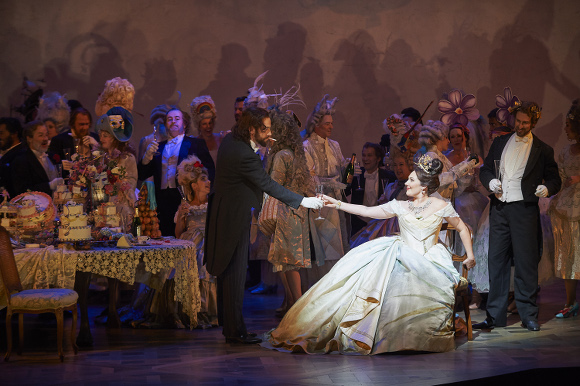
Guth’s Figaro at the COC

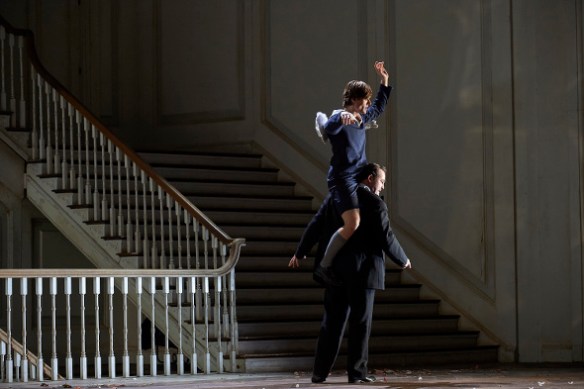
Claus Guth’s production of Mozart’s Le Nozze di Figaro, first seen at Salzburg in 2006, opened last night at the COC.  I was curious to see how it would be received because, while by no means an extreme production by European standards, it’s well beyond the 1970s aesthetic beloved by sections of the Toronto audience.  The aesthetic is Northern European; a Strindberg play or a Bergmann film perhaps.  It’s monochromatic, quite slow and focusses on the darker side of the characters’ psyches.  It’s the antithesis of Figaro as Feydeau farce.  There’s also a non-canonical character, Cherubim.  He’s a winged doppelganger of Cherubino and seems to be a cross between Cupid and Puck.  Pretty much omnipresent he manipulates scenes and characters though with a power that falls well short of absolute.  Perhaps the whole production is best summed up in the final ensemble.  Cherubim visits each couple in turn and is brusquely rejected.  Only Cherubino is still subject to his power and that seems to have become destructive.  Perhaps the message is “Now we are married forget this love nonsense and let us get back to our drab lives of quiet despair”.

Figaro-MC-1107

Continue reading

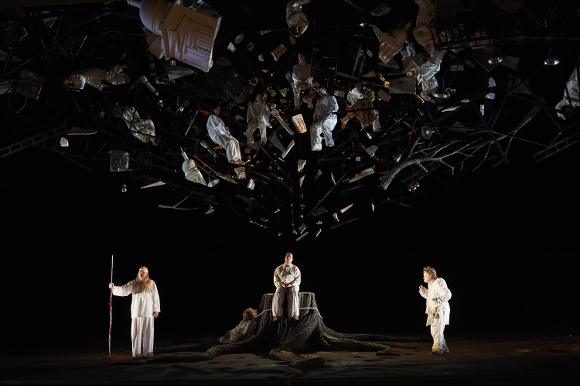
Heil dir, Sonne!

François Girard’s Siegfried, a revival of his 2006 production, opened last night at the COC.  Despite using the same basic set concept as Atom Egoyan’s Die Walküre, Girard’s Siegfried, has a rather different look and feel.  The fragments of Valhalla and the remains of Yggdrassil are still there but they are supplemented in imaginative fashion by a corps of supers and acrobats who play a key role in shaping the scenes.  For example, in the opening scene we have Yggdrassil festooned with bodies, as if some enormous shrike were in residence.  Some of these are dummies and some aerialists who come into the drama at key points.  The flames in Siegfried’s forge are human arms.  Acrobats make a very effective Fafner in the Niedhöhle scene and the flames around Brünnhilde’s rock are human too.  Most of the characters are dressed in sort of white pyjamas which makes for a very monochromatic effect on the mostly dark stage.  The one visual incongruity is the “bear” who is present, tied to Yggdrassil, throughout Act 1.  Frankly it looks less like a bear than John Tomlinson after a night on the tiles.  Still, all in all, the production is effective without being especially revelatory.
Siegfried-0629

Continue reading

Traviata redux

Nederland, Amsterdam, 02-05-2013. Muziektheater, DNO: La Traviata voorgenerale orkest.Last night we saw the last performance of the current COC run of La Traviata, this time with the alternate cast.  Joyce El-Khoury, Andrew Haji and James Westman came in for Ekaterina Siurina, Charles Castronovo and Quinn Kelsey.  We were also sitting in Ring 3 rather than lower down which gave a rather different perspective; perhaps not showing off the clever lighting for the intimate scenes quite as well but much more effective, by giving greater depth, for the party scenes.

Continue reading

Night of the living mezzos

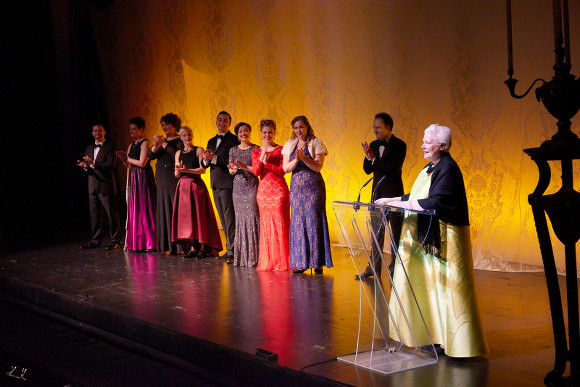
As previously revealed the line up for last night’s Centre Stage; the COC’s gala competition cum Ensemble Studio final audition featured four mezzos, two sopranos and two baritones.  Not a tenor to be had.  As was the case two years ago the competition was split into two parts; a late afternoon session for an invited audience and an early evening public session separated by a cocktail reception.  Each singer presented one aria in each session.  Accompaniment was provided by the COC Orchestra with music director Johannes Debus.

The Lieutenant Governor with the contestants

The Lieutenant Governor with the contestants

Continue reading

Pyramus and Thisbe – Beyond time and space

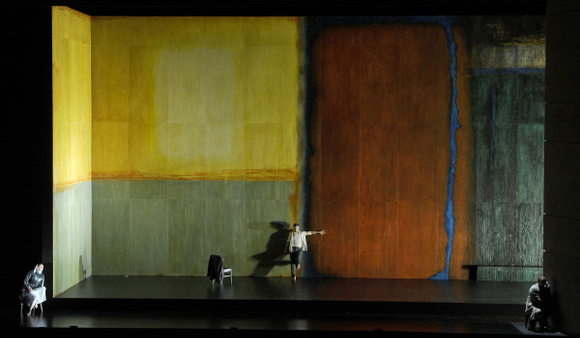
Back last night for a second look at Pyramus and Thisbe at the COC.  I’ve been involved in a huge amount of discussion, mostly with Katja, about this show since we saw it on Tuesday and there were many things about the Monk Feldman piece and its staging that I wanted to think about again.  Lots of thoughts and, perhaps, a slightly different perspective since I was watching from two levels higher in the house this time.

Pt-GB-19 Continue reading

Pyramus and Thisbe – a world premiere

The new COC creation Pyramus and Thisbe with music by Monteverdi and Barbara Monk Feldman opened last night at the Four Seasons Centre.  I was expecting abstract and cerebral, which it is, but I was rather expecting that I might admire it more than enjoy it.  As it turned out it was a remarkably satisfying show on many levels.

PT-GB-95 Continue reading

Suirina, Castronovo and Kelsey rock Traviata

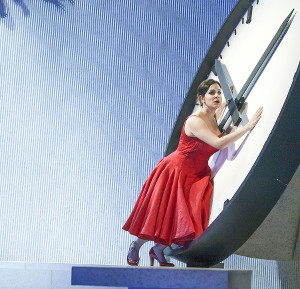
There’s a lot to like in the COC’s production of Verdi’s La Traviata that opened at The Four Seasons Centre last night.  Arin Arbus’ production; a co-production with Chicago Lyric Opera and Houston Grand Opera avoids the cloying sentimentality of many productions of this piece and, without being in any way gratuitous, deals very directly with the world Verdi wanted us to see; a world of hypocrisy, sex for sale and early, pointless death.

0097 – (in foreground) Roberto Gleadow as Dr. Grenvil and Ekaterina Siurina as Violetta in the COC’s production of La Traviata, 2015. Conductor Marco Guidarini, director Arin Arbus, set designer Riccardo Hernandez, costume designer Cait O’Connor, and lighting designer Marcus Doshi. Photo: Michael Cooper Michael Cooper Photographic Office- 416-466-4474 Mobile- 416-938-7558 66 Coleridge Ave. Toronto, ON M4C 4H5

Continue reading

Ensemble Studio Barber

The Ensemble Studio got to do their thing last night with their annual main stage performance; this year, of course, Joan Font’s production of The Barber of Seville.  This year only one role was split; Andrew Haji singing Almaviva in Act 1 with Jean-Philippe Fortier-Lazure coming off the bench for the second half.  The other main roles went to Clarence Frazer as Figaro, Charlott Burrage as Rosina, Iain McNeil as Doctor Bartolo, Gordon Bintner as Don Basilio and Karine Boucher as Berta.  Ringer Jan Vaculik sang both Fiorello and the Officer.

2537 – (l-r) Clarence Frazer as Figaro, Andrew Haji as Count Almaviva, Charlotte Burrage as Rosina, Gordon Bintner as Don Basilio, Karine Boucher as Berta and Iain MacNeil as Doctor Bartolo in the Ensemble Studio performance of the Canadian Opera Company’s production of The Barber of Seville, 2015. Conductor Rory Macdonald, director Joan Font, set and costume designer Joan Guillén, choreographer Xevi Dorca and lighting designer Albert Faura.  Photo: Michael Cooper  Michael Cooper Photographic Office- 416-466-4474 Mobile- 416-938-7558 66 Coleridge Ave. Toronto, ON M4C 4H5

Continue reading

All change for Seville

Last night saw the alternative cast for the COC’s Barber of Seville take the stage for the first time.  Almaviva, Rosina, Bartolo, Basilio are all changed and, last night, owing to illness Joshua Hopkins was replaced as Figaro by Clarence Frazer which, in turn meant Jan Vakulik sang the Officer.

Continue reading

Back to Bartók

0222 – Ekaterina Gubanova as Judith and John Relyea as Duke Bluebeard in the Canadian Opera Company production of Bluebeard’s Castle, 2015. Conductor Johannes Debus, director Robert Lepage, revival director François Racine, set and costume designer Michael Levine, and lighting designer Robert Thomson. Photo: Michael Cooper Michael Cooper Photographic Office- 416-466-4474 Mobile- 416-938-7558 66 Coleridge Ave. Toronto, ON M4C 4H5I was back at the Four Seasons Centre last night for another look at Duke Bluebeard’s Castle or, perhaps more accurately, another listen.  I really enjoyed the production again and I don’t have much to add to my earlier review.  It was the music that had much more impact this time.  I often find that with “modern” scores I get much more out of them on a second listening and that was true here.  First time round I felt so battered by the loud bits, especially the section where the fifth door (Bluebeard’s empire) is opened with it’s extra brass and JohnWilliams on acid crescendos, that my brain somewhat discounted the quieter bits.  Last night I was struck mainly by the meditative nature of much of the music. The influence of Débussy, especially Pelléas et Mélisande, seems clear.  The little repeating figures for the woodwinds; there’s one that’s usually given (I think) to the flutes and or oboes) and another descending figure in the bassoons, are quite haunting.  It’s really quite lovely when it’s not being brutal.

I also appreciated the relationship between Bluebeard and Judith more.  This isn’t Perreault’s tale of a brute and an innocent.  Gubanova’s rather fierce Judith is running the show.  Maybe there is an element of hubris in this Judith.  Relyea’s Duke by contrast is almost an observer and commentator; acquiescing in what must be.  Some of this, of course, is in the libretto.  Bluebeard isn’t killed and Judith shares the fate, whatever it is, of the other wives.  But here she seems to do so willingly.

I’m glad I saw this again.

Photo credit: Michael Cooper