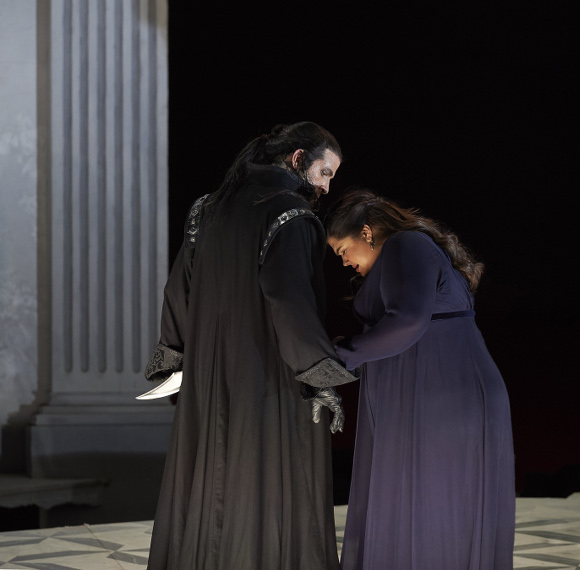
Magic Flute – the other cast

Last night I saw the alternate cast of the COC’s Magic Flute.  Owen McCausland swaps First Armed Man for Tamino with Andrew Haji, Kirsten MacKinnon comes in as Pamina, Phillip Addis is Papageno and Matt Boehler is Sarastro.  The changes don’t really affect things much at all.  All the new faces are very good.  MacKinnon is a very perky Pamina which works well with Addis who has maybe a bit more of the “cheeky chappy” than Hopkins.  Fans of Owen McCausland and Andrew Haji will see exactly the differences in timbre and vocal technique one would expect but the interpretation is pretty much the same.  Overall, I would say that someone not very familiar with these singers would scarcely notice any differences.  What I did notice is how much better this production looks from Ring 3 than from the Orchestra.  Getting something of a “plan view” makes the antics during the overture look less cluttered and frantic and the trials scene is much more effective.  And the sound is better too.

Photos by Michael Cooper under the fold. Continue reading
Twilight

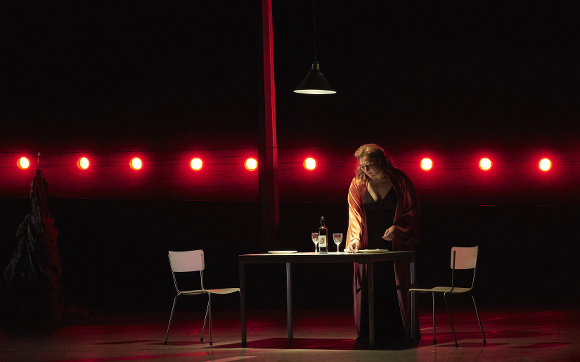
Last night the COC began its run of Götterdämmerung, the last and longest opera in Wagner’s epic tetralogy at The Four Seasons Centre.  It’s very different from Die Walküre and Siegfried.  The visual elements that tied them together; tottering Valhalla, disintegrating world ash, gantries, dancers, heaps of corpses are mostly gone.  In Tim Albery’s production the visuals are spare almost to abstraction.  The Gibichung Hall is a CEO suite with computer monitors and red couches, both Brünnhilde’s rock and the Rhinemaidens’ hang out look improvised, almost like squatters’ camps.  Costuming, apart from an occasional flashback, as in Waltraute’s scene, is severely modern business; grey suits, black dresses.  Only Siegfried himself in tee shirt and leather jacket stands out from the corporate crowd.  Dancing flames are replaced by red lights.  Everything that can be understated is and the world ends not with an overflowing Rhine and collapsing Valhalla but a stately pas de quatre between Brünnhilde and the Rhinemaidens.

gotterdammerung-mc-0646

Continue reading

Magic Flute revived at COC

Last night saw the first performance of this season’s run of Mozart’s Die Zauberflöte at the COC.  It’s a revival of the Diane Paulus 2011 production with Ashlie Corcoran as revival director.  It has a “theatre within a theatre” overlay in Act 1; it’s supposed to be an aristocratic birthday party for Pamina where the guests perform the opera, which mysteriously disappears in Act 2 though it makes an odd reprise right at the end where all the characters appear to perform a country dance.  Strip that element out and it’s a workmanlike Flute with nothing much to say but some pretty visuals.  The animals are cute and the trials scene is rather well done.  There is one notable change from 2011.  Pamina’s lurid pink Disney princess outfit is gone, replaced by something Regencyish and far less jarring.

priests

Continue reading

Norma encore

Back to the Four Seasons Centre last night for a second look at Norma.  This time with Elza van den Heever singing the title role.  Van den Heever has a more conventional voice than Sondra Radvanovsky.  It’s perhaps not as dramatic and distinct but it’s an accurate, flexible instrument with plenty of colours and big enough for the role.  She’s also every bit as good as an actress so I don’t think the production suffers from losing its “headliner”.  Russell Thomas impressed again.  He’s so much better as Pollione than he was as Don José.  The acting is convincing and he really gets the chance to let rip here with what is a truly glorious tenor voice.  All the obvious comparisons suggest and are not ridiculous.  Isabel Leonard was also very fine last night and the duets with van den Heever were perhaps the highlight of the show.  Hat tip too to Charles Sy who never sounded out of place even when Thomas was singing all guns blazing,  It’s only two years since he was singing in a student production of HMS Pinafore.

norma-mc-2109

Continue reading

Coming of Age in the Hebrides

What are we to make of Handel’s Ariodante?  The plot centres on the notion that female chastity is the be all and end all of life.  It’s not a notion that would find much support in 21st century Toronto, even among a Sunday afternoon audience at the Four Seasons Centre.  Ginevra, princess of Scotland and heir to the king, is  betrothed to Ariodante.  Ariodante has a rival, Polinesso who is loved in a besotted kind of way by Ginevra’s maid, Dalinda.  Polinesso claims to have slept with Ginevra and offers to prove it to Ariodante.  He drugs Ginevra and gets Dalinda to put on Ginevra’s clothes and invite him into her room.  Ariodante disappears, apparently having committed suicide in a fit of despair.  On the flimsiest of evidence Ginevra, who has no idea what happened, is condemned to death.  Her accusers, including her father, don’t even bother to ask who the man in her room was.  Polinesso tries to remove the now inconvenient Dalinda from the scene but fails and when Ariodante shows up again she spills the beans.  Polinesso is killed by Ariodante’s brother in a duel but not before confessing.  All is forgiven and everyone carries on as if nothing in the least traumatising just happened.  So, what to do with this?

ariodante-mc-0093

Continue reading

Norma at the COC

Kevin Newbury’s production of Bellini’s Norma at the COC (co-pro with San Francisco, Chicago and the Liceu) is perhaps best described as serviceable.  I have seen various rather desperate efforts made to draw deep meaning from it but I really don’t think there is any.  That said, it looks pretty decent and is efficient.  The single set allows seamless transitions between scenes which is a huge plus.  So, what does it look like?  It’s basically a sort of cross between a barn and a temple with a back wall that can raised or moved out of the way to expose the druids’ sacred forest.  There’s also a sort of two level cart thing which characters ascend when they have something especially important to sing.  Costumes were said to have been inspired by Game of Thrones; animal skins, leather, tattoos (which actually don’t really read except up very close), flowing robes.  Norma herself appears to be styled, somewhat oddly, on a Klingon drag queen. The lighting is effective and there are some effective pyrotechnics at the end.  All in all a pretty good frame for the story and the singing.

norma-ch-063

Continue reading

Maometto Secondo – really

Just back from a second look at the COC’s production of Rossini’s Maometto II.  This time I was sitting on the orchestra level and a bit closer which helps with this production.  Basic impressions remain the same as opening night; great singing, visually spectacular, but I did have some additional, and related, thoughts about both the libretto and the production.

Maometto-MC-1161

Continue reading

Maometto II

Rossini’s rarely performed opera seria Maometto II opened at the Four Seasons Centre last night in a production by David Alden and with substantially the same cast as when it played in Santa Fe on 2012.  This is the restored Maometto in the edition prepared by Hans Schellevis in an attempt to get as close to Rossini’s initial Naples score as possible.  So, no happy ending and all the complexity of Rossini’s original design.

Maometto-MC-0287

Continue reading

Carmen again

We were back at the COC last night for the first performance of Carmen by the alternative cast.  (First cast review) As so often seems to be the case with these double cast shows it felt almost like a different production.  The biggest differences are produced by the new Don José, David Pomeroy, and the new Carmen, Clémentine Margaine.  Pomeroy is a very decent singer but he doesn’t have the ease, power and bloom of Russell Thomas.  What he does have is vastly superior acting chops.  His Don José is a believably complex human being.  We can see his decline from rather boring and provincially stuck up into despair(1).  It’s palpable.  Margaine’s Carmen is a similar story.  Her voice isn’t as big or dark as Anita Rashvelishvili(2) but she’s much more physical on stage.  Further, Pomeroy and Margaine are much more credible as a couple.  The net result is the drama that was rather missing in the first two acts on Sunday.  The price is not hearing two absolutely incredibly beautiful voices.

Carmen-MC-0189

Continue reading

Carmen in Cuba?

I caught the second performance of the current run of Carmen at the COC this afternoon.  It’s a revival of the production previously seen in 2010 but with, we are told, debuting director Joel Ivany being given some freedom to change things up a bit.  Obviously he was mostly constrained to use the existing sets and costumes which, for reasons that escape me, transplants the piece to 1940s Cuba which was, as far as I know, markedly short of both gypsies and bull fights but there you go.  Actually it matters scarcely at all because both sets and costumes are generic scruffy Hispanic and could be anywhere from Leon to Lima.  For the first two acts too the blocking and Personenregie is pretty standard too.  It’s all really down to the chemistry between the singers and the quality of the acting and neither is anything to write home about.  It says a lot when Frasquita is scene stealing.  Fortunately it livens up a lot after the interval.  The third act is atmospheric and Micaëla’s aria is deeply touching and for the first time I felt genuine emotion.  It gets even better after that with a really effective use of the whole auditorium for the parade which had much of the audience clapping along and a clever stage set up for the crowd during the final confrontation scene.  I don’t think it’s a production for the ages but it’s better than merely serviceable and I’ve seen much worse Carmens.  And, frankly, it’s simply not realistic to expect one of the season’s cash cows to push the envelope very far.

Carmen-MC-4225

Continue reading