Munich Orphée hits 11 on the WTFometer

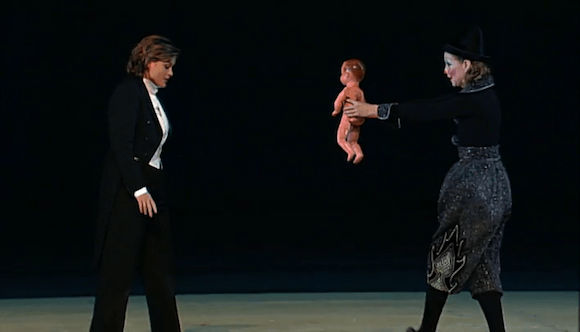
Back in July I reviewed John Eliot Gardiner’s Paris recording of Gluck’s Orphée et Eurydice which I found musically fine, in good taste (too much so) and ultimately unengaging. Lydia pointed me to a Bayerischen Staatsoper version with Vesselina Kasarova in the title role. It’s the 1859 Berlioz version with a ballet tacked on at the end, more of which below. Musically it’s very good. Chorus and Orchestra under Ivor Bolton are excellent, Kasarova sings and acts very competently and manages an amazing cadenza in her big first act aria. Rosemary Joshua as Eurydice is perfectly adequate if a bit anonymous and Deborah York is an androgynous looking and sounding Amour which works fine for this production.

1.baby

Continue reading

An everyday story of country folk

If Thomas Hardy had written an opera libretto he might well have come up with something like Janáček’s Jenůfa. It’s a simple rural love story with domestic violence, betrayal, desertion, bastardy and infanticide thrown in. It also has an absolutely gorgeous score mixing folkloric elements, incredible lyricism and some pulsating rhythmic sections. The opera was substantially modified after it’s 1904 Brno premier but in 1989 Glyndebourne put on the original Brno version in a production by Nikolaus Lehnhoff. It’s a three acter and opens with with scenes around a mill owned by Jenůfa’s fiancé, Števa. It’s all a bit cramped and old fashioned looking; probably a function of the small stage in the pre-reno Glyndebourne. Acts 2 and 3 take place inside Jenůfa’s foster-mother’s (Kostelnička) house and here the small stage makes the fairly simple room appropriately claustrophobic. What makes this performance worth seeing though is not the staging but the performances by the three principals; Anja Silja as Kostelnička, Roberta Alexander as Jenůfa and Philip Langridge as Jenůfa’s other suitor, Laca. They are backed up by a superb performance by Andrew Davis and the London Philharmonic. Davis just has an uncanny ability to wring every drop of lyricism out of score without sacrificing drama or forward momentum and he does it here every bit as well as he did in Ariadne at the COC back in May. Other reviews of this DVD that I have read have focussed heavily on Silja’s Kostelnička. I can see why. She is not far short of a force of nature and she drives the drama, especially in the horrific second act and the final scene. I think though that Alexander’s Jenůfa is just as important. She contributes the lyricism in the singing. It’s not that she lacks drama, she doesn’t, but she has a sweet toned voice that carries that element of the music through all three acts. Langridge’s Laca impressed me too. In Act 1 I wasn’t at all sure. He seemed miscast with the role not offering much for his stylish lyrical tenor but he grew on me during the more domestic bits of Acts 2 and 3.

jenufa1

Continue reading

Surrounded by these ghouls; the living and the dead

Britten’s Owen Wingrave is one of very few operas written for television. It’s also the second opera Britten wrote based on a Henry James ghost story. Owen Wingrave comes from a family of soldiers and their portraits and their ghosts dominate the family mansion. Owen is an officer cadet and a brilliant student who, for reasons of conscience, decides to abandon the family line of work. The family, his fiancée, his ancestors and the house are not at all keen on the idea. There is no happy ending.

The version I watched is a 2001 production directed by Margaret Williams for Channel Four. The story has been updated to the 1950s which works fine. Filming is extremely atmospheric mixing location shots with archive footage of troops parading in London. Clever use is made of fades into black and white and a certain ambiguity surrounds the ghost figures. Musically and dramatically it is very strong throughout. The ever reliable Gerald Finley sings the title role brilliantly. He often seems at his best in modern music and this is no exception. He is both powerful and sensitive while always remaining thoroughly musical. The other stand out is Peter Savidge as the military academic Coyle; the one character who makes a real effort to understand Owen. His is a really sensitive, nuanced and finely sung performance. I also enjoyed the rather fetching Swedish mezzo Charlotte Hellekant as Kate, Owen’s girlfriend. The only singer I have reservations about is Josephine Bairstow as Miss Wingrave, Owen’s aunt. She seems a bit shrill to me but maybe that’s intentional. It’s certainly one with the role. All of the singers articulate clearly, sound idiomatic in English and are well recorded. This is more than usually important as there are no subtitles on the disc. Kent Nagano directs the Deutsches Symphonie-Orchester Berlin in a neat, tight reading of the score which is twelve tone influenced with a lot of tuned percussion. There seem, appropriately enough, to be a few references back to the War Requiem buried in there. The choral contribution, which is pretty small, is from the choristers of Westminster Cathedral Choir. All in all this is a very fine realisation of a work I’m glad I have now seen as, up until today, it was one of only a couple of Britten operas that I had neither seen nor heard.

Technically it’s a pretty limited affair. The picture is 16:9 anamorphic and the only sound option is Dolby stereo. As mentioned before there are no subtitles. The disc does include an hour long documentary about Britten called The Hidden Heart. It’s a bit vague and waffly but it does include some interesting archive footage. The disc is available from Kultur in North America and Arthaus in Europe.

Here’s the preview:

Second thoughts (2013) here.

The Most Ghastlie Murther of Mr. Henry Purcell

Purcell’s semi-operas are notoriously difficult to recreate for the stage though it can be done, and brilliantly, as the recent The Fairy Queen at Glyndebourne showed. M. Hervé Niquet and his collaborators (co-perpetrators might be a better term) in Montpellier take the Purcell/Dryden piece King Arthur and provide an object lesson in how not to do it. Starting with a campy explanation of how he couldn’t inflict five hours of John Dryden on us, M. Niquet inflicts upon us a travesty each five minutes of which seem to last longer than five hours of Dryden, or even Racine. The objective, we are told, was to create a narrative to link the Purcell numbers and create something coherent. Except the “plot” (more or less non-existent) which M. Niquet has cooked up with the help of a hitherto unknown to me french comedy duo, Shirley and Dino, doesn’t actually do that. It’s not helped by the fact that no differentiation is made between British and Saxon characters but that’s really minor compared with the overall lameness of it. Most of the linking action is camped up. It’s supposed to be Pythonesque apparently but this lot of Frenchmen are about as convincing as Pythons as the Pythons are as Frenchmen. All the action, except Purcell’s songs, is in French which also seems odd. The Purcell is sung in English, though with the exception of the solid and idiomatic bass, Joao Fernandez, it’s not always obvious. The other singers really aren’t adequate in any department; shrill, forced and unidiomatic to a man/woman, though being forced to camp it up all the time doesn’t help. I couldn’t watch it all. I got half way through Act 2 then fast forwarded to Act 5. I wish I hadn’t. The suffering that is inflicted on that gorgeous song “Fairest Isle, all isles excelling” is just the final straw.

Searching desperately for positives besides Joao Fernandez I would say that the band, Le Concert Spirituel, is very good indeed. Everything else is almost enough to make one forget how good the music Purcell wrote for King Arthur actually is.

Watch if you dare…

The Turn of the Screw

The usual way to do an opera DVD is to film a live stage performance. I guess because this is also the cheapest way. Various alternative ways of committing opera to film have been tried; some using the singers as actors and some using more photogenic actors with the singing dubbed over. In 2004 BBC Wales made a version of Britten’s The Turn of the Screw using the singers as actors. It makes for an interesting film. For example it allows for an appropriately aged girl to play Flora where in the opera house the role has to given to a young adult soprano. It also allows for the interior monologues, which feature a lot in this piece, to be sung with the actor not moving his/her lips. It also allows for some notable location shots by the lake and in the churchyard (Highgate Cemetery was used). Director, Katie Mitchell, makes good use of the options available to her to play with the elements of perception vs reality which are quite hard to communicate on stage.

The singing and playing are excellent and thoroughly idiomatic throughout. Mark Padmore (Prologue/Quint) sounds as if Peter Pears has come to haunt the production. Lisa Milne is thoroughly competent as the troubled governess and the ever dependable Diana Montague is an excellent foil as Mrs. Grose, the housekeeper. Catrin Wyn Davis is a very good Miss Jessel; scary as Hell but just not quite completely demented. The children are excellent. Nicholas Kirby Johnson as Miles and Caroline Wise as Flora look and sound like children. Better, they inhabit the roles of upper class Edwardian children almost uncannily. The tricky score (the vocal scenes are each preceded by a variation on a twelve tone theme) is played really well by the London Sinfonietta under Richard Hickox. All in all this is a really good presentation of one of Britten’s most interesting but problematic works.

The DVD is released by Opus Arte and it’s pretty much up to the standard of their recent offerings. The 16:9 picture is average to good DVD quality. Sound options are LPCM stereo or Dolby 5.1. A range of subtitles are included. English speakers won’t need the subtitles as the diction and articulation throughout are exemplary and the voices are never overwhelmed by the band, and nor should they be when a work is scored for thirteen musicians.

The Opus Arte trailer gives a pretty good idea of what to expect.

La Clemenza di Tito – Salzburg 2003

Second thoughts on this production posted July 20th, 2013.

Original 2011 review

Some time ago, Shezan from LiveJournal pointed me towards the 2003 Salzburg Festival production of Mozart’s La Clemenza di Tito. This is not a work I know at all well and previous efforts to watch it without sub-titles failed miserably. Now I’ve had a chance to watch the DVD. I can do the musical part of the review very quickly. It’s virtually flawless. All six principals (Michael Schade – Tito, Dorothea Roschmann – Vitellia, Vesselina Kasarova – Sesto, Elina Garanca – Annio, Barbara Bonney – Servilia, Luca Pisaroni – Publio) sing exceedingly well and Nikolaus Harnoncourt in the pit coaxes a thoroughly satisfying performance out of the orchestra. What I’m less sure of is what to make of Martin Kusej’s production. He uses the arches of the Felsenreitschule to create a three level heavily compartmentalized area which frames centre stage. Sometimes the compartments are used effectively for the various plotting and overhearing bits of the drama; fair enough. At others they are used to frame tableau that no doubt mean something to Kusej but which escaped me. For example, during the overture, Tito rushes around the set making the odd phone call while very young boys in underpants stand to attention in the various archways. Similarly in the final scene the active stage area is surrounded by a repeated motif of a man and a woman in formal dress with a table with a young boy (again in underpants) draped across it as if for a human sacrifice. I had similar problems with some of the Personenregie. Is Tito supposed to be mad? Certainly many of his arm and facial gestures suggest so and they contrast oddly with his classically stylish singing. My guess is that much more of this kind of thing was going on but Brian Large’s (who else?) direction for video was almost all in close up, often super close up. Maybe he couldn’t figure out what was going on either so decided to ignore it. This was one DVD release that could have used an interview with the director or at least some documentation.

Technically, this TDK release is very good. It’s spread across two disks and has a very good 16:9 picture and choice of LPCM stereo, Dolby 5.1 or DTS sound. The sound balance has the voices fairly far forward but not annoyingly so. The second disk has (at least my copy has) trailers for other TDK Salzburg releases including a 1962 Ariadne and a really freaky Turandot. Definitely worth a quick look!


Freedom for the Rich

Brecht and Weill’s Rise and Fall of the City of Mahagonny might seem a peculiar choice for the Salzburg Festival but it was performed there in 1998 and was broadcast by ORF and subsequently issued as a DVD on Kultur in North America and Euroarts in Europe.

The musical style is pretty similar to most other pre USA Weill works; it sounds more like cabaret than grand opera and feels as if it would benefit from a more intimate setting than the Grosses Festspielhaus. One also feels that the director (Peter Zadek) is trying a bit too hard to fill up the space; There’s lots of “stuff” and busy action that doesn’t seem to add any meaning. It’s a problem I’ve also noticed with the Met HD broadcasts. A bigger problem though lies in the casting. Voices that can fill a huge theatre are maybe not the most idiomatic for this music. The problem really comes over with the women. Dame Gwyneth Jones as the widow Begbick is truly a piece of WTF casting. Catherine Malfitano as Jenny (a role created by Lotte Lenya) is better but still a bit overly operatic. She does act very well though. The one clear success is Jerry Hadley as Jim Mahoney who seems to manage to be idiomatic and to project enough sound. His is a great performance. Among the other characters I thought Wilbur Pauley as a lean, even cadaverous, Trinity Moses really stood out. The orchestral playing is precise and jazzy at the same time. Dennis Russell Davies gets some really good playing from the Vienna Radio Symphony Orchestra.

The staging is eclectic and inevitably didactic. Brecht leaves no Marxist cliche unemployed and the staging and direction follows suit. The best examples are early in the second act where Jacob Schmidt is eating himself to death in a scene reminiscent of The Meaning of Life closely followed by a good deal of nudity and more; it seems to be veering towards anal fisting at one point, to underscore the commoditised nature of sex in capitalist society. During this extended indictment of commercialism, Mahoney moves through the orchestra into the audience and we get the irony of him singing surrounded by the Salzbourgeoisie in their finery. Subtle? Not so much. There’s also lots of weird symbolism in the sets; disembodied Statue of Liberty, elephant statues etc, that I just don’t get. All in all, this isn’t a bad production but it’s not one I can imagine watching very often and I feel like I want to see the more recent LA version to see if it’s more successful.

Technically, the DVD is of its era. The picture is 16:9. The only sound option is Dolby Digital 2.0. There are English subtitles only (This production is sung, mostly, in German). Brian Large (surprise!) directed for TV. For once, I don’t mind that he used a lot of close ups as much of the action cropped seemed to serve little purpose but to fill up space.

And in today’s “only connect” trivia moment I can point out that the premiere of Mahagonny was conducted by Alexander Zemlinsky whose Florentine Tragedy will be directed in Toronto this season by one Catherine Malfitano.

Here’s a link to the “Loving” scene from Act 2. Don’t play this at work!

Salome – DVD of 2008 ROH production

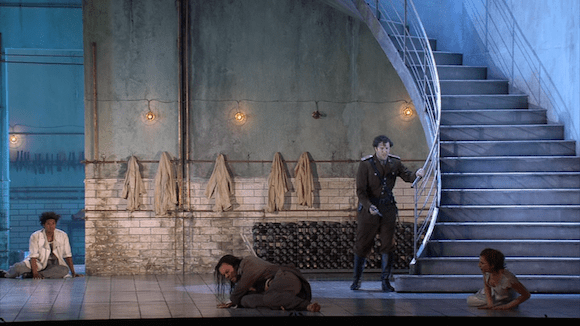
Strauss’ Salome is not for the faint hearted. It contains perversions including, but not limited to, necrophilia, paedophilia and incest. I think this makes David McVicar an obvious choice as director. In fact, by McVicar standards, this 2008 Covent Garden production is fairly restrained and straightforward. McVicar gves the work a 1930s setting which works just fine. The action evolves on a rather elegant two level set; upstairs is Herod’s banquet and downstairs is a sort of guardroom including Jokanaan’s cistern. It’s all quite elegant in light blues and greys and essentially all the action takes place downstairs. There are a few supers including a naked woman and another not far off floating around for no apparent reason except perhaps to suggest that the Judean army is not the Brigade of Guards.

1.beginning

Continue reading

Roberto Devereux

Donizetti’s Roberto Devereux is based (even more loosely than most Donizetti historical operas) on the relationship between Elizabeth the First and the Earl of Essex. Unfortunately for Liz, Essex is in love with the wife of the queen’s bestie; the entirely fictional Sarah, Duchess of Nottingham, whose ducal husband is also Essex’ bestie. Got that? As the opera opens, Essex has been recalled from Ireland to face treason charges but is vigorously defended by Nottingham. Eventually the queen rumbles Essex and agrees to sign his death warrant. By now Nottingham has also figured out what is going on and ties up his wife to stop her delivering the token ring to Elizabeth that will force her to pardon Essex. Essex is executed and the queen goes mad, abdicating in favour of James VI and I (who has been hanging around all along) and then dropping dead from grief. Pretty much par for the Donizetti course really.

1.papers

Continue reading

Orphée et Eurydice – Gardiner DVD

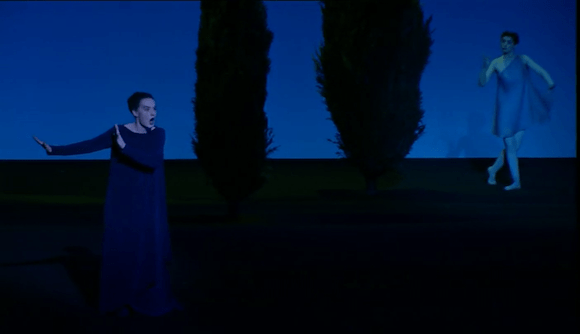
John Eliot Gardiner chose to videorecord the French version of Gluck’s Orphée et Eurydice at the Théâtre Musical de Paris – Châtelet. Choosing the French version is consistent with Gardiner’s other Gluck recordings. The Paris cast is a bit less starry than his Lyon CD version but more than adequate. Orphée is sung by mezzo Magdalena Kozena, Eurydice by Madeline Bender and Amour by Patricia Petitbon. Gardiner uses his usual forces for chorus and orchestra; the Monteverdi Choir and the Orchestre Révolutionnaire et Romantique. Choreography is by Giuseppe Frigeni, stage direction by Robert Wilson and video direction by Brian Large. The DVD is on EMI, has 16:9 video and Dolby 2.0 sound. It was recorded in 2000.

orphchat1

Continue reading