Midnight Marschallin

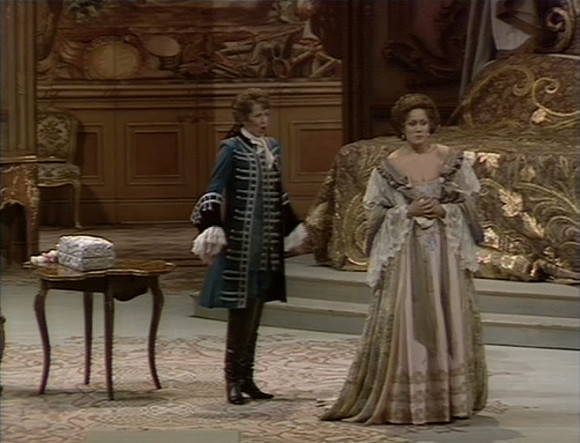
In 1985 the Royal Opera House staged film director john Schlesinger’s production of Der Rosenkavalier to mark the 25th anniversary of Sir Georg Solti’s house debut.  It’s an essentially traditional production.  We are in 1740s Vienna and both costumes and set are highly elaborate.  The opening scene stars one of the largest beds ever seen on an opera stage.  That said, it’s well put together.  The chemistry between the principals is good and the nonsense at the beginning of Act 3 is deftly handled.  There are a number of small touches that help set the tone too.  For example, at the beginning of Act 2 fake books are being installed in the Faninal “library”.

1.marschallin and octavian Continue reading

traviata et nous

traviata et nous is a documentary by Philippe Béziat about the creation of the 2011 Aix Festival production of Verdi’s La Traviata.  The stars are stage director Jean-François Sivadier and his leading lady, Natalie Dessay.  It’s two hours long and is much more insightful than the average “making of” bonus feature.  This really gets inside the heads of the director and the performers (we see a fair bit of Charles Castronovo and Ludovic Tézier as well as Dessay) as they begin to understand and then elaborate on the director’s ideas.  Dessay comes across, as one would expect from her performances, as an exceptionally intelligent, thoughtful and hard working person.  Sivadier too is très sympa; worlds removed from the caricature of a German Regie director ruthlessly imposing his ideas on libretto and performers alike.  I found it interesting that when Sivadier is working with Dessay or Tézier  French is spoken but at pretty much all other times the working language, even in a French house like Aix, is English.

1.natalie Continue reading

Up close with Aschenbach

Death in Venice is a curious opera.  Based on a Thomas Mann novella, it concerns the aging writer Gustav von Aschenbch and his meditations on aging and art, as well as his obsession with a Polish boy encountered at his Venice hotel.  Very little actually happens.  Aschenbach has a series of encounters with quotidien characters such as the hotel manager and a hairdresser but mostly he observes and what we hear are a series of inner monologues.  To work as theatre Aschenbach must capture our interest and our sympathy.  If he doesn’t the piece can be incredibly boring and irritating.

1.aschenbach Continue reading

Where gay hussars are found

OK I’m not going to pretend that Johann Strauss’ Der Zigeunerbaron is profound or anything but it is kind of fun, especially when given the no holds barred Mörbisch Seefestspiele treatment.  It’s a tale of mistaken identity and romance with some silly humour thrown in and lots of gypsies (complete with obligatory anvil chorus) and a hidden treasure.  Heinz Marecek’s 2000 production is old fashioned spectacular with scads of dancers, galloping hussars and rather outlandish costumes all set on the large Mörbisch island stage and complete with a noisy and spectacular firework display at the start of Act 3.  There are bonus pigs.

1.gypsy Continue reading

Never mind the murder; that’s a detail

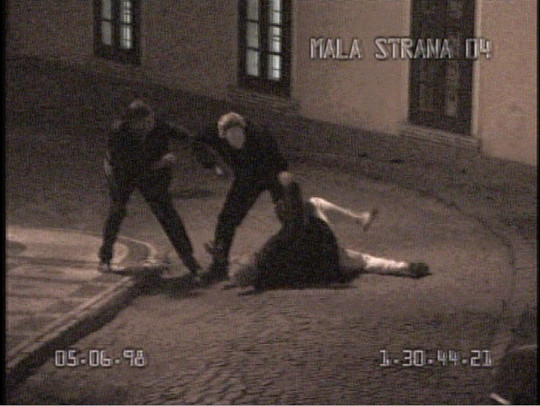
The Real Don Giovanni is an extremely quirky 1998 docu-drama starring Sir Thomas Allen.  It’s set during a work when he is singing the Don at the Stavovské divadlo; site of the opera’s 1787 premier.  He’s also investigating his theory that Don Giovanni was based on Giacomo Casanova who was, indeed, he claims, much involved in the creation of the opera.  He pursues his research in various archives, including Duchkov Castle, ladies’ bedrooms and through an interesting encounter with two tarts in a graveyard..

1.murder Continue reading

Girard’s Parsifal on Blu-ray

François Girard’s production of Parsifal at the Metropolitan Opera was much written about at the time of the HD broadcast in March 2013.  My review of that broadcast is here.I don’t think my opinion has changed very much.  It’s a powerful and intensely beautiful production and there are some wonderful performances, especially that of René Pape.  I’m not going to rehash the previous review but there were a few things I noticed second time around.  In Act 1, for instance, the gendering of the scene is mirrored in other ways to emphasize the polarity.  The knights are in white, the women in black.  The men are in orderly circles, the women are just a crowd.  Also the final scene is almost overwhelmingly intense.  Kaufmann sings quite beautifully with fine diction, gravitas and simply gorgeous high notes.  Pape caps off a performance of great pathpos and humanity with the gentle gesture with which he closes Kundry’s eyes in death.  It’s compelling stuff.

1.rings Continue reading

Gluck à l’outrance

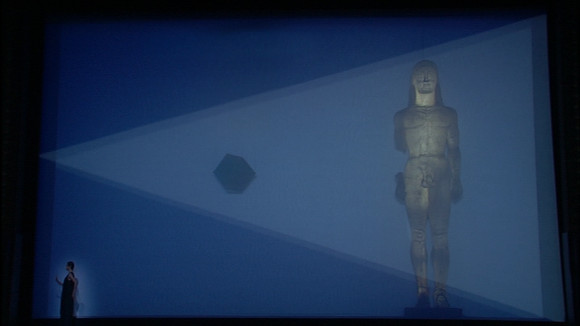
Gluck’s Alceste is not as well known as Orfeo ed Eurydice or the Iphigénie operas but in some ways it’s an even better example of what Gluck meant by “reform”.  It’s simple, restrained and elegant.  The plot has some similarities with Orfeo.  The good king of Thessaly, Admète, is doomed to die unless someone else volunteers in his place.  Naturally enough, this being opera, his wife Alceste volunteers.  There is much dignified lamenting.  She descends to Hades.  Husband and wife reproach each other for their selfishness in being the one to die.  Hercules shows up and, in gratitude for earlier hospitality, saves the day.  There is (dignified) rejoicing.  It;s an easy score to listen to with plenty of good tunes but no blockbuster, memorable, numbers.

1.statue Continue reading

Curiously aloof Tristan

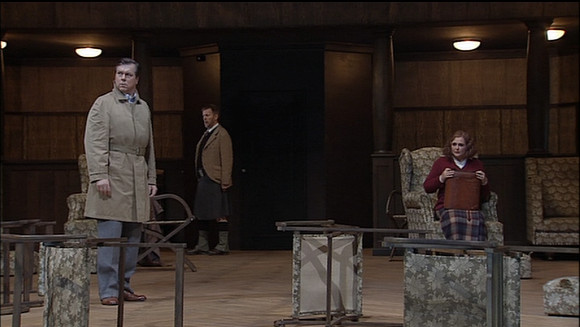
Christoph Marthaler’s 2009 Bayreuth production of Tristan und Isolde is set in a sort of Stalinist brutalist aesthetic populated with stock figures from the 1950s.  Passion is at a minimum and the characters all seem to be trying as hard as possible to be conventional representatives of their roles.  The only one who shows any real human engagement is Kurwenal who comes across almost as a commentator on the action, or even a director.  There’s also some fairly stylized gesturing in a sort of pseudo-Sellars manner.  It’s epitomised by the costumes in Act 2 where Isolde and Brangäne look like dolls dressed as Hausfraus and Tristan wears a hideous blue blazer.  This is all rather reinforced by Michael Beyer’s video direction which uses a lot of close ups but also has a curious stillness about it that seems to amplify the emotional void; if indeed one can amplify a void.  Oddly though, in places this approach really works in that the distance, coupled with very precise blocking, gives space for the music’s essential intensity to come through.  Act 2 Scene 2, perhaps the emotional crux of the piece, is very moving and the So stürben wir, um ungetrennt is quite impressive.

1.chairs Continue reading

In the summer of seventeen hundred and ninety seven

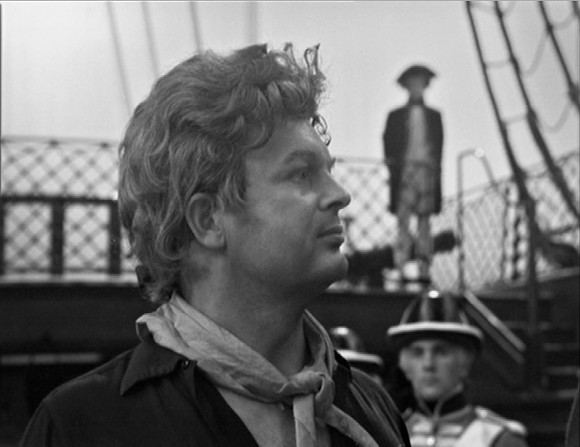
Billy Budd is the second of Britten’s large scale operas.  Originally envisaged as a four act piece with prologue and epilogue it was later reorganised into two acts and that’s the version the BBC recorded and broadcast in 1966.  That broadcast has now been released on DVD.  Technically it shows it’s age.  The picture is 4:3 black and white though there’s a remastered, and very decent, LPCM mono sound track.  There’s also an enhanced Dolby mono track.  The video too has been restored and looks pretty decent.

1.billy Continue reading

Cecilia and Bryn

Cecilia and Bryn at Glyndebourne is the DVD recording of a concert from 1999 featuring two of those singers who prove you don’t have to be dead skinny to be a great singer and have a commanding stage presence.  It’s great fun, focussing on the lighter end of the repertoire for the most part.  It’s mostly Mozart with some Rossini, Donizetti, Haydn and Handel thrown in.  There are a couple of overtures and a few arias but the greatest pleasure comes in the duets.  For the second time in a week I got to see Lá ci darem la mano sung by singers of extremely contrasting heights and where else is one going to see Mr. Terfel and Ms. Bartoli sing the Pa-pa-pa-pa duet from Die Zauberflöte.  As ever Ceci’s coloratura is a thing of wonder and Bryn is no slouch.  The accompaniment is ably provided by Myung-Whun Chung and the London Philharmonic.  It’s the perfect antidote to a week of watching Wozzeck.

1.hat Continue reading