Alfano’s Sakùntala

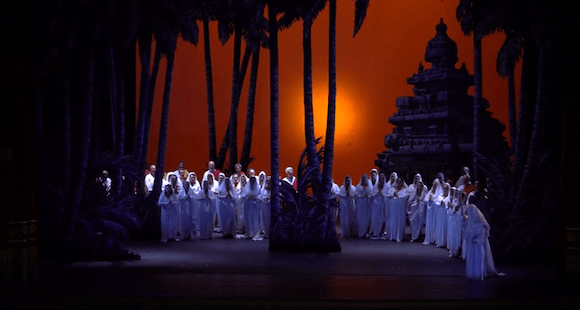
Alfano is probably best known for his completion of the third act of Puccini’s Turandot or maybe for his Cyrano de Bergerac but he did write other operas including Sakùntala, which Fritz Reiner described as “the Italian Parsifal“.  I don’t know why as, apart from having a religious/mythological theme, they aren’t very similar at all.

1.trees Continue reading

Brisk and attractive Figaro

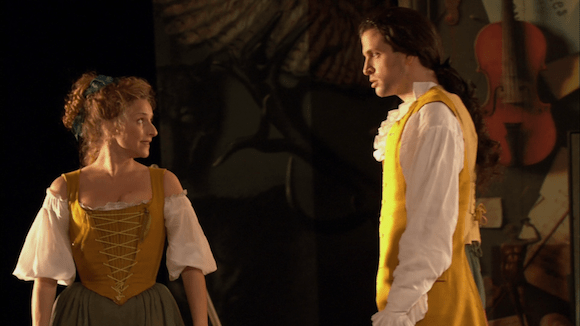
This recording of Mozart’s Le nozze di Figaro was made in 2004 and released on DVD, which won a Grammy.  It’s now been remastered and released on Blu-ray.  It was recorded at the Théâtre des Champs Elysées in Paris and directed by Jean-Louis Martinoty.  The production is visually attractive and well thought out but not concept driven in any way.  The sets are largely made up of 16th century paintings while the costumes are the operatic version of the 17th or maybe 18th century; low necklines, full skirts, breeches etc.  There are a few interesting touches.  Act 3 is set in the count’s curio room with dead reptiles, skulls and so on and it seems somehow to provoke extreme nostalgia in the countess during Dove sono.  For the most part it’s a highly competent, well paced effort though with nothing new or different to say.

1.figarosusanna

Continue reading

Cavalli’s Elena

Cavalli is a rather neglected composer. Something like thirty of his operas exist but few are ever performed and only one, La Calisto, appears at all frequently. It’s hard to see why. He was Monteverdi’s pupil and a worthy successor whose work was decidedly popular in his lifetime. It’s even harder to see why a work like Elena could have been ignored for 350 years before being revived at the Aix en Provence Festival in 2013. It’s really got the same things going for it as Il coronazione di Poppea. There’s sex, homoeroticism, mythology, cross dressing, a weird (Shakespearean?) mix of the serious and the comic and some really lovely music. The only downside I can see is a rather convoluted plot and the fact that one of the leading roles was written for a high castrato.

1.prologue

Continue reading

If you are going to be crazy, do it properly

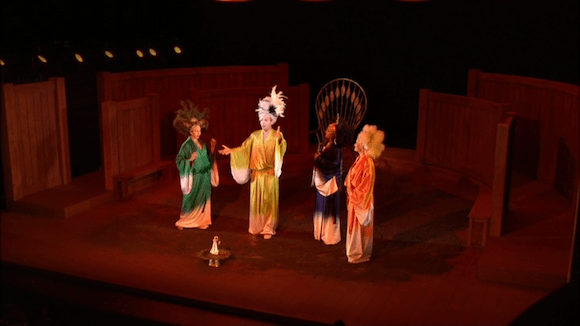
In 1884 Ludwig II of Bavaria put on a spectacular outdoor show for his guests at Herrenchiemsee.  It featured perhaps the first use of electric light outdoors in a spectacular lighting plot designed by Edison trained Alois Zettler.  That’s the jumping off point for Des Königs Zauberflöte.  So now imagine, as was not uncommon in the 19th century, that the aristocratic guests had decided to put on a spectacular amateur performance of Die Zauberflöte.  Ok, it’s not that probable that Emperor Franz Joseph and his wife, let alone Otto von Bismarck,would have performed but hang in there.  Now suppose, through some warp of time, space and imagination that the “real” Papageno had shown up and pointed out loudly, and at length, that’s not really what happened.  And so we get Enoch zu Guttenberg’s reimagining of Mozart and Schikaneder’s iconic work that played at Munich’s Prinzregententheater in 2013.

1.ladies

Continue reading

Rosmonda d’Inghilterra

One thing the Donizetti Festival in Bergamo is noted for is unarthing Donizetti rarities.  The 2016 edition was Rosmonda d’Inghilterra; a dramatically rather slight piece based on the story of Henry II’s mistress, generally known as “The Fair Rosamund”.  In the opera version Rosmonda is locked up in a tower by her lover Edegardo who has promised to marry her except he’s really Henry II (Enrico) and Leonora (Eleanor of Aquitaine) is going to have something to say about that. Complicating matters; Enrico’s page Arturo is in love with Rosmonda and her dad, Clifford, is the king’s principal counsellor and not at all happy about his daughter carrying on with a married man.   Clifford’s plan to save the family’s honour is to have Arturo take Rosmonda off to Aquitaine and marry her.  Rosmonda’s is to retire to a convent (as, apparently, the historical Rosamund did) . Enrico’s is to divorce Leonora (given Enrico’s problems with the church this seems highly implausible but, hey, bel canto) and make Rosmonda his queen.  Leonora isn’t having any of this and shows up at the tower and kills Rosmonda.  Finito.  Along the way there’s lots of very workmanlike Donizetti music which sounds pretty much like most Donizetti operas.

1.leonoraarturo

Continue reading

The Dark and the Light

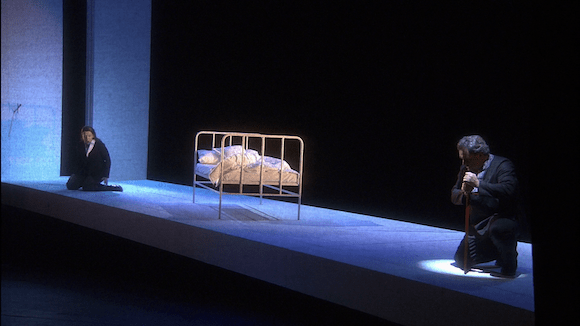
David Pountney is rarely afraid of taking risks in pursuit of an idea and that seems to be what’s going on in his 2008 Wiener Staatsoper production of Verdi’s La forza del destino.  The basic concept seems to be to draw as much distinction as possible between the piece’s predominantly dark tone while making the ‘scherzo’ like elements as mad as possible.  And occasionally mixing up the two to create deliberate confusion.  To this end he uses a lot of moving set elements and projections; often fuzzily superimposed on stage action.  Preziosilla and the camp followers are hot pants clad cowgirls.  The full effect is seen in the Act 3 “orgy” where hospital patients, some on drips etc, interact with cow girls and a marching band while giant fuzzy B&W projections of WW2 armour play on the scrim.  It’s really busy and takes some decoding.

1.bedroom

Continue reading

Europa Riconosciuta

It’s sometimes a bit of a mystery why some works disappear from the opera repertoire while other, not obviously superior, works enjoy lasting success so it’s always a pleasure to discover an obscure work that is really good (1).  Salieri’s Europa Riconosciuta fits that description in my view.  It’s basically an opera seria much along the lines of Mozart’s opere serie (opera serias? – who knows?(2)) except that there’s a longish ballet at the end of Act 1.  There are long, florid, arias with, for the two female leads, very high tessitura.  Two of the three male roles were written for castrati and the one intact male role is for that sort of heroic tenor who crops up in Idomeneo or La Clemenza di Tito.  It’s not as formulaic as works of 50 years earlier.  There are far more ensemble and choral numbers than in any of Handel’s Italian works.  It’s also just plain rather good.  Salieri understands singers and he writes really good melodies.  I guess he was just a bit unfortunate to have that pesky Salzburger as competition.

1.soldiers

Continue reading

Cogent Parsifal

Wagner’s Parsifal has been served rather well on Blu-ray and DVD in the last few years.  The 2016 Bayreuth recording is another interesting addition to the list.  Uwe Eric Laufenberg’s production is not exactly traditional but it’s not “in your face” conceptual either.  The setting is contemporary and various visual clues locate it where Europe meets Asia; perhaps the Southern Caucasus.  The grail temple is run down.  There are soldiers and refugees and tourists, as well as the Grail knights.  There’s plenty of Christian symbolism around.  The “swan scene” is played straight.  The “communion scene” uses Amfortas as the source of the communion blood; an idea which seems common enough.  Here he’s wearing a crown of thorns (and not much else) and there’s lots of blood.

1.swan

Continue reading

Alagna and Gheorghiu in L’elisir d’amore

Shortly after their marriage in 1996 Angela Gheorghiu and Roberto Alagna appeared together in Donizetti’s L’elisir d’amore at Opéra de Lyon.  At the time she was 31 and he was 33 so pretty much ideal for the roles.  The production was directed by Frank Dunlop.  It’s straightforward, set in the 1920s and essentially traditional though there are a few nice touches.  It’s what the recent COC production might have been if the asinine attempts to be “relevant” had been ditched.

1.village

Continue reading

Straightforward Otello from the Met

In 2015 the Metropolitan Opera premiered a new production of Verdi’s Otello directed by Bartlett Sher.  It was broadcast in the Met in HD series and subsequently released on Blu-ray and DVD.  It’s a bit hard to judge the production on video because of the video direction.  I don’t think there are any big ideas but it’s decorative enough with arrangements and rearrangements of plexiglass wall/rooms and some effective video projections for things like the storm scene.  Only Act 4 breaks the mould with a sparse stage with just a bed and a few chairs.  I strongly suspect though from the occasional wide angle shot that there was a lot more going on visually than one sees on the video.  Costumes are 19th centuryish and quite decorative.

1.storm

Continue reading