 Massenet’s Grisélidis gets the Bru-Zane treatment. Review at La Scena Musicale.
Catalogue information: Bru Zane BZ105

Massenet’s Grisélidis gets the Bru-Zane treatment. Review at La Scena Musicale.
Catalogue information: Bru Zane BZ105
 The latest CD from the Toronto Symphony and Gustavo Gimeno features two works by Stravinsky and a Glenn Gould inspired piece by Kelly-Marie Murphy. The first piece is the 24 minute long suite from the ballet Le baiser de la fée which is a sort of pastiche of what Tchaikovsky might sound like if Tchaikovsky could orchestrate as well as Stravinsky! It’s well played but I don’t find it terribly exciting.
Murphy’s piece is another story. There’s a running joke about short pieces by contemporary composers at the TSO. They get called “garage pieces” because they get played at the beginning of concerts when half the patrons are still on their way up from parking. Murphy’s Curiosity, Genius and the Search for Petula Clark absolutely does not deserve the label. It was inspired by a road trip Glenn Gould took up north one time and it’s fascinating. There’s a restless energy to it and a kind of flirting with atonality coupled with lyricism and a lot of percussion. It’s kind of like a feral love child of Holst’s Mars; Bringer of War and a Shostakovich symphony crammed into ten minutes. Continue reading
 Olivier Py directed a production of Stravinsky’s Le Rossignol at the Théâtre des Champs Élysées in 2023 and a live recording was made for CD. The Nightingale is sung by soprano Sabine Devieilhe and she is very good indeed. She has pretty much the perfect voice for this role with its coloratura sections and very high tessitura. Her voice sounds suitably sweet all the way up and her coloratura is very precise. She’s very well backed up by an all French cast featuring the excellent tenor Cyrille Dubois as the Fisherman and the unmistakable Laurent Naouri as the Chamberlain. Jean-Sébastien Bou also impresses as a suitably tremulous Emperor and there’s a nice cameo from Chantal Santon Jeffery as the Cook. The minor roles are all well sung and French diction is notably good across the board. Continue reading
 Elgar’s The Dream of Gerontius is very well served on record but a new version with good soloists may still be worth a look. And there is a new one on the Ondine label featuring Christine Rice, John Findon and Rod Williams. There’s a rather staggering collection of choirs; the Helsinki Music Centre Choir, the Cambridge University Symphony Chorus, Dominante | Helsinki Chamber Choir and the
Alumni of the Choir of Clare College, Cambridge. All this plus the Finnish Radio Symphony Orchestra and conductor Nicholas Collon. Continue reading
 Uncharted is a new CD from countertenor Aryeh Nussbaum Cohen and pianist John Churchwell. It appears to be the first time a countertenor has recorded a disc of classic German Lieder which is interestig and perhaps surprising. There are three sets on the record. It starts with Korngold’s Lieder des Abschieds Op. 14; four songs I was previously unfamiliar with but I’m glad to have heard them. The second set alternates mostly well known songs by Brahms and Clara Schumann and the last set is Robert Schumann’s Liederkreis Op. 39 with, appropriately, his “Der Nussbaum” to wrap things up. Continue reading
 More Rivers is a CD of piano music by Frank Horvat played by Christina Petrowska Quilico. It’s a sort of sequel to Rivers a record of music by Ann Southam, released on Centrediscs in 2005. It’s a set of seven pieces of various lengths. “More Rvers 1 – for Ann” is the last piece on the album but it’s the longest piece of the set and sets up in various ways the others. The music is a kind of looping minimalism but with quite a lot of harmonic complexity. Different rhythms and speeds are encountered. As Frank says in the notes “some rivers are long, some are short, some have rapids, and some have calm water”. But all but the most benighted rivers flow and these pieces evoke natural streams; clean, pure and life giving. Played with great virtuosity, discipline and control by Christina it’s a very pleasant way to spend 65 minutes. Continue reading
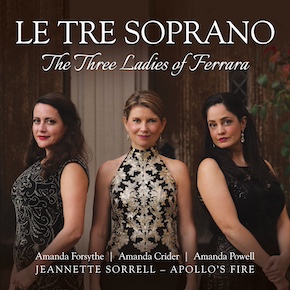 Le Tre Soprano is an intriguing album based on the careers of the Three Ladies of Ferrara; three virtuosi who served as Ladies in Waiting to the young Duchess of Ferrara in the late 16th century and became sufficiently renowned as musicians that Tasso wrote poems about them and Monteverdi, Strossi and others wrote music for them.
The music on the album is all from that period, so it often sounds surprisingly “modern”.. It’s quite varied musically and very well performed by three excellent singers; sopranos Amanda Forsythe and Amanda Powell and mezzo Amanda Crider along with members of the American period ensemble Apollo’s Fire and their leader Jeannette Sorrell who is also responsible for the arrangements. The band consists of Francisco Fullana and Emi Tanabe – violin, Andrew Fouts – violin and viola, René Schiffer – cello, William Simms and Brian Kay – archlute, theorbo, and guitar, Parker Ramsay – baroque triple harp and Anthony Taddeo – percussion with Sorrell on keyboards.
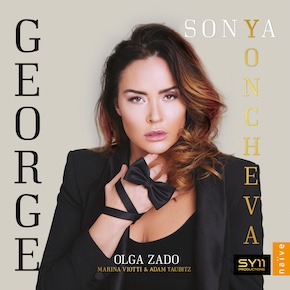 George is a new CD from soprano Sonya Yoncheva and friends made up of music George Sand would have listened to and some readings fro her works. There’s a particular emphasis on Pauline Viardot; close friend of Sand and sister of Maria Malibran.
The music includes Chopin piano pieces played by Olga Zado, who also accompanies the songs. His Casta diva, based on the Bellini aria, is particularly interesting. There are songs by Leoncavallo, Delibes, Offenbach, Tosti and Liszt as well as piano music and songs by Viardot. On two of the songs Yoncheva is accompanied by mezzo Marina Viotti and Zado is joined by violinist Adam Taubitz for a Viardot Romance.
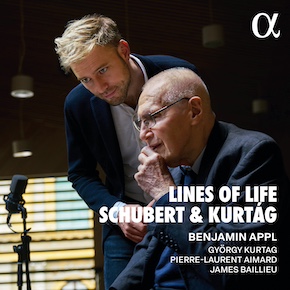 Lines of Life is a CD produced out of a deep collaboration between German baritone Benjamin Appl and Hungarian composer György Kurtág. It’s a mixture of works by Schubert and Kurtág (with one song by Brahms at the end). It centers on Kurtág’s Hölderlin-Gesänge Op.35a but there are other Kurtág works on the disk too, Most of these are sung a capella but there are four settings of texts by Ulrike Schuster that have piano accompaniment (Pierre-Laurent Aimard). The Schubert songs feature James Baillieu on piano except for the last one, and the Brahms, where Kurtág himself accompanies. Continue reading
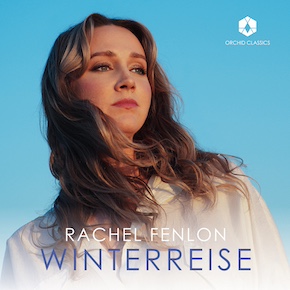 Rachel Fenlon is a very rare, perhaps unique, talent. She’s the only Lieder singer I know who accompanies herself on the piano. I saw her perform live in Toronto back in 2018. It appears she spent lockdown isolated in a forest near Berlin studying Winterreise (as opposed to be eaten by goblins or kidnapped by elf kings) which she has now recorded. Many people would consider Winterreise as one of the epic challenges of the Lieder repertoire. It’s an hour and a quarter of songs that cover pretty much the whole technical and emotional range of Schubert’s Lieder. One might say the Everest of Lieder singing. To perform it self accompanied is kind of the equivalent of climbing solo without oxygen instead of with a bunch of mates and Sherpas to carry the gear. By that token perhaps we should consider Rachel the Reinhold Messner of Lieder singers!
 operaramblings