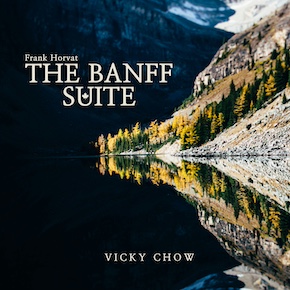
 Frank Horvat’s Banff Suite is a series of piano pieces inspired by hiking the trails around Banff. Full review at La Scena Musicale.
Banff Suite
Reply

Frank Horvat’s Banff Suite is a series of piano pieces inspired by hiking the trails around Banff. Full review at La Scena Musicale.
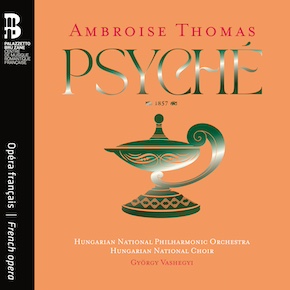 Ambroise Thomas’ Psyché is yet another more or less forgotten French opera rescued from obscurity by the Bru Zane label. Canadian Hélène Guilmette sings the title role. Full review at Opera Canada.
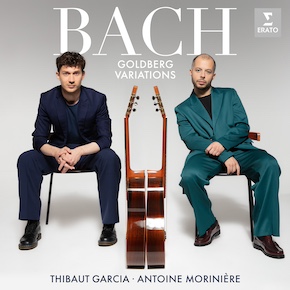 One tree, two guitars, one sound. This was the creative mission for Hugo Cuvilliez, guitar-maker and wood-whisperer from the Drôme region of south-eastern France: to honour the essence of a partnership with the sonic unity of one and the same instrument.
This was the vision of Thibault Garcia and Antoine Morinière; guitarists at the Paris Conservatory. The goal, to create a version of Bach’s Goldberg Variations in which each guitarist becomes one hand of the keyboard. Each on a sonically identical instrument. It’s fascinating because it’s close to, but not exactly like, the piece played on a harpsichord. And it is beautifully played.
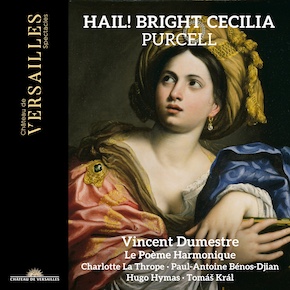 Château de Versailles Spectacles have produced a really classy period instruments recording of Purcell’s Hail! Bright Cecilia with a bonus of Blow’s Welcome Every Guest. The band s La Poème Harmonique under the direction of their founder Vincent Dumestre. It’s a very authentic period sound and the small chorus is precise and sings in excellent English.
The Blow piece is short but but interesting and it gets a sprightly and almost jazzy reading. Both baritone Tomáš Král and teHugo Hymas are excellent and have perfect English, “The sacred Nine” is particularly enjoyable.
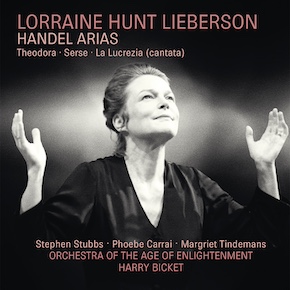 In 2003, in conjunction of a revival of Peter Sellars’production of Handel’s Theodora at Glyndebourne ,Lorraine Hunt-Lieberson went into the studio and recorded a Handel album with Harry Bicket and the Orchestra of the Age of Enlightenment. That album was released to great acclaim in 2004. It’s now been remastered and the new version will be available on October 17th.
The album contains all of Irene’s music from Theodora including superb versions of “As with rosy steps the morn” and “Lord, to Thee, each night and day”. There’s also the cantata Lucrezia where she is accompanied by Harry Bicket on harpsichord & chamber organ, Stephen Stubbs on 10-course lute and Baroque guitar, Phoebe Carrai on cello and Margriet Tindemans on viola da gamba. There are also two arias from Serse; “Se bramate d’amar, chi vi sdegna” and “Ombra mai fu”. Continue reading
 My review of the Château de Versailles Spectacles recording of Rameau’s Pygmalion and Iso’s Zémide featuring, among others, Ema Nikolovska is now up at Opera Canada.
 Songs of Passion is a new recording from mezzo-soprano Lea Desandre with the Jupiter Vocal and Instrumental Ensemble and their director and lutenist Thomas Dunford. It’s ninety minutes of music by John Dowland and Henry Purcell arranged for various combinations of voices plus the instruments; violins, viola, double bass, viola da gamba, recorders, lute, harpsichord and organ. They are interesting and varied arrangements and suit the range of emotions of the music well. Continue reading
 My review of Andrew Staniland’s highly experimental The Laws of Nature is now available at La Scena Musicale.
 My review of Il Pomo d’Oro’s CD of Purcell’s Dido and Aeneas with Joyce DiDonato as the Queen of Carthage is now available at La Scena Musicale.
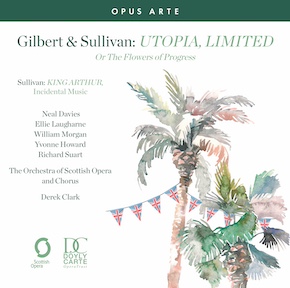 I was curious about Scottish Opera’s new recording of Gilbert and Sullivan’s Utopia, Limited because it’s a G&S I’ve not heard before. It’s a late work and was less successful than its better known predecessors. The plot concerns an island in the “South Seas” where the king is so taken with all things English that he sends his daughter to Cambridge and has her return with a bevy of English worthies including Captain Joseph Corcoran KCB. Eventually the king enacts all kinds of reforms including turning the entire population into limited liability companies. They revolt but the day is saved by Princess Zara pointing out that with party government all the reforms will inevitably be repealed after the next election. Continue reading
 operaramblings