John Terauds is promoting what sounds like a really worthwhile event; a “pop up concert” for Toronto Composer Nic Gotham. You can find John’s post here.
Reblog
Reply


John Terauds is promoting what sounds like a really worthwhile event; a “pop up concert” for Toronto Composer Nic Gotham. You can find John’s post here.
Last night saw the first concert of the Toronto Summer Music festival which runs at a variety of venues until August 3rd. The theme for the festival is Paris La Belle Époque and this was reflected in last night’s opening concert being given by the distinguished French trio Trio Pennetier Pasquier Pidoux. One might question though to what extent works written in 1914 and 1923 can be said to belong to the themed era. It didn’t seem to bother a packed Koerner Hall. The reception to all three pieces given was raucous.
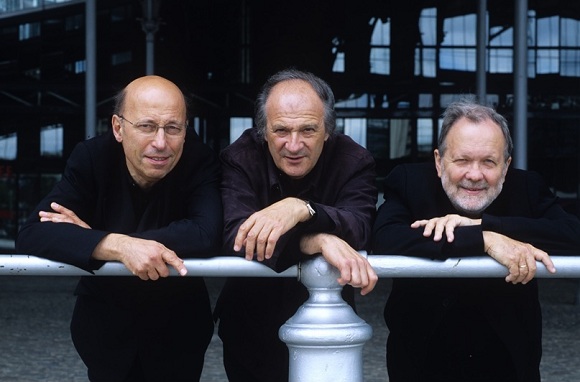
Trio Pennetier Pasquier Pidoux (From left to right:
Roland Pidoux, cello; Régis Pasquier, violin; and Jean-Claude
Photo credit: Guy Vivien
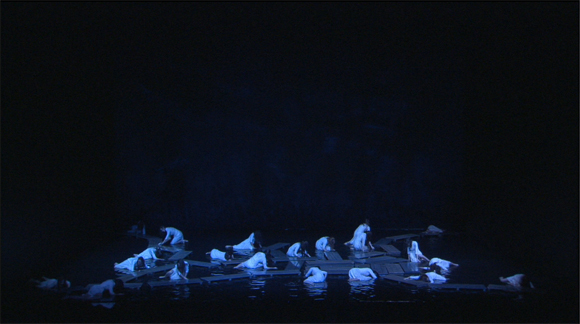
Robert Carsen’s producton of Janáček’s Kat’a Kabanová is typically simple and elegant. Recorded at the teatro Real in Madrid it features a flooded stage with a large number of wooden pieces, like palettes, that are rearranged to form the set. At the beginning of Act 1 the pieces form a pathway through the water simulating the banks of the Volga. Later they are rearranged int a square at centre stage to represent the claustrophobic Kabanov house. All this rearrangement is done by the ladies of the chorus who roll around in the water in white shifts. No breaks are needed between scenes, just the intermezzi the composer provided for the purpose. A mirror at the back of the stage reflecting the water and an elegant and effective lighting plot complete the staging.
 The Tcherniakov Don Giovanni that I just finished watching on Blu-ray is a Canadian Opera Company co-production so, sooner or later, it should end up in Toronto. That will be interesting. There’s a very conservative streak in the Toronto audience and, especially, among the critics for the major newspapers. These are people who are disturbed by Robert Carsen and go apopleptic over Chris Alden. It will be most interesting to see what the reaction is to something like Tcherniakov’s interpretation, even though it’s not that radical by European standards.
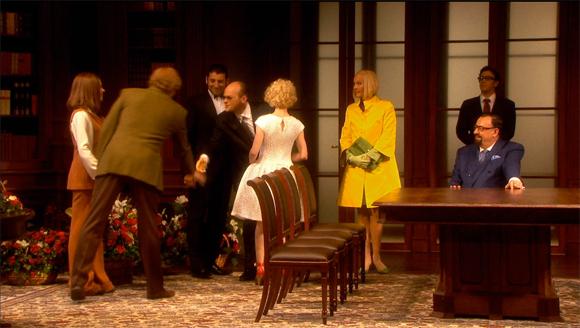
Dmitri Tcherniakov’s Don Giovanni recorded at the 2010 Aix-en-Provence festival is full on Regie. He takes the characters and story of Mozart/DaPonte and recasts them quite radically. Zerlina is Donna Anna’s daughter. Donna Elvira, Donna Anna’s cousin, is married to Don Giovanni. Leporello is a family member too. The sense is of one extended, conventional, bourgeois family in which Don Giovanni is a fatally disruptive intrusion. Tcherniakov changes the time line too. Instead of taking place over a 24 hour period the story plays out over many weeks.
So, onto Siegfried. Now we are in 1968 but it’s a rather laid back Danish 1968. It doesn’t reference any of the canonical events of that momentous year though there is a bit of a youth vs experience vibe. Holten doesn’t let us forget that Siegfried is 18 and Stig Anderson, at 60, manages to pull off the look very well. James Johnson’s Wotan, on the other hand, is shown in decline; the elder statesman who can’t retire gracefully, like a Berlusconi or Murdoch. Mime is an ageing nobody hunched over his typewriter and still yearning for some “success”.
I’ve been looking really hard for a video recording of Tristan und Isolde that I felt I could recommend because, frankly, nothing is worse than a badly executed Tristan as those who suffered through the Met HD broadcast a few years ago will know. In the 2007 La Scala recording I have found one I feel confident about. Is it perfect? No. A perfect Tristan is probably beyond mere mortals. I’m never sure whether I find it more astonishing that anyone can sing this music or that a composer might have imagined that he could find people who could. That said, the La Scala recording is very close to an ideal Gesamtkunstwerk.
 There have been many histories of opera. Most of them focus on the development of the genre from primarily a musicological perspective. In The Gilded Age: A Social History of Opera Daniel Snowman does something different. He looks at opera as a social and commercial phenomenon. Taking a broad sweep from late 16th century Florence to the Met’s “Live in HD” broadcasts, he looks at who attended the opera, how much they paid and what they expected from the experience. He looks at the always vexed question of who subsidised the opera; for ticket sales have very rarely covered costs. He analyses the entrepreneurs and bureaucrats who ran the opera houses. Of course, he looks at singers; where they came from, how much power they had and how much they were paid. It’s an intriguing and comprehensive analysis well worth slogging through over 400 pages plus apparatus.

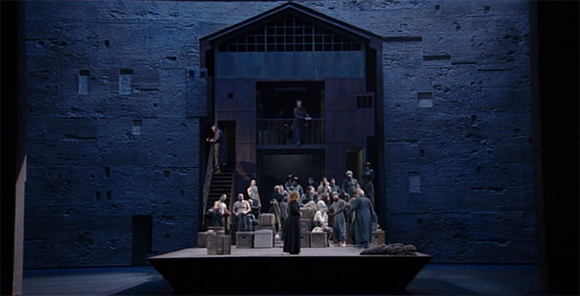
Calixto Bieito has a reputation as one of opera’s “bad boys” but there is nothing particularly shocking about his production of Carmen filmed at Barcelona’s Liceu in 2011. The action is updated to maybe the 1970s (there’s a phone box and a camera that uses film) and there are lots of cars on stage. For Bieito, this is a story of people living on the margins where sex is a commodity that women use as a trade currency and where violence, especially toward women, is endemic. It’s enough to disturb, as this piece did its original audience, without being gratuitous.