My review of Saturday’s opening night performance of La Traviata at the COC is now up at Bachtrack.

Photo credit: Michael Cooper


My review of Saturday’s opening night performance of La Traviata at the COC is now up at Bachtrack.
Photo credit: Michael Cooper
 It’s not much of a secret that I’m a bit fanatical about new opera. This year Tapestry has two really exciting looking premieres in Toronto. Later in the year there’s Brian Current’s Gould’s Wall which, as an ex climber, I just have to see but first, in fact coming up next month, is RUR: A Torrent of Light by Nicholas Billon and Nicole Lizée. It’s about robots and it’s a collaboration with OCAD U who are developing some way cool technology for the show. There’s now loads of really good preview material about the show on Tapestry’s Youtube channel. So I have two suggestions to make:
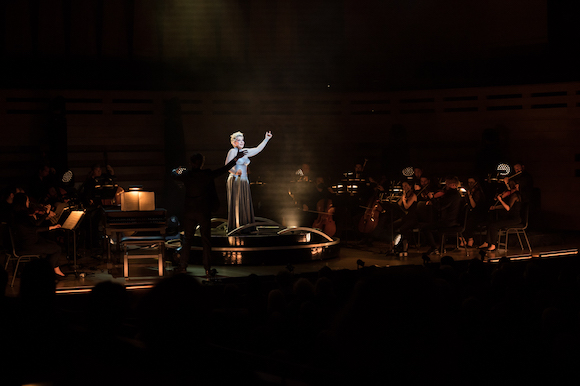
Last night Joyce DiDonato and il Pomo d’Oro brought their touring show Eden to Koerner Hall. It’s one of those genre defying shows that’s not especially easy to describe. Basically it’s a recital of art songs and arias; most of the latter from the 18th century, with chamber orchestra accompaniment. It’s also staged but not with any obvious narrative. Rather Joyce interacts with two very large metal hoops which move around and rotate on their axes. All of this is backed up by John Torres’ complex and sometimes spectacular lighting plot. Cynics might call it gimmicky but given the difficulty of building the audience for vocal recitals I’m all for trying new things and the audience loved it so I think that’s justification enough.
There’s a fair number of shows appearing at fairly short notice as people scramble to adapt to relaxing regulations so this post will contain events for April not previously noted plus a look forward to May.
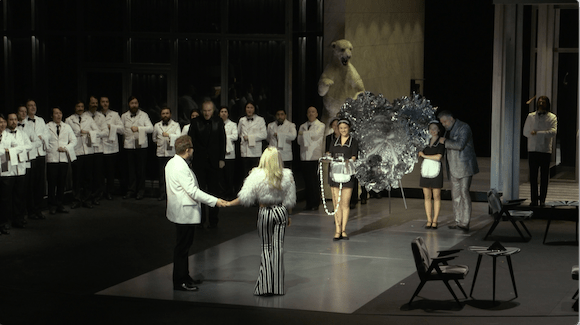
Stanisław Moniuszko’s Halka is sometimes regarded as Poland’s national opera. It’s one of those mid 19th century works that tries to create some kind of national idiom broadly within the framework of the musical style of the age (the composer was conservatory trained in Berlin). It’s really quite good but rarely performed outside Poland so it’s interesting to look at it, especially in a rather good production by Mariusz Treliński that was given and recorded at Theater an der Wien in 2019.
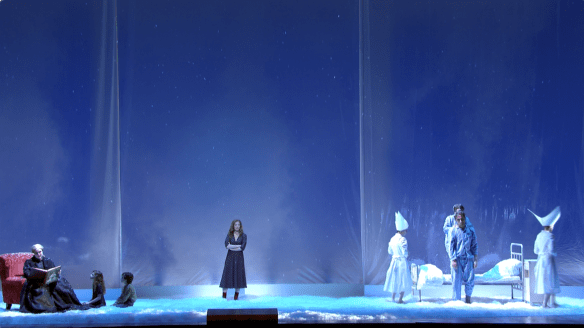
As written, Hans Abrahamsen’s The Snow Queen is a fairly dark piece that cleaves pretty closely to the original Hans Christian Andersen story. The production at the Bayerische Staatsoper (in an English version adapted by Amanda Holden from the original Danish) and recorded in Munich in 2019 takes it to a new level of complexity and darkness. Director Andreas Kriegenburg has added additional avatars of the children Gerda and Kay to the scene creating three Gerda/Kay pairings. There are the children as children played by actors. There’s an adolescent pair played by mezzo-soprano Rachael Wilson as Kay and an actor, Anna Ressel, as adolescent Gerda and a forty-something couple played by soprano Barbara Hannigan as Gerda and actor Thomas Graßle as Kay.
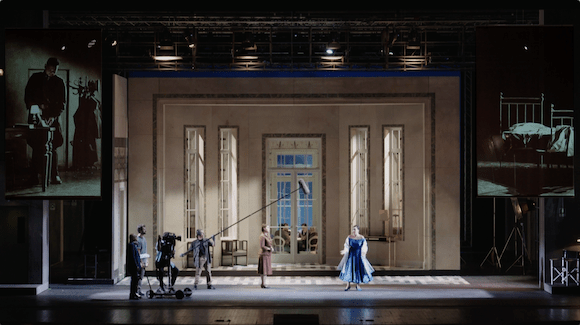
I’m really not sure what to make of the recent recording of Giodarno’s Siberia made at the Maggi Musicale Fiorentino in 2021. It’s certainly a rather weird experience. It’s partly that it’s a bit of an oddball of an opera, partly Roberto Andò’s production and partly that it was recorded under COVID conditions with the chorus masked and blocking that seems, if rather inconsistently, to be designed for social distancing.
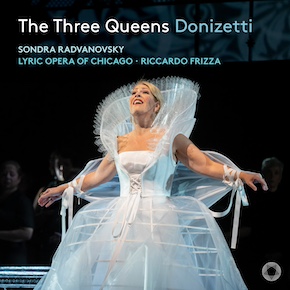 Donizetti’s three “Tudor Queen” operas; Anna Bolena, Maria Stuarda and Roberto Devereux (of which, despite the title, the real star is Elizabeth I) are often seen as a sort of trilogy and have occasionally been performed as such with a single soprano starring in all three. It’s a feat Sondra Radvanovsky managed at the Metropolitan Opera in the 2015/16 season. It’s not particularly surprising then that she should have been sought after by Lyric Opera of Chicago to star in a show featuring the final scenes of each opera which was recorded live at the Lyric in December 2019. Continue reading
 The latest release in the CD/book series from the Palazetto Bru Zane is Saint-Saëns’s 1893 opéra comique, Phryné, loosely based on an incident in the life of the famous 4th century BCE courtesan. It’s a two-act piece lasting about 65 minutes. The original was given with spoken dialogue, but as so often with this genre, recitatives (here added by André Messager in 1896) have been used in this recording, as they were in most contemporary performances.
The plot is straightforward enough. Dicéphile is a rather pompous magistrate and has just been honoured by the city with a bust. His nephew/ward Nicias is in love with Phryné, but also broke and about to be arrested for debt. With the help of Phryné’s servants, he beats up the officials sent to arrest him and hides in her house, where, after the usual confusion, she admits to being in love with him. Dicéphile shows up to find that his bust has been disfigured with a wineskin and remonstrates with Phryné, who quickly changes the subject to her upcoming trial on a charge of impiety. Dicéphile is overcome by her (obvious) charms and agrees to drop the charges. He also agrees to share his fortune with Nicias and all live happily ever after. Continue reading
 My review of Sunday’s performance of Samuel Barber’s Vanessa is now up at Opera Canada.
 operaramblings