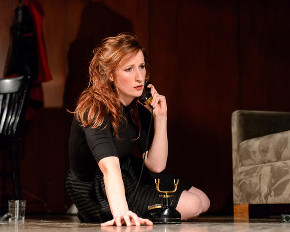
It’s another pretty busy week. There are two student shows today, both free. At 2.30pm in the MacMillan Theatre there’s a performance of a new opera based on EM Forster’s The Machine Stops. It’s by Patrick McGraw, Robert Taylor and Steven Webb. Sandra Horst conducts and Michael Albano directs. Then at 8pm in Mazzoleni Hall, Christina Campsall is performing Poulenc’s La Voix Humaine with Brahm Goldhammer providing piano accompaniment.
Tag Archives: tso
Requiem come to life?
Joel Ivany’s much anticipated “semi-staged” version of Mozart’s Requiem K. 626 finally saw the light yesterday evening at Roy Thomson Hall. There were some interesting ideas but, ultimately, I didn’t think I came away with any new insight into the piece or life or death or anything really(*). I’ll go into the reasons but first I should describe how it was performed. The mass is prefaced by the slow movement from the Clarinet Quintet. The lights go down. The five players enter via the aisles in the audience lower level and take their seats (sadly to applause which we had been asked to refrain from). As the quintet is played (and it was very beautiful) the players are joined by the rest of the orchestra, the choirs, conductor and soloists enter through the audience and from the wings and deposited slips of paper (I think) on two benches at front of stage left and right. Names of the dead? Probably and that’s a nice touch though scarcely original. The quintet concludes. More unwanted applause. At this point the orchestra are seated , more or less conventionally, around the conductor with the choirs around them. There are lots of fancy chairs. The soloists are more or less in conventional position in front of the audience. Everyone, except the mezzo and the soprano, are in black. The very crowded stage is quite dimly lit in bluish tones. As the mass progresses, the soloists interact in various ways. The choirs gesture in rather obvious ways; the text says “king” so we pump our fists, the text talks of “writing” so we make scribbly gestures. At some point the soloists start to rearrange the pieces of paper with the names of the dead in a sort of game of Dearly Departed Patience. The soloists exit through the orchestra. The lights go down. The End.

Heating up
Next week things get rather busy. There’s all the Hannigan shenanigans at UoT ; lecturing, masterclassing, concerting, walking on water, details here. There are a couple of lunchtime concerts in the RBA. Tuesday sees Gordon Bintner and Charles Sy perform Schumann’s Liederkreis and Britten’s Les Illuminations while on Thursday Jean-Philippe Fortier-Lazure appears with the members of the COC Orchestra Academy and their mentors.
Big, fat Messiah
Sir Andrew Davis is in town conducting his own orchestration of Handel’s Messiah. In the modern world this is probably as close as it gets to Sir Malcolm Sargent and the Huddersfield Choral Society. He conducts the TSO with brass and woodwinds that Handel never saw and lots of percussion including snare drum, sleigh bells, tambourines and marimba. He also has the not inconsiderable heft of the Toronto Mendelssohn Choir.

Mahler 4 at the TSO
Last night’s TSO concert was pretty satisfying. It kicked off with The Dance of the Seven Veils from Salome. I don’t think I’ve ever really listened to this without visuals before so that was interesting. I thought Michael Sanderling did a good job of maintaining clarity while building towards the big climax. For the rest of the program the orchestra was joined by Simone Osborne. We got some “lollipops” in the first half. The Song to the Moon from Rusalka, Depuis le jour from Louise and, unannounced, Vilja from The Merry Widow. Lovely singing, here sensitively accompanied by Sanderling and the orchestra. Simone was clearly audible throughout which doesn’t always happen at Roy Thomson Hall.
Second week of November
A bit of a lull this week with the COC fall season over and Yaksmas festivities still, mercifully, some time away. Still there are a couple of events of note. Simone Osborne is singing with the TSO at Roy Thomson Hall on Thursday and Saturday in a program of Mahler, Dvoràk, Charpentier and Strauss. There’s also the fall production from the Glenn Gould School. It’s a double bill of Xavier Montsalvatge’s Puss in Boots and Luciano Berio’s Folk Songs. Friday and Saturday at 7.30pm in Mazzoleni Hall.
Get your Messiah here
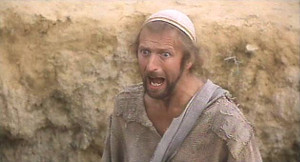
As Brian Cohen discovered picking a Messiah is a tricky business. So is picking a Messiah. As usual the winter solstice season in Toronto offers multiple options. The nearest thing to the John Barbirolli approach is the TSO at Roy Thomson Hall. This is your big, grand Messiah with famous soloists, modern instruments and a big chorus. This year, besides the perennial Toronto Mendelssohn Choir, there are soloists Erin Wall, Liz DeShong, Andrew Staples and John Relyea and, best of all, Andrew Davis conducts. This one is on December 15th, 16th, 18th and 19th at 8pm with a 3pm matinee on the 20th.
Upcoming events – mostly November
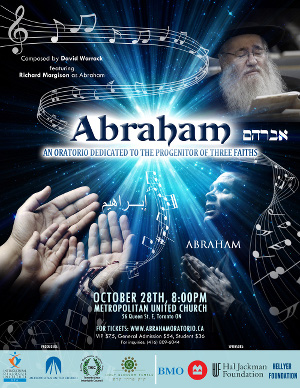
As ever there’s no shortage of announcements of new and interesting stuff in the Toronto area. Here are a few from the inbox. Next week, there’s a premiere of David Warrack’s oratorio Abraham. It’s a multi-faith event in aid of the Syrian Refugee Program at Metropolitan United Church. It’s on Wednesday, October 28th at 8 p.m. at Metropolitan United Church, 56 Queen Street East, Toronto. Richard Margison stars as Abraham and joining him are five principal vocalists; Ramona Carmelly, Meredith Hall, Hussein Janmohamed, George Krissa and Theresa Tova, three choirs: the Elmer Iseler Singers, the Jarrahi Sufi Choir with Whirling Dervishes,and the Bach Children’s Chorus David Warrack will be at the piano. Whirling Dervishes? Get in! It’s a good cause. General admission tickets are $54; $36 for students. $75 VIP tickets offer reserved seating and an invitation to the post-concert reception. Tickets and more information at www.abrahamoratorio.ca. Continue reading
The Hannigan show
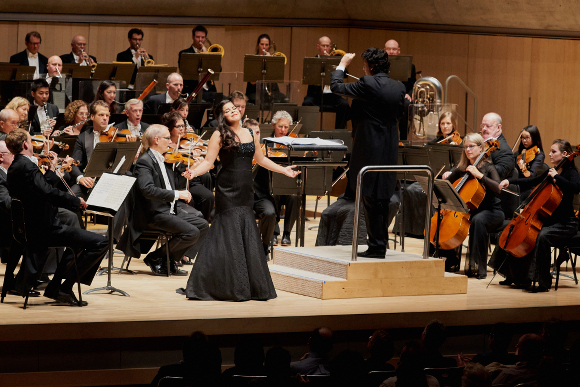
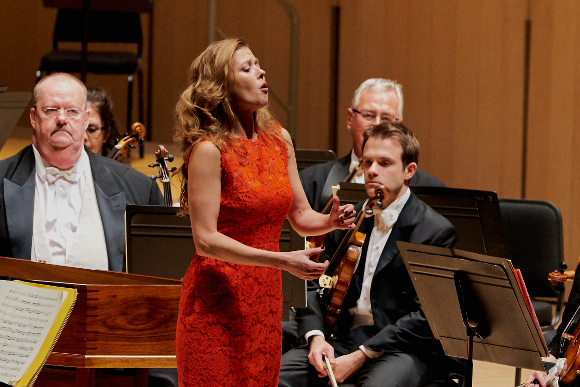
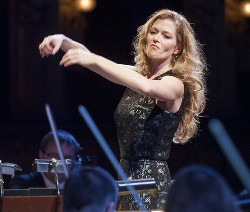
Last night at Roy Thomson Hall Barbara Hannigan made her North American conducting debut with the TSO. And, of course, she sang too. She kicked off with Luigi Nono’s Djamila Boupacha for solo voice. It’s a short but haunting piece inspired by a woman activist from the Algerian War. I don’t think I’ve ever heard a solo, unaccompanied, voice in that hall and the effect is eerie. It’s also a hell of a sing and to navigate it with utter precision is quite some feat. As the last note died away (precisely on pitch) the violins came in with the opening Haydn’s Symphony no. 49 “La Passione”. It starts off with an Adagio that’s curiously similar in mood to the Nono piece and Hannigan was conducting without score or baton. In fact it was more like an interpretive dance than conventional conducting. She has amazing arms and hands; the arms and hands of a ballerina in fact and as she summoned the strings to a sort of shimmering sound I couldn’t help but reminded of Swan Lake. Corny perhaps but very real and quite disturbing. And the orchestra, quite a small subset of the TSO, responded. This was four movements of really lovely, chamber music like playing.
Next week
There are a couple of biggies coming up next week. On October 7th and 8th the amazingly talented and apparently fearless Barbara Hannigan is singing with and conducting the TSO. For all I know she’ll be tap dancing and doing hand stands as well. It’s her conducting debut with this orchestra. The programme features works by Nono, Haydn, Mozart, Ligeti and Stravinsky. 8pm Roy Thomson Hall.