Where’s the Champagne?

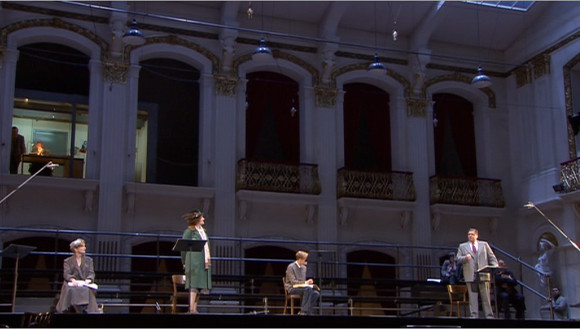
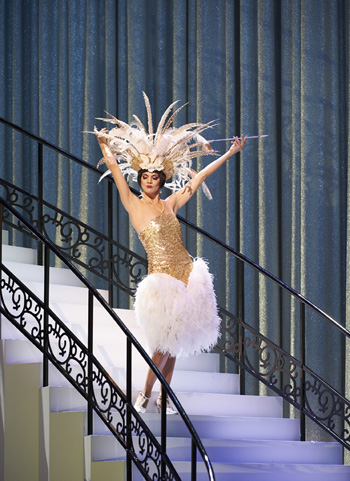
It’s really hard to know where to start with Hans Neuenfels’ Die Fledermaus.  It’s a prodcuction that enraged the more conventional patrons when it opened at the Salzburg Festival in 2001.  It even provoked a “false pretences” lawsuit!  There is so much going on that it almost seems to call for a catalogue raisonnée of the various scenes though one fears that would actually be both tedious and unhelpful.  Let’s try instead to explore it thematically.  Neuenfels takes very considerable liberties with the libretto.  A lot of dialogue is cut, a lot is added and numerous non-canonical characters are inserted.  That’s just a start.

1.nosejob Continue reading

Best of 2013

So what was I most impressed with on the opera and related scene in in 2013?

Big house opera

frau1The COC had a pretty good twelve months.  I enjoyed everything I saw except, maybe, Lucia di Lammermoor.  Making a choice between Christopher Alden’s probing La Clemenza di Tito, the searing opening night of Peter Sellars’ Tristan und Isolde; the night when I really “got” why people fly across oceans to see this piece, Robert Carsen’s spare and intensely moving Dialogues des Carmélites or Tony Dean Griffey’s intense and lyrical portrayal of the title character in Peter Grimes is beyond me.  So, I shall be intensely disloyal to my home company and name as my pick in this category the Metropolitan Opera’s production of Die Frau ohne Schatten.  Wernicke’s production is pure magic and Anna Schwanewilms was a revelation.

Continue reading

Die Frau ohne Geisterwelt

Christoph Loy, in his 2011 Salzburg production of Richard Strauss’ Die Frau ohne Schatten, avoids the problem of how to represent the Spirit World by essentially eliminating it.  Instead we get a Konzept based on Böhm’s first recording of the work in Vienna’s Sofiensalle in 1955.  Vienna is still recovering from the war and the hall is unheated and the singers unpaid.  The Empress is rising star Leonie Rysanek and the Nurse is long time favourite Elisabeth Höngen.  They represent the generations separated by the war.  The Emperor is an American singing in Europe for the first time and, crucially, Barak and his wife are a real life married couple.  Initially we see a lot of recording studio action as singers are moved about by actors in this experiment in early stereo.  Then the action, particularly the Barak/Wife interaction slips more and more off stage.  For the finale, we get a sort of celebratory concert in evening dress.  It’s not a bad concept and this cast handles it very well but I fancy it’s a tough introduction to this far from straightforward opera and it does lose the magic of the Spirit World. (In other words I’m glad I saw the Met production before this one.)

1.studio Continue reading

Die Frau ohne Schatten at the Met

We caught Richard Strauss’ Die Frau ohne Schatten at the Met on Wednesday night.  Expectations were high.  It’s Strauss, and rare Strauss at that.  It was our first time at the Met.  The on-line opera world was abuzz with Christine Goerke’s performance as the Dyer’s Wife.  By and large we weren’t disappointed.

frau1 Continue reading

Love and Life

Songs of Life&Love HR (4 of 25)Anne Larlee and Simone Osborne brought their Maureen Forrester recital tour to Toronto today, courtesy of Jeunesses Musicales Canada and the COC’s free lunchtime concert series.  The programme featured works by Bellini, Schumann, Hahn and Richard Strauss plus two specially commissioned pieces from Brian Current.

I particularly enjoyed the Schumann and Strauss pieces.  Simone’s interpretation of the Frauenliebe und -Leben showed a very wide range of emotion and tone colour and exceptionally good German diction.  The three Strauss songs also displayed considerable power.  This was very classy lieder singing.

Continue reading

Herheim and Egoyan

This Sunday afternoon (in Toronto) and evening (in Oslo) Brent Bambury of the CBC will interview Atom Egoyan (in Toronto) and Stefan Herheim (in Oslo) about their respective approaches to Richard Strauss’ Salome.  The Egoyan version is just finishing up a run at COC (my impressions here) while Herheim’s version, previously seen in Salzburg, opens at Den Norske Opera & Ballett on Saturday.  There will be live audiences in both cities connected by videolink.  Details for Toronto are under the cut.

Continue reading

Alden productions heading for London

12-13-02-b-MC-D-3024English National Opera’s new season includes two Christopher Alden productions that originated at COC.  Die Fledermaus is brilliant and a must see.  Rigoletto may be a bit more of an acquired taste though it certainly has its strong points.  The London cast for Fledermaus doesn’t look as strong (to me) as the Toronto cast but the Rigoletto has the estimable Quinn Kelsey in the title role, Barry Banks as the Duke and Anna Christy as Gilda.

Dates and casts are on the ENO website; Die Fledermaus and Rigoletto.

My reviews of the Toronto performances; Die Fledermaus, with Ambur Braid and with Mireille Asselin (as Adele) and Rigoletto, with Lynch, Lomelli and Osborne and with Kelsey, Pittas and Sadovnikova (Rigoletto, Duke, Gilda).

Cinematic Salome

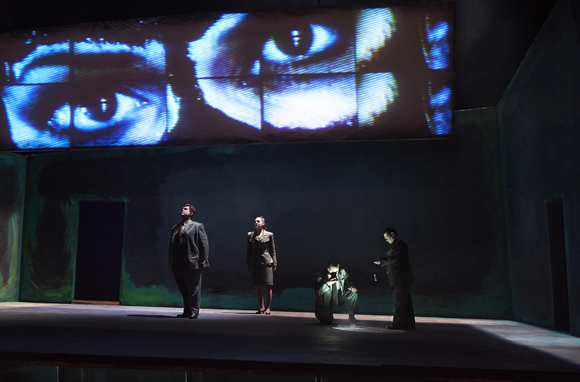
It comes as no surprise that an opera by Atom Egoyan comes across as somewhat cinematic but it’s hard not to use the term of his production of Richard Strauss’ Salome at Canadian Opera Company.  It’s quite a spare production.  There’s a raked stage; the raised end providing a sort of dungeon for Jochanaan and the back and side walls used for projections, especially of a giant mouth prophesying (shades of Big Brother here) and shadow puppets.  Costumes are simple and in shades of red, white and green.  The concept is based on the idea that Salome is a very young girl who has a history of sexual abuse at the hands of Herod that explains her “monstrousness”.  It’s most vividly explored during the dance of the seven veils where Salome rises above the stage on a swing and her robes form a scrim on which a video is projected.  It starts with a very young girl in a garden and gets progressively darker until it finishes up with today’s Salome being raped by her stepfather’s entourage.  Fittingly, the opera ends with Herod himself strangling Salome, perhaps more to silence her than out of disgust.

12-13-06-MC-D-081 Continue reading

Words and music and pictures?

Richard Strauss’ Salome opens April 21st at Canadian Opera Company in a production by Atom Egoyan.  Curiously, this is a piece I know well in three languages as besides the Hedwig Lachmann German translation I own a bilingual edition containing both the original French text and Wilde’s own English translation.  My copy is one of a limited edition published by the Limited Edition Club in 1938.  It contains the English text with reproductions of the original Beardsley illustrations as well as a separate volume of the French text illustrated with pochoirs by Fauvist André Derain.  Here’s an example.

salome_6

There are a dozen photos of text and illustrations from the French volume here for people who like that sort of thing.

Dodgy theology night at the opera

Thais190I seem to be in the middle of a run of operas full of dodgy theology.  First it was the Met’s Parsifal where Wagner à la Girard dished up a puzzling mixture of misogyny, sacred wounds, centuries long curses, bastardization of the Eucharist and weird holy weapons.  There’s a really good conversation about this over at Likely Impossibilities.  Today I was at Opera in Concert’s semi-staged production of Massenet’s Thaïs.  (My review of this should be in the summer edition of Opera Canada).  So today was more misogyny, hairshirts, lots of penance and the idea that the road to sainthood is to be a tart until one’s looks start to go and then torture oneself to death in an appropriately aesthetic manner.  Also, showing empathy for anyone not exactly like oneself leads to doubts, expulsion and damnation.  Coming up soon, Poulenc’s Dialogues des Carmélites, in which salvation is achieved by rejecting anything to do with the Enlightenment and being guillotined.  There’s a Salome in there too somewhere though I’m not sure there’s anything that could be called coherent theology at all in that.

Blessed are the cheesemakers… Really.