All the Mozart

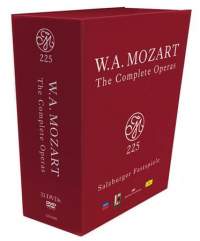
dg0743902Deutsche Grammophon have re-released the Mozart M22 recordings in a new edition.  It contains all the operas, singspiels and other bits and pieces mostly recorded at Salzburg in 2006.  The whole thing comes to 33 DVDs recorded in HD and with 5.1 surround sound.  It’s also incredibly cheap.  Amazon.ca has it listed at C$139.99 including shipping.  Full details are available on the Presto Classical site which is likely a good source for UK buyers but others might want to watch the postage charges on this one!  The set includes some fine productions including Kušej’s Don Giovanni and La clemenza di Tito and Guth’s Le nozze di Figaro.  It’s also still currently the only way of getting hold of Herheim’s notorious Die Entführung aus dem Serail which has been out of the catalogue for ages and still isn’t available separately.  The only drawbacks I can see are that many collectors will already have many of these discs and it’s only available on DVD rather than Blu-ray (but most of these recordings never did make it to Blu-ray).  It would make a great Christmas present for someone starting an opera DVD collection.

Abstract Fidelio

Fidelio is an interesting piece.  The music is great and it has a powerful, very straightforward, plot.  There are no convoluted subplots here.  But there is a lot of spoken dialogue which slows things down.  Is it necessary?  Claus Guth doesn’t think so and in his 2015 Salzburg production he replaces the dialogue with ambient noise and also doubles up Leonora and Don Pizarro with silent actor “shadows”; the former using sign language in the manner of the narrator character in Guth’s Messiah.  It works remarkably well.  The ambient noise sections are quite disturbing and the “shadows” add some depth, especially the frantic signing in the final scene.  Perhaps worth noting that the “noise” contains a lot of very low bass and precise spatial location.  It may need a pretty good sound system to have the intended effect.

1.room

Continue reading

Another fine Cesare

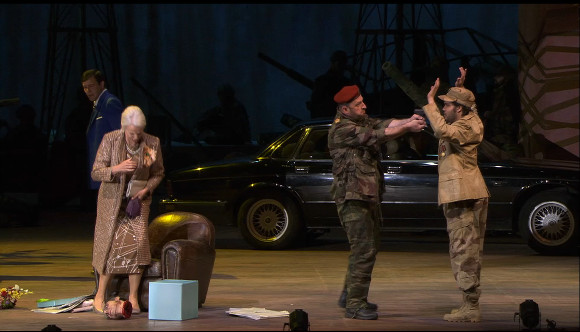
Handel’s Giulio Cesare is pretty well served in terms of video recordings.  The very fine Glyndebourne and Copenhagen versions get some serious competition from the 2012 production that inaugurated Cecilia Bartoli’s reign as director of the Salzburg Whitsun Festival.  The production is by Moshe Leiser and Patrice Caurier.  It’s set in somewhere like Iraq in an immediately post-war period.  It’s quite dark, probably darker than Negrin’s in Copenhagen and world’s away from McVicar’s almost RomCom version.  There’s a lot of violence and some pretty sleazy sex.  A lot of this centres around Tolomeo who is portrayed as beyond revolting.  There’s a scene where he rips guts out of a statue of Caesar and starts to gnaw on them and there is a fair bit in that vein.  Caesar and Cleopatra are portrayed ambiguously too.  Sure they are the “heroes” of the piece but Cleopatra’s delight in flogging off her country’s oil wealth to the Romans shows a degree of cynicism.  This is not a production for the Konzept averse but I think all the choices made have a point and the overall effect is coherent.  It’s not without humour either.  Cleopatra sings V’adore pupille in a 70s blonde wig while riding a cruise missile with Caesar watching through 3D glasses.

1.head

Continue reading

Grumpy Otello

Verdi loved Shakespeare and tried to reflect the psychological depth of his characters in the operas he based on the bard.  You really wouldn’t know that watching the 2008 Salzburg Festival production of Otello.  There’s a lot to like in both production and performance but the emotionally monochromatic performance of the title role by Aleksandrs Antonenko, who can do every mood from fairly grumpy to furious, and the moustache twirling Jago of Carlos Álvarez rather reduce the piece to pathologically jealous nutter with anger management problem kills wife.

1.orgy Continue reading

The Solti show

The recording of Richard Strauss’ Die Frau ohne Schatten made at the Salzburg Festival in 1992 is very much Sir Georg Solti’s show.  The conducting is superb and the Vienna Philharmonic, of course, respond for Solti.  From the opening, shattering cords through the various orchestral interludes to the final ensemble and chorus Solti is utterly convincing in his command of tempi and dynamics.

1.ammekaiserin Continue reading

Historic Ariadne

Opera videos of performances before 1980 are quite rare and are mostly films.  Recordings of live performances are extremely uncommon and often quite interesting.  A couple have just been rereleased on DVD.  The one reviewed here is an Ariadne auf Naxos from the 1965 Salzburg Festival (the other is a recording, in German, of Don Giovanni with Fischer-Dieskau – watch this space).  It’s an old ORF TV broadcast with a grainy 4:3 black and white picture and less than stellar mono sound but it does provide an idea of what audiences saw and heard fifty years ago.

1.haushofmeister Continue reading

Fan – tastic

It was during the recent run of Cosí fan tutte at the COC that I realised that I really needed to get my hands on the M22 recording (Salzburg 2006).  Specifically it was discussing the Salzburg reading of Ursel and Karl-Ernst Herrmann with Thomas Allen and Rachel Andrist; who is the on stage continuo player in the Salzburg recording.  It sounded like there might be interesting parallels.  And parallels there are.  In both cases the girls are aware of the “plot” (in every sense).  In both cases four attractive young singers have been cast as the lovers and Don Alfonso and Despina made much older and more cynical.  There I think the parallels end.  Egoyan’s vision is essentially a positive one about relationships.  The Herrmans, I think, are more interested in exploring the psychologically destructive power of love and desire.

1.egg Continue reading

Where’s the Champagne?

It’s really hard to know where to start with Hans Neuenfels’ Die Fledermaus.  It’s a prodcuction that enraged the more conventional patrons when it opened at the Salzburg Festival in 2001.  It even provoked a “false pretences” lawsuit!  There is so much going on that it almost seems to call for a catalogue raisonnée of the various scenes though one fears that would actually be both tedious and unhelpful.  Let’s try instead to explore it thematically.  Neuenfels takes very considerable liberties with the libretto.  A lot of dialogue is cut, a lot is added and numerous non-canonical characters are inserted.  That’s just a start.

1.nosejob Continue reading

Die Frau ohne Geisterwelt

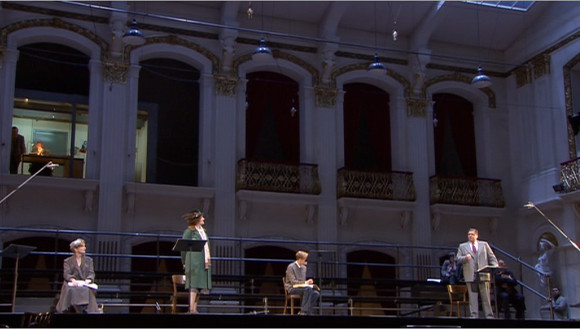
Christoph Loy, in his 2011 Salzburg production of Richard Strauss’ Die Frau ohne Schatten, avoids the problem of how to represent the Spirit World by essentially eliminating it.  Instead we get a Konzept based on Böhm’s first recording of the work in Vienna’s Sofiensalle in 1955.  Vienna is still recovering from the war and the hall is unheated and the singers unpaid.  The Empress is rising star Leonie Rysanek and the Nurse is long time favourite Elisabeth Höngen.  They represent the generations separated by the war.  The Emperor is an American singing in Europe for the first time and, crucially, Barak and his wife are a real life married couple.  Initially we see a lot of recording studio action as singers are moved about by actors in this experiment in early stereo.  Then the action, particularly the Barak/Wife interaction slips more and more off stage.  For the finale, we get a sort of celebratory concert in evening dress.  It’s not a bad concept and this cast handles it very well but I fancy it’s a tough introduction to this far from straightforward opera and it does lose the magic of the Spirit World. (In other words I’m glad I saw the Met production before this one.)

1.studio Continue reading

Woe unto him who conceals deserts

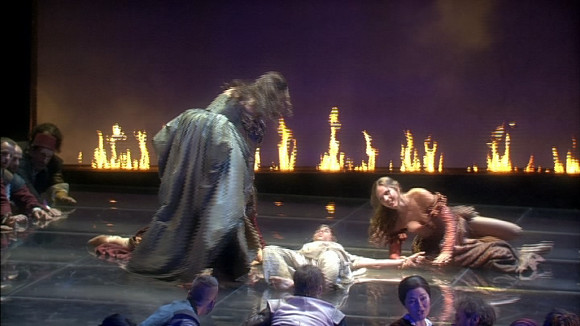
coverWolfgang Rihm’s Dionysos is described by him as “eine Opernphantasie”.  It certainly isn’t an opera in the conventional sense lacking, as it does, anything resembling a plot.  It’s a staged setting of poems by Nietzsche written just before his final descent into madness (if one considers that’s not where he was from the start!).  Rihm conceives this as four scenes each dealing with a different “element” in Nietzscean terms.  The four are Water, a scene set on a lake; Air, a mountain scene; Intimate Space, a scene in a brothel; and Public Space, set in a town square.  So, episodic and linked only by a certain kind of mood and the characters.  The weight of the piece is carried by “N”, a baritone role.  he interacts variously with  a amle guest who doubles as Apollo and a high soprano who doubles as Ariadne.  In addition there is a trio of ladies; high soprano, mezzo, contralto, who play various roles from pseudo Rhinemaidens to tarts.

Continue reading