Five operas from the last fifty years

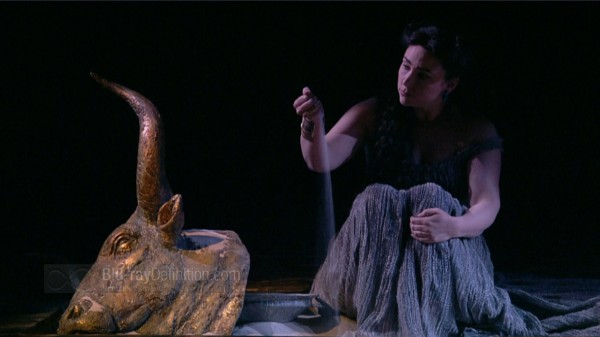
BDDefinition-TheMinotaur-a-1080-600x337Lisa Hirsch asked on Twitter the other day for suggestions for the five most important operas written since 1965 (i.e. in the last fifty years).  It’s a really interesting question and I pinged off a quick, semi-considered response.  Thinking about it some more I think I would stick with my choices.  (Obviously I haven’t seen every eligible opera but it surprises me a bit how many I have seen live or on DVD).  So here are my picks:
Continue reading

Weint! Weint! Weint! Weint!

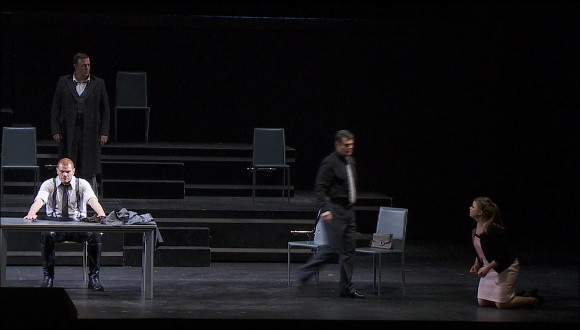
Aribert Reimann’s Lear is a pretty good example of how to create a thoroughly modern opera within a thoroughly traditional framework.  It’s a classic story of course.  Here librettist Claus Henneberg has taken the classic German translationof the Shakespeare play and condensed it in a highly intelligent fashion; retaining all the emotional drama while sacrificing some fairly peripheral narrative.  Reimann’s score is modern though not strictly twelve tone.  He creates a distinct musical voice for each character; speech/Sprechstimme for the Fool, weird coloratura for General etc. This is reinforced by many of the characters having a tone row that serves as a sort of leitmotiv.  Atonality and quarter tones are used for varying effects from the violence of the Blasted Heath scene; apparently inspired by the composer’s experience, as a nine year old, of the bombing of Potsdam, to the shimmering, ethereal quarter tones of Lear’s final monologue.  For anyone with even a vague tolerance for “modern” music it’s a fascinating listen.

1.learcordelia Continue reading

Heaneygone

Saddened by the news of the death of the great Seamus Heaney, I took some time out from opera last night to listen to the man reading his translation of Beowulf.  Some scholars may disparage the freedom of the translation but I love it.  I own, I think, four different translations of Beowulf and the Heaney is much my favourite.

This is a shot of the Folio Society bilingual edition (original poem, Heaney translation).  It's a glorious thing. Continue reading

The dream is over but the night not yet

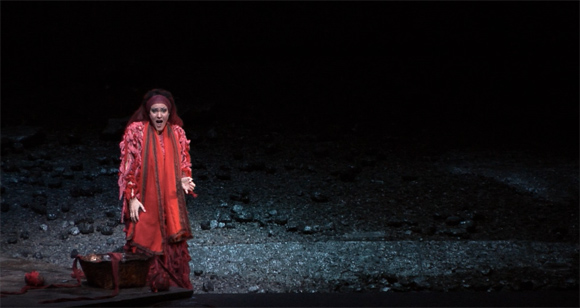
So closes Aribert Reimann’s 2010 opera Medea.  It’s a two hour piece in four “pictures” that premiered at the Wiener Staatsoper in 2010 and the Blu-ray/DVD recording is taken from that initial run.  Actually there’s a good deal more nightmare than dream in this version as, I suppose, there is in just about any version of the Medea story.  This one draws on Franz Grillparzer’s version for the libretto and is entirely concerned with events after Jason and Medea reach Corinth.  It’s unusually sympathetic to Medea herself with Jason and Kreon very much the villains.

Continue reading

Not a DVD review

Nixon in China at the COC

There are an awful lot of opera DVDs about.  It sometimes seems like there’s a new Tosca or Traviata out every week, often for no apparent reason.  It’s perhaps surprising then that some works don’t make it to DVD.  One particularly egregious case would seem to be John Adams’ Nixon in China.  It’s a good piece and has had plenty of productions both in North America and elsewhere.  A couple of years ago I saw it twice in 24 hours; on a Friday evening at COC followed by the HD broadcast from the Met the following afternoon and I’ve been listening to an audio recording of the COC version on my walk to and from work.  But there’s no DVD!  I guess that the Met probably planned to release the HD recording but James Maddalena, the Nixon in the recording, was so obviously ill I was actually surprised that he continued after the interval and I guess that scuppered that. Continue reading

Some help from my American friends?

I believe in new opera. I think it’s vital to the survival of the genre and I like quite a lot of it. Most of what I like has come from European or British composers or John Adams. I love Reimann’s Lear and Birtwistle’s The Minotaur and Sariaaho’s L’Amour de Loin.  I’m equally impressed by Nixon in China and, maybe to a lesser extent, Doctor Atomic.  All of these, it seems to me, lie within the range of idiom of contemporary symphonic or chamber music.  I’ve had much less luck finding contemporary American opera, Adams aside, that I enjoy or even find interesting.  I loathed A Streetcar Named Desire and five minutes of Adamo’s Little Women had me reaching for the barf bucket.  It’s a combination of cloying sentimentality and music that sounds like South Pacific minus the good tunes.  It’s certainly not the sort of music one could imagine hearing at a symphony concert. Am I missing something?  What should I try to see if I want to see intelligent, musically interesting contemporary American opera?