So, apparently Toronto has three opera singers from the otherwise unremarkable town of Corner Brook, Newfoundland. Today they (Michael and Peter Barrett and Adam Luther) together with Doug Naughton on guitar, Andrew Grimes on bhodran and, the definitely not from Newfoundland, Sandra Horst on piano produced a fun recital of arrangements of more or less traditional songs from Newfoundland and the British Isles together with a few pieces that aren’t actually traditional but people think they are. And actually, of course, a lot of the time differentiating between a traditional Newfoundland song and a traditional British song is a bit fraught.
Tag Archives: rba
Yet more shows
The Toronto opera/recital calendar just keeps on giving. Late April and May are always a bit crazy with the usual three operas on at the COC but there’s a stack more stuff going on. The latest additions to my calendar are a new Queen of Puddings Music Theatre commission La Selva de los relojes (The Forest of Clocks) by Canadian composer Chris Paul Harman. This vocal chamber work setting texts by Lorca will be performed by Krisztina Szabó and an ensemble of 6 instruments as part of the free lunchtime concert series at the Four Seasons Centre at noon on April 30th. Sadly this will be the last work from Queen of Puddings who are winding up this summer. Next is Ruth, a new opera by Jeffrey Ryan, which will be workshopped by Tapestry at the Distillery on May 4th. Finally there is a Talisker Players show called On the Wing featuring Erin Bardua and Vicki St. Pierre in a birdsong themed programme. It’s playing on May 7th and 8th at the Trinity St. Paul’s Centre.
Canadian Art Song Project again
Today saw the premiere of the Canadian Art Song Project’s second annual commission (My review of last year’s effort). This time it was Norbert Palej’s Small Songs; a setting of ten texts from Jan Zwicky’s Thirty-seven Small Songs & Thirteen Silences. It’s an ambitious piece drawing on a wide range of vocal and piano colours and occasionally on non-standard technique. That said, although sounding like a work from the 21st century it’s really quite accessible to anyone with any familiarity at all with modern art song. Some passages were really lovely. I especially like the haunting and clever setting of Small song on being lost which evokes the loneliness of the sea and the self. The piece that followed; Small song for the moon in the daytime was also rather special ending movingly on “the wind is nowhere to be found”. All in all, great integration of text and music as art song should be. The composer “warned” us up front that the music was extremely difficult to perform because he was writing it for two very fine musicians. They didn’t disappoint. Tenor Lawrence Wiliford used all of his range; dynamically, colourwise and pitchwise to give a very text sensitive reading and he was very well accompanied by long time collaborator Steven Philcox at the piano.
The French connection
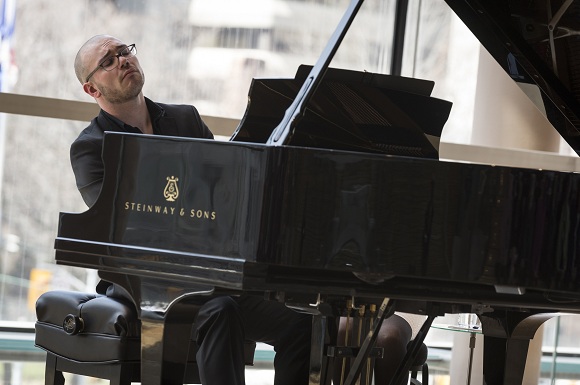
Today’s free lunchtime concert in the RBA was given by Topher Mokrzewski wearing his pianist hat; as opposed to his conductor, accompanist, music director, vocal coach or tap dancing hat.
And now for something completely different
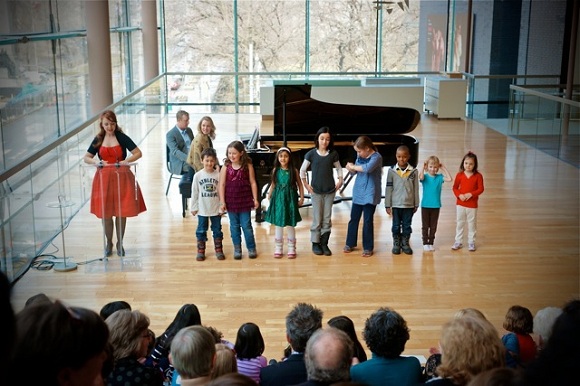
It’s March break in Toronto which means lots of children friendly activities. Yesterday’s lunchtime concert at the Four Seasons Centre was one of them. It was a session/performance by soprano/educator Kyra Millan together with sidekicks baritone Jesse Clark and pianist Christina Faye. There were lots of kids, mostly quite young, there. Some had even brought their parents.
An anti-Valentine
Today’s lunchtime recital in the Richard Bradshaw Amphitheatre was a recital of Schubert and Strauss songs on the theme “Love’s Dark Shore”. The performers were German bass Franz-Josef Selig, in town singing King Marke in Tristan und Isolde, and the COC’s own Rachel Andrist at the piano. There wasn’t much about “Love” in the pieces chosen but there was plenty of death, depression and despair. One might think it would be a complete downer but nobody could possibly be depressed witnessing the artistry of Selig.
Those who have heard Selig in Tristan know that he has a massive voice. It was fascinating to hear him turn it to lieder. He is a very German lieder singer in the best possible way. He enunciates with great clarity and gets full value out of the meaning of every phrase. He clearly loves the texts. He also manages his huge voice wonderfully. Mostly he sang quite quietly with beautiful legato and perfect control but when he wanted volume it was there in abundance and without strain. He also has a real range of tone colour and sheer beauty of tone. Often he sounded more like a baritone than a bass but he could get almost tectonically low when he needed to. It was very impressive. Rachel’s accompaniment was perfectly fine too though I think most of the audience was focussed on the voice.
I did hear a few grumbles about the unrelieved darkness of the material but I felt the works suited the singer and it was, as these things are, a fairly short programme so the lack of variety didn’t really bother me. All in all, a very worthwhile way to spend one’s lunch break.
First of the year
Yesterday saw the first free lunchtime concert of 2013 at the Four Seasons Centre. Five singers from the COC’s Ensemble Studio gave us a programme of works by Mozart and Salieri, mostly comparative rarities. I enjoy hearing the singers of the Ensemble Studio because it’s not just a chance to hear some good singing but also to see how voices are developing and make some guesses about whether one is seeing a future star.
Grimmfest
It’s pretty Grimm in Toronto these days. Friday will see the 500th performance of Dean Burry’s 1999 opera for children The Brothers Grimm. Now, 500 performances for any recent opera is pretty remarkable. 500 performances for a Canadian work is extraordinary. Anyway, in the lead up to Friday there are a number of events scheduled including a concert yesterday lunchtime in the Richard Bradshaw Amphitheatre with a Grimm theme.
Eric Domville introduced the music. He gave us a disquisition on the Grimm brothers, philology, the Great German Dictionary, folk tales and the oral tradition, his childhood, Romanticism as a reaction to Enlightenment, the plot of several folk tales in their English, French and German incarnations and a potted summary of the cultural, political and religious state of Germany in the mid 19th century. It was perhaps just a teeny bit more than one resally needed to explain three arias from Hansel and Gretel and one from Königskinder. Continue reading
Second annual COC Ensemble Studio competition
Last night I was in a very full Richard Bradshaw Amphitheatre for the second annual COC Studio Ensemble competition. Ten singers, selected down from 146 in auditions across Canada and in New York were competing for cash prizes and an opportunity to join the COC Ensemble Studio. COC General Director Alexander Neef chaired the panel of judges which included soprano and teacher Wendy Nielsen as well as assorted COC brass. Chorus Master Sandra Horst MC’d in her own inimitable fashion. The format was typical of such events. Each singer offered five arias. They got to sing one of their choice and then the judges requested a second from the remaining four. Piano accompaniment alternated between the equally excellent Rachel Andrist and Steven Philcox.
Free Concert Series 2012/13
The COC has announced the line up for the 2012/13 series of free concerts in the Richard Bradshaw Amphitheatre at the Four Seasons Centre. There’s the usual mix of vocal, instrumental, jazz, world music and dance. There are plenty of opportunities to see the Ensemble Studio members as well as solo gigs by Franz-Josef Selig and Anna Christy. For fans of Indian classical music there’s also a sarangi recital by Aruna Narayan. Also of interest is a concert by Queen of Puddings Music Theatre “Inspired by Lorca”.