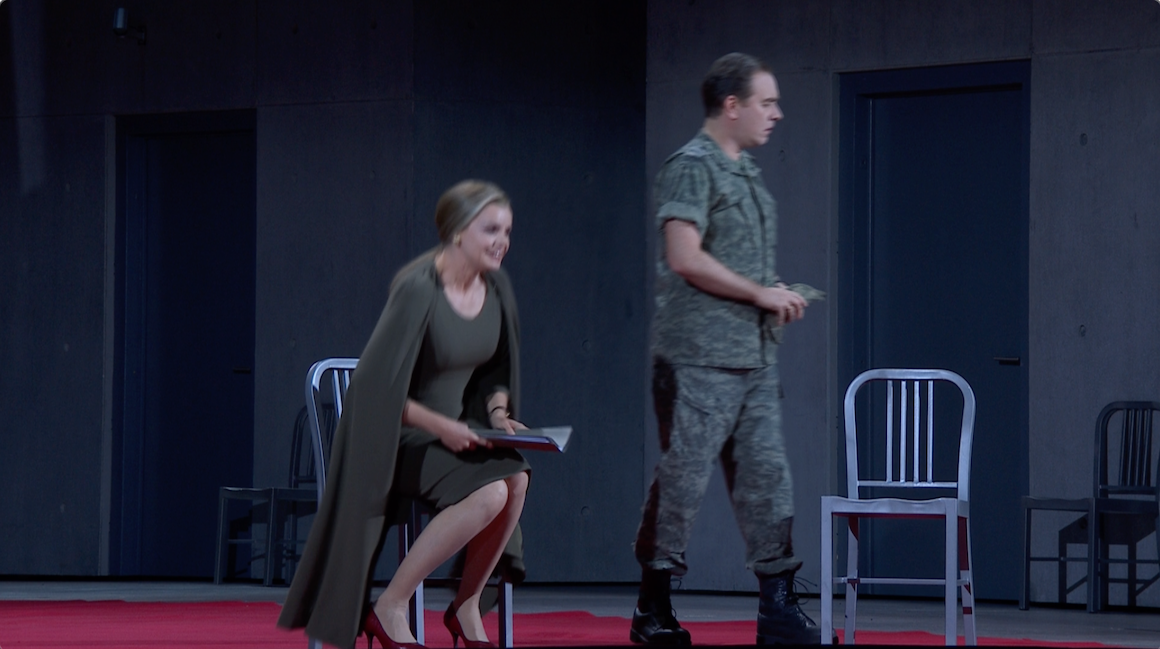
De-exoticising Aida

Robert Carsen’s production of Verdi’s Aida seen at Covent Garden in 2022 is a very good example of what Carsen can do.  In this case it’s to strip out elements he considers non-essential and focus on the essentials of the drama.  In the rather good “extra” feature on the video recording Carsen summarises it as focussing “on the story not the place”.

1.amnerisradames

Continue reading

Ernani

Ernani is an early Verdi opera (1844) and it’s not performed that often (16th most performed Verdi opera according to Operabase).  It was given at the Maggio Musicale Fiorentino in 2022, in a production by Leo Muscato, which was recorded for video release.  How you react to it may partly depend on how you feel about bel canto operas on (more or less) serious themes.  This is an opera about unrequited love and revenge (lots of revenge) but, in typical bel canto style, the music doesn’t always fit the mood.  So here we open on a prelude where Ernani’s bandit gang are sorting out the corpses from their latest skirmish while the orchestra plays a rather jolly tune, then they break into a drinking song and then Ernani enters and sings a rather lovely cavatina.  There are places where the music is darker and some of it is really rather good.  In particular there are some strong duets for Ernani and his (everyone’s) love interest Elvira.  Overall, I rather liked it musically.

1.bandits

Continue reading

Moving Traviata from MMF

It’s not all that often I feel genuinely moved by an opera on video.  It’s so much less immersive than experiencing live.  There is the occasional one.  Both the Berlin Parsifal and the Aix-en-Provence La traviata come to mind.  The recently released La traviata from the Maggio Musicale Fiorentino is another one.  It’s an interesting and effective production with a strong cast centred on the searing Violetta of Nadine Sierra.

1.mirror

Continue reading

I due Foscari

Verdi’s sixth opera, I due Foscari, is probably not well known to many readers so a brief description may be in order.  It’s a rather grim tale of injustice and revenge.  Francesco Foscari is the aged Doge of Venice.  His son, Jacopo, has been stitched up by the family rival Jacopo Loredano and exiled to Crete.  He returns to try and clear his name but is fitted up again.  This time for the murder of one Donato.  Despite torture he refuses to confess and is sentenced to return to exile in Crete.  The first three quarters of the opera is mostly either father or son bemoaning their fate (Francesco has already lost three sons.  Lady Bracknell would be unimpressed) or Lucrezia, Jacopo’s wife, pleading for mercy to anyone who will listen.  Then there’s a final scene where Francesco receives proof of his son’s innocence, closely followed by news of his death, closely followed by news that the Council and Senate are sacking him.  Loredano gloats.  Foscari dies.  Structurally it’s very much a “numbers” opera with a succession of short scenes mostly featuring various combinations of the three Foscaris and the chorus.  There are a lot of quite sophisticated ensemble pieces as well as a couple of solo arias for each of the principals.  It’s musically rather distinguished in fact.  The three Foscari roles are big sings.  Nobody else has much to do.

1.gondoliers

Continue reading

Babes in bodices

After a less than satisfactory introduction to Donizetti’s Anna Bolena in a MetHD broadcast last year it was with some trepidation that I approached the DVD version recorded at the Wiener Staatsoper and also starring Anna Netrebko.  I need not have worried because it’s very good indeed.  It has a stronger cast, Eric Genovese’s relatively simple production trumps David McVicar’s overstuffed effort and Evelino Pido doesn’t try and make the orchestra sound like it’s playing Wagner.  The sound on the DVD is also way better than it was on that broadcast.

1.anna_giovanna Continue reading