Minimalist (?) Barbiere

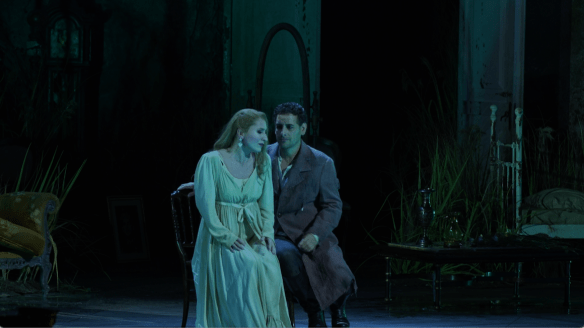
Herbert Fritsch’s production of Rossini’s Il barbiere di Sivigla filmed at the Wiener Staatsoper in 2021 is strangely ambiguous.  At first blush it looks like the sort of hyper traditional production the WSO might have had in repertory for fifty years.  There are big wigs, knee breeches and so on but it soon becomes apparent that something more (or less) is going on.  Tje costumes are exaggerated.  The fabrics are elaborate and shiny and very not early 19th century at all.  The wigs are odd colours.  Rosina’s dress shows rather a lot of leg.  There’s virtually no scenery and the only props I recall in the whole piece are a ladder and Lindoro’s sword at the end of Act 1.

1.serenade

Continue reading

Duelling tenors

Damiano Michieletto’s production of Rossini’s La donna del lago filmed at the Rossini Festival in Pesaro in 2016 has some odd features but at least it’s not as all around annoying as the Met production the year before.

1.elenauberto

Continue reading

The actual Paris Orphée

Gluck’s Orfeo/Orphée is one of those works where things get a bit complicated because an Italian and a French version wre produced and then all kinds of mash ups of the two versions.  It’s a bit like Don Carlo/Don Carlos or Guglielmo Tell/Guillaume Tell.  The original Orfeo ed Euridice, which premiered in Vienna is quite short and has Orfeo written for a castrato.  The Paris version spreads the piece out over three acts, adds both new vocal music and lots more dance music and has Orphée written for haut-contre.  Today, when people do the French version they usually cut some of the new music and use the higher Orphée music; casting either a mezzo or a counter-tenor.  This is true of both recordings  (Paris 2000 and Munich 2003) which have come my way in the past.

1.opening

Continue reading

I due Foscari

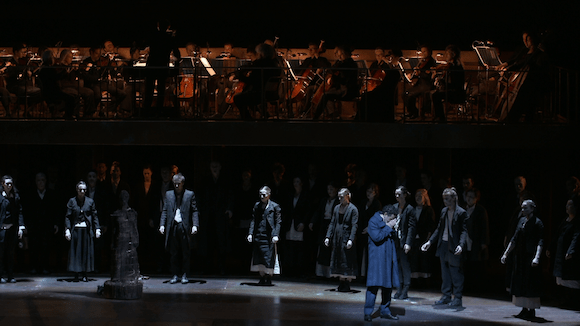
Verdi’s sixth opera, I due Foscari, is probably not well known to many readers so a brief description may be in order.  It’s a rather grim tale of injustice and revenge.  Francesco Foscari is the aged Doge of Venice.  His son, Jacopo, has been stitched up by the family rival Jacopo Loredano and exiled to Crete.  He returns to try and clear his name but is fitted up again.  This time for the murder of one Donato.  Despite torture he refuses to confess and is sentenced to return to exile in Crete.  The first three quarters of the opera is mostly either father or son bemoaning their fate (Francesco has already lost three sons.  Lady Bracknell would be unimpressed) or Lucrezia, Jacopo’s wife, pleading for mercy to anyone who will listen.  Then there’s a final scene where Francesco receives proof of his son’s innocence, closely followed by news of his death, closely followed by news that the Council and Senate are sacking him.  Loredano gloats.  Foscari dies.  Structurally it’s very much a “numbers” opera with a succession of short scenes mostly featuring various combinations of the three Foscaris and the chorus.  There are a lot of quite sophisticated ensemble pieces as well as a couple of solo arias for each of the principals.  It’s musically rather distinguished in fact.  The three Foscari roles are big sings.  Nobody else has much to do.

1.gondoliers

Continue reading

Ossian meets Anne of Green Gables

Rossini’s La donna del Lago is based on the Walter Scott poem, itself a deliberately romantic view of Scottish history, simplified until not much is left but the rivalry for the heroine’s hand by her three suitors and a completely unexplained war between the king of Scotland and the Clan Alpine.  Dramatically it’s thin indeed but it’s Rossini so there is crazy virtuosic music and it’s very hard to cast.  One needs two mezzos; one a mistress of Rossinian coloratura, the other more dramatic, and two tenors; both of which can do the crazy high stuff.  The supporting roles aren’t easy either.  Realistically only a major house could cast this adequately.

1.anne

Continue reading

Guillaume Tell

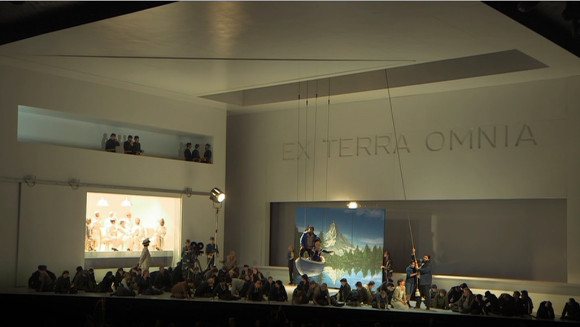
Rossini’s last opera, Guillaume Tell, was written for Paris and is an extremely ambitious piece of great musical sophistication.  It’s also very long.  Performed uncut, a rarity, it runs something like four hours including ballets.  It’s also hard to cast with the role of Arnold Melcthal in particular making unusual demands.  It’s a high tenor role combining the flexibility needs of a typical Rossini role with something much more heroic.  The soprano role of Mathilde has some of the same issues; signature Rossini coloratura is combined with the sort of dramatic heft one might more associate with early Wagner.

1.boat

Continue reading