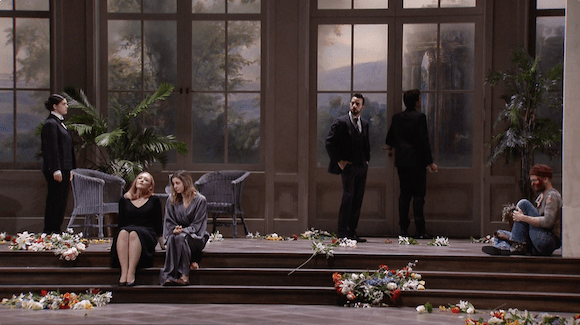
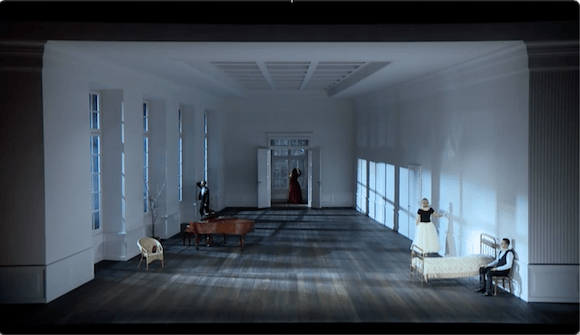
Greyscale Macbeth

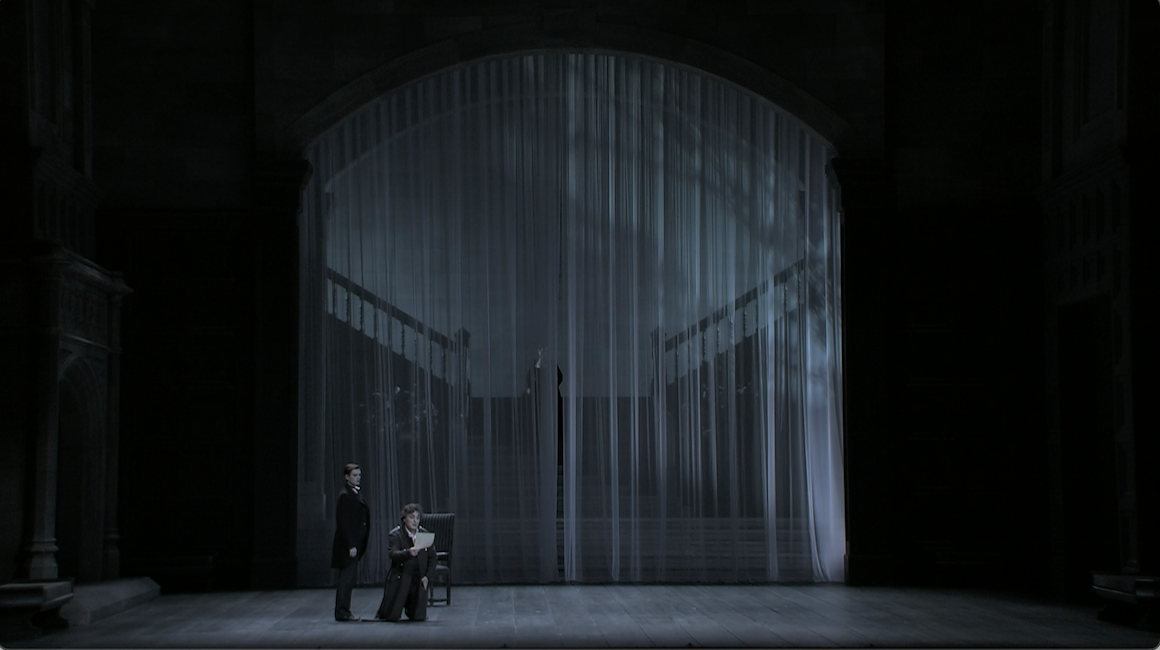
Christof Loy’s production of Verdi’s Macbeth filmed at the Liceu in Barcelona in 2016 is grey, very grey.  Costumes and lighting are such that one might think one is watching a black and white film.  The first, brief, touch of colour; some lights and bunches of flowers appears at the beginning of Act 4.  Beyond the greyness the vibe is essentially late 19th century and it’s pretty sparse.  It’s also very dark; at times almost unwatchably so on video (even Blu-ray).

Continue reading

The COC’s production of Cherubini’s Medea is grand opera at its grandest

Cherubini’s Medea, in the 1909 Italian version being used by the COC, got there by a fairly circuitous route.  Euripides 5th century BCE tragedy and Seneca’s 1st century CE play inspired a French verse version of 1635 by Thomas Corneille which was turned into an opera by Marc-Antoine Charpentier in 1693.  In 1797 a version with music by Cherubini to a libretto by François-Benoît Hoffman; retaining much of Corneille’s version as spoken dialogue, premiered in Paris.  In 1909, for the Italian premiere at La Scala an Italian translation with added recitatives was used and that became, more or less, the standard version for its rare 20th century revivals (most notably in the 1950s with Maria Callas) and that’s the version being given at the COC with Sondra Radvanovsky in the title role.  Understandable really.  It’s hard enough to find a cast that can do justice to the music.  To expect them also to be expert at declaiming Alexandrines en français is probably expecting a bit too much.

23-24-06-MC-D-0760

Continue reading

None But the Lonely Heart

So you are Christof Loy, it’s early 2021 and your production of Fedora in Frankfurt can’t go ahead due to… you know.  So what are you going to do with a set that basically consists of a lavishly decorated, multi-purposable drawing room?  Loy’s answer is to create a narrative around twenty four Tchaikovsky songs and some of his piano/chamber music and stage and film it in an empty theatre.

1.blankcanvas

Continue reading

Der Schatzgräber

Franz Schreker’s Der Schatzgräber premiered in Frankfurt in 1920.  It was his last and most successful opera but it disappeared from the repertory under the Nazis and performances have been rare since WW2.  Christof Loy directed it for Deutsche Oper Berlin in a new production in 2022, marking the 100th anniversary of the first performance in Berlin.  It was also a continuation of Loy’s project of bringing less well known opera with “strong female characters” to DOB, following his production of Korngold’s Das Wunder der Heliane and Zandonai’s Francesca di Rimini.

1.foolqueen

Continue reading

The other Humperdinck opera

Humperdinck’s second “fairy tale” opera; Königskinder, is unusual in that, although it includes traditional fairy tale elements, it isn’t based on a traditional fairy tale but rather on a play by Else Bernstein-Porges.  It’s, of course, also performed much less frequently than Hänsel und Gretel.  It was given at Dutch National Opera, in a production by Christof Loy, in 2022 and recorded for video release.

1.hut

Continue reading

Il Trittico with Asmik Grigorian

It’s quite rare nowadays to stage all three Il Trittico operas in one evening and it will probably get rarer as financial pressures force shorter shows.  Nonetheless it was done in Salzburg in 2022 in productions by Christof Loy.  The USP was having Asmik Grigorian sing all three principal soprano roles so, not unreasonably, the usual order was switched up with Gianni Schicchi coming first and Suor Angelica closing things out.  Unsurprisingly, and as intended, the evening increasingly became the Grigorian show as each opera succeeded the previous one.

Continue reading

Eine Winterreise

Eine Winterreise is a show conceived and created by Christof Loy and presented and recorded at Theater Basel in 2022.  What it’s not is Schubert’s Winterreise. with or without staging.  Loy describes it as a “kaleidoscopic” look at Schubert’s life through his music.  So the show is a compendium of Schubert’s vocal and instrumental music with a bit of spoken text.  It runs about 100 minutes but only 24 or so are music from Winterreise, of which only six of the twenty-four songs are included.

1.stage

Continue reading

Christmas Eve

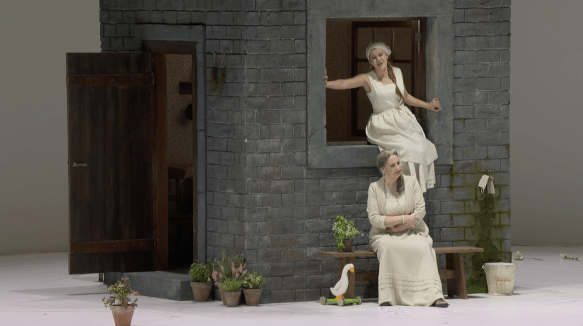
Rimsky-Korsakov’s 1894 opera Christmas Eve is based on the Gogol short story The Night Before Christmas which also formed the basis for Tchaikovsky’s The Tsarina’s Slippers.  We are in a small village in Ukraine just before Christmas.  Basically the smith Vakula is in love with Oksana, the beautiful daughter of the rich farmer Chub.  To complicate matters Vakula’s mother, Solokha, is a witch who is (in the words of the subtitles) “having it off” with every prominent male in the village including Chub plus the Devil. Vakula shows up unexpectedly at his mum’s where she has been hiding successive lovers in sacks as the next (unscheduled) one arrives.  Vakula “tidies up” the sacks but then runs into a big party of villagers where the contents of the sacks are revealed (except for the Devil).  Oksana teases Vakula and says she will only marry him if he brings her the Tsarina’s slippers as a Christmas gift.  Vakula vows never to be seen in the village again and sets off with the Devil in his sack.

1.oksana

Continue reading

Sex and violence

There’s a certain logic in Christof Loy following up his 2019 production of Korngold’s Das Wunder der Heliane at the Deutsche Oper Berlin with Riccardo Zandonai’s 1914 piece Francesca da Rimini. Both pieces deal with overt, somewhat perverted, sexuality as the means of a woman achieving some sort of agency and both have lush, hyper-romantic scores.  Loy claims his next project will be Shreker’s Der Schatzgräber for the same house so there’s apparently more to come.

1.room Continue reading

Euryanthe

Weber’s 1823 “Grand-heroic opera” Euryanthe doesn’t get performed very often.  It’s not hard to see why even though Christof Loy’s production for the Theater an der Wien filmed in 2018 has some interesting features.

1.ballroom

Continue reading