Bergman’s Magic Flute (Trollflöjten)

Despite having seen many Magic Flutes and pretty much every Bergman movie it’s only now that I’ve got around to watching his famous film of the Mozart opera, or rather Bergman’s version of the opera, because it differs in important ways from Shikaneder’s libretto.  The basic concept is that Pamina is Sarastro’s daughter, who he has removed from the evil influence of her mother.  He intends Pamina to inherit his kingdom and leadership of the Brotherhood but only after he’s found a suitable chap to keep her out of trouble which is, of course, where Tamino comes in.  So whatever else has changed, the misogyny is intact.  There are other changes too.  Monostatos is almost written out of the script and a good deal of dialogue is changed or omitted, as are some musical numbers.  The whole thing comes in at 135 minutes so maybe 30 minutes of material have been cut.  None of this seems very radical today but must have raised a few eyebrows in 1975.

1.dragon Continue reading

Dusty Capriccio

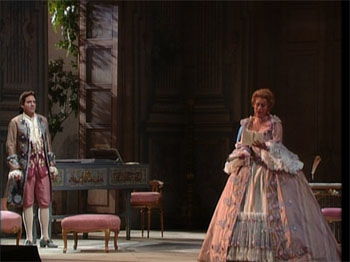
The 1993 San Francisco Opera production of Strauss’ Capriccio is about as literal a take on the work as one could imagine.  Stephen Lawless’ production sticks to the stage directions as laid down with an almost fetishistic fidelity.  This is backed up by highly decorated costumes and sets firmly placed in a slightly over elaborated 1775.  The traditionalists dream?  I suppose so if one thinks that Strauss and Krauss meant the work to be taken literally.  I don’t.  This is an opera about an opera about opera.  It begs to be deconstructed and the time and circumstances of its composition tend to reinforce the idea that all is not as it seems.  To take it at face value is actually a bit absurd but that’s what happens here and the result is rather dull and unsatisfying. Continue reading

Chacun à son goût

There’s lots to like in the 2003 Glyndebourne recording of Die Fledermaus.  Let’s start with Stephen Lawless’ production.  It’s attractively designed, quite slick and has a few good new gags without going overboard.  The sets are designed with striking diagonals and staircases and gantries.  Rotation is used both as a device to change the setting and as an element in the scene composition.  The overall effect is that the scene changes from drawing room to a sort of “gilded cage” for Orlofsky’s party – which opens out to create space for the action – to a prison with minimum disruption to us or the action.  Spots are used to create stagey effects and at one point Jurowski in the pit ostentatiously upstages the actors on stage.  Lawless never lets us forget this is a “show”.  Continue reading