In which I get a plague and miss one

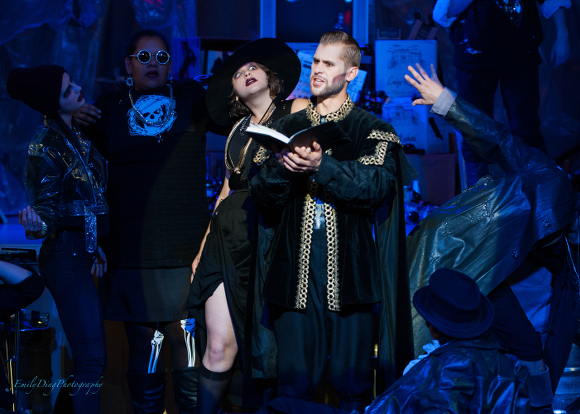
Last night I was at the Arts and Letters Club for the opening night of Opera 5’s Edgar Allan Poe themed show In Pace Requiescat. I had hoped that I had kicked the thing that has been afflicting me since Wednesday but I was over optimistic.  I spent the first half of the show either in a coughing fit or trying desperately to avoid one and then had to leave at the interval thus missing Cecilia Livingston’s new piece The Masque of the Red Death.

in Pace Promo Picture 1What I did see; Daniel Pinkham’s The Cask of Amontillado and Debussy’s La Chute de la Maison Usher, was, as best I recall, pretty good.  Staging and costumes are appropriately creepy and there was some very good singing from Adrian Kramer and a brief appearance from Lucia Cesaroni that made me want to see more.  If I can shake this thing before the end of the run I’ll go back and do a proper review.  There are further performances on Wednesday and Thursday.

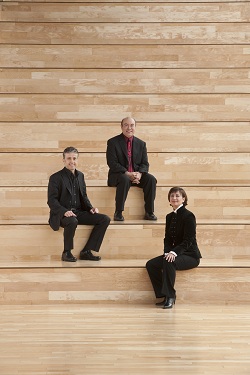
Gryphon Trio with Robert Pomakov

Gryphon_085v1(1)Back to Koerner Hall last night for a concert of chamber music and art song.  Anchoring the show were the Gryphon Trio.  They kicked off with the Debussy Piano Trio in G Major.  This was an enjoyable and compact piece with a very playful second movement.  Then came what was, for me, the main reason for going, Mussorgsky’s Songs and Dances of Death.  For this the Gryphons were joined by Toronto bass Robert Pomakov.  He was excellent.  Obviously completely at home singing in Russian he produced a nuanced reading of text and music.  His acting with the voice was exemplary and no extraneous physical acting was required.  His control of dynamics was exemplary.  He has a really big voice which he deployed as appropriate but he was also capable of floating a lovely pianissimo.  Accompaniment from the Gryphons was also well up to par.  There are some interesting instrumental lines including making the cello go about as low as a cello can to match the bass voice.  Continue reading

Upcoming events

sellarsThere a couple or three things coming up in Toronto that might be of interest to readers.

On Sunday 27th January at 2pm Russell Braun and Rihab Chaieb are giving a recital of German songs in the Glenn Gould Studio.  Tickets are $60 but only $25 for under 25s.

The following evening Peter Sellars is giving a talk on his production of Tristan und Isolde at the Toronto Reference Library.  This one is free but ticketed.  Tickets are available from the TPL website.

And in free RBA noon concert news, on 24th January Sasha Djihanian and Cameron McPhail with pianists Timothy Cheung and Jenna Douglas are offering up Debussy’s Ariettes oubliées and Schumann’s Dichterliebe.

Pelléas et Mélisande in the Valleys

The Gramophone Classical Music Guide 2010 describes the DVD of the 1992 Welsh National Opera performance of Debussy’s Pelléas et Mélisande thusly:

This is, in every respect, a model of what a DVD ought to be, a perfect realisation in picture and sound of Debussy’s sole and inspired opera.

Followed by a good deal more in the same vein.  This, regrettably, tells us more about the Gramophone Guide than about this DVD(1).  Actually it’s not bad at all by 1992 standards but “a perfect realisation” it isn’t.
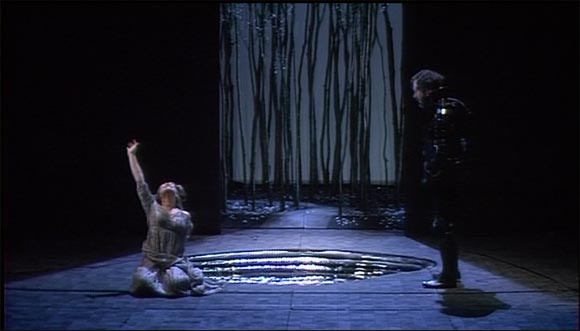
Peter Stein’s production is semi-abstract and monotone.  The tone is “dark”.  There’s some interesting lighting but visually it’s pretty nondescript.  The director’s focus is clearly on the actors and their interactions and in a work like Pelléas et Mélisande that makes sense.  There is some very good acting, especially from Alison Hagley as Mélisande.  The tower scene is brought off rather well with perhaps the most extravagant hair extension in the history of opera.  This also features in a disturbingly violent Act 4 Scene 2.  Act 4 also sees a brief appearance by a live sheep, no doubt in deference to local sensibilities.  I’m not entirely convinced that Stein gets enough complexity from his cast to really raise the psychology beyond the cardboard cut out level.  Donald Maxwell’s rather crude and coarse Golaud doesn’t really make a case for his descent into jealousy, madness and murderous rage based on not much at all really.  He’s not helped by the rather colourless Pelléas of Neill Archer.  On the other hand Alson Hagley conveys the fragility and mystery of her character exceptionally well.  (I also wondered whether a visual reference to Gerald of Wales’ Melusine was being made in the tower scene but maybe that’s over-theorising).  She’s very much in the same frantic and febrile mould here as Natalie Dessay on the Theater an der Wien recording.  Kenneth Cox gives a strongly characterised Arkel with particularly good chemistry with Hagley.  Stein uses a boy treble, Samuel Burkey, in the role of Yniold.  It works dramatically but I don’t much care for it musically.
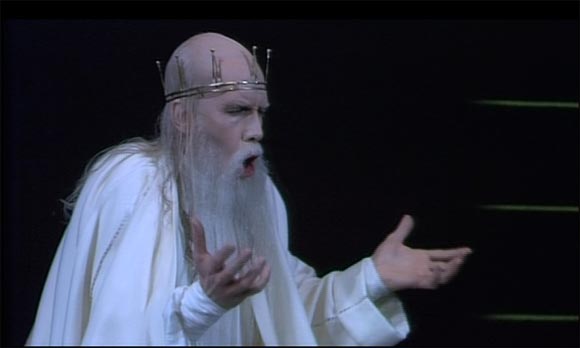
In general the singing is very good.  All the principals have adequate French at least, though they can’t quite match Vienna’s line up of Francophone star talent.  Pierre Boulez conducts.  He gets a very detailed, transparent reading from the WNO orchestra while occasionally pushing out a genuinely Wagnerian dramatic climax.  No complaints here.
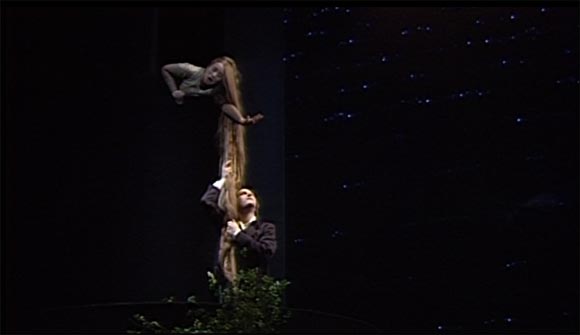
Stein also directed for TV/DVD.  It’s pretty conventional 1992 TV direction.  There are lots of close ups but generally there’s no sense that one is missing anything.  Although recorded live, there is no applause and no sign of an audience.  During the orchestral interludes we get film of the orchestral score which is an interesting treatment but tends even more to make this like a film rather than a theatre performance.
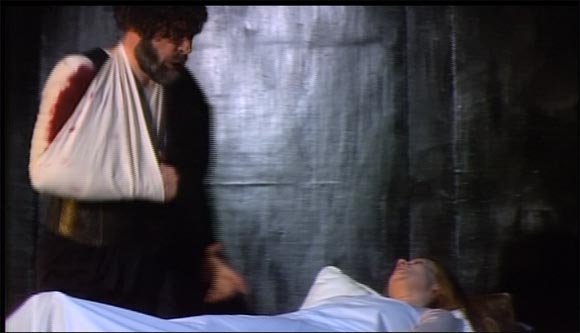
The picture is average DVD 16:9 and the sound options are PCM stereo, Dolby 5.1 and DTS 5.1.  The surround tracks were created from an original stereo source using DG’s AMSI II technology.  The DTS track is very decent but not quite up to best modern standards.  Extras include a trailer, a picture gallery and some DG promo material.  Subtitles are French, English, German, Spanish and Chinese.  There’s a trilingual booklet with track listings, synopsis and a short, not very useful essay.

This is a good (though far from perfect!) effort.  It’s definitely worth a look though I personally prefer the more recent Vienna recording.

fn1. I’ve long been skeptical about reviewers who claim that the best recording of a well known work is one made by Fritz Busch in his garden shed in 1935.

 

Dialogues of the Arkelites

Debussy’s Pelléas et Mélisande is not an opera I’m especially familiar with. It’s a strange piece based on a libretto by Maeterlinck. For much of the time it’s wordy without much action. There is a lot of philosophising. When the action does break out; Golaud’s mad jealousy in Act 3, the killing in Act 4, it gets musically and dramatically quite violent. The music is tonal and mostly quite dreamy. It’s almost mood music. All of this reminds me quite strongly of Poulenc’s Dialogues des Carmélites hence the title of this post. Also it’s French. Actually it’s very French.

Laurent Pelly’s 2009 production for Theater an der Wien is also very French; French director, French conductor, almost entirely French cast. In an opera where the words and the relationship between the music and the words matter a lot that’s a distinct advantage. The sets are semi-abstract and placed on a rotating turntable so that scenes can follow on with a minimum of interruption. The forest, the tower, the cave are all suggested rather than made entirely explicit. Even Mélisande’s extra long hair is not depicted explicitly. This fits the indirect nature of both the libretto and the music rather well. The costumes suggest somewhere around 1900 and the colour palette doesn’t stray far from “forest floor”. Lighting is quite dark but evocative. The sense of a gloomy castle in a gloomy (Breton?) forest is quite strong.

With the exception of a few outbursts from Mélisande’s husband, Golaud, and one fairly lyrical love scene between Mélisande and Pélleas the singers have few opportunities for vocal pyrotechnics. They do need to sing stylishly and articulate well though and this cast excels in that department. Natalie Dessay as Mélisande does the fragile Natalie thing which works really well in this role. Perhaps she could create more mystery around her character but her interpretation seems quite valid. Stephane Degout as Pélleas is a good physical actor and is lyrical where he needs to be. I’m not sure that there is much depth to be got out of the character anyway. Perhaps the most interesting role is the insanely jealous Golaud, sung here by the admirable Laurent Naouri. He has a fairly major emotional arc to go through and is strong in the scene of crazy jealousy where he gets his young son, Yniold (well sung and acted by Beate Ritter), to spy on the lovers. It’s a fine all around performance. The part of the old king, Arkel, is sung by Philip Ens. He conveys wisdom, sympathy and a kind of philosophical detachment in an extremely dignified but weary way. It’s a fine job of portraying a very old man without the voice sounding past it. Good supporting performances too from Marie-Nicole Lemieux as Geneviève and Tim Mirfin as the doctor.

Bertrand de Billy is in the pit with the ORF Radio-Symphonieorchester Wien. He seems to be thoroughly at home with the score and gets some lovely, transparent, sound out of the orchestra. The chorus, the Arnold Schoenberg Chor, does what little it has to do perfectly adequately.

The video direction, by Landsmann and Landsmann, is pretty sympathetic. A lot of the time not much is happening and they close in on the singer(s) which is fair enough. When there is a stage to be shown they show it. It’s nowhere annoyingly gimmicky. The picture is top DVD quality 16:9 and the DTS 5.0 sound is mellow rather than punchy which seems appropriate. AV quality is pretty much as good as it gets without going to Blu-ray. There are English, French, German, Spanish and Italian subtitles. Despite being split over two disks there are no extras. The documentation too is limited to credits (there’s not even a track listing). It;s quite a major omission for a work like this. An interview or an article about the director’s reading of the piece and his approach would be very useful.

There’s some stiff competition for this release, notably from Zurich and WNO, so I’ll certainly be trying to get my hands on some alternative versions in an attempt to deepen my understanding of the work as much as anything.