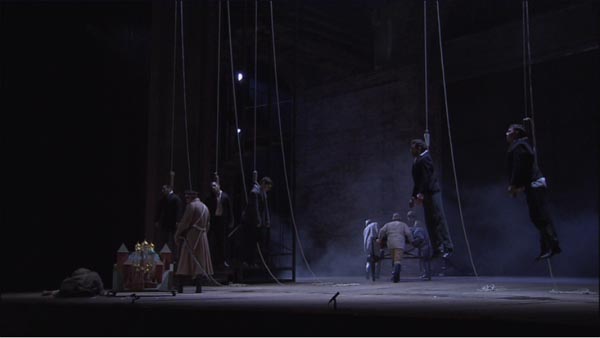
There are only two video recordings of Mussorgsky’s Khovanshchina currently available. The 1989 Vienna recording, which I wrote about yesterday, and a 2007 production from Barcelona’s Gran Teatre del Liceu which I’ve also just had a chance to see.
The two productions make for interesting contrasts on many levels. In Barcelona, music director Michal Boder, while opting to use the Shostakovich orchestration as a basis modifies it in places with elements of the Rimsky-Korsakoff version. He also uses Voronhov’s lower key alternative to the Stravinsky in the final chorus and he makes some cuts; most notably the Susannah scene in Act 3. He also gets quite a different sound from the orchestra. Where Abbado in Vienna is very refined, one might almost say Viennese, Boder is brasher. In places the music almost sounds like Shostakovich with the characteristic braying brass. Admittedly some of this may be due to the quality of the recorded sound. The Vienna recording is rather soft focussed Dolby 2.0 while Barcelona gets very crisp and detailed DTS 5.1 (There’s LPCM stereo too but I didn’t check it out).
 Continue reading →

 So Toronto’s hottest indie opera company, Against the Grain Theatre, has finally announced a 14/15 season. Not entirely unexpectedly they are bringing #UncleJohn; a transladaptation (©Lydia Perovic) of Mozart’s Don Giovanni to Toronto after it’s successful appearance in Banff this summer. With a new English libretto by Joel Ivany, #UncleJohn will be staged at The Black Box Theatre at 1087 Queen St. West’s vintage rock venue, The Great Hall. .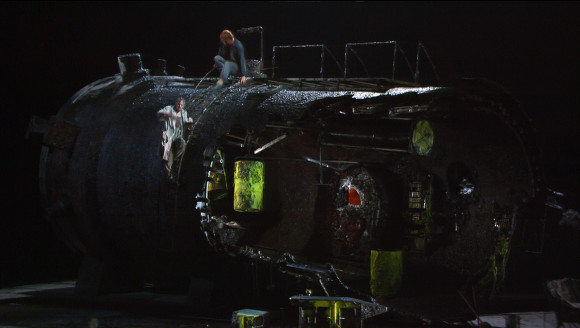
 operaramblings