New additions to the COC Ensemble Studio

The COC today announced six new singers will join the Ensemble Studio for the 2013/14 season.  If you read my review of the Ensemble Studio competition in November you’ll not be surprised.  The three prize winners; bass-baritone Gordon Bintner, tenor Andrew Haji and mezzo Charlotte Burrage are among the six as is my pick, dramatic soprano Aviva Fortunata.  The remaining two are baritone Clarence Frazer and mezzo Danielle MacMillan who were also quite impressive in the competition.

The Ensemble Studio is losing Mireille Asselin, Neil Craighead, Rihab Chaieb, Chris Enns and Ambur Braid as well as both pianists; Timothy Cheung and Jenna Douglas, at the end of this season though all of them can be seen in some capacity in La Clemenza di Tito next month.  Rihab is also appearing in Dialogues of the Carmelites in the spring.  There’s no word on new non-singing talent for Ensemble.  I’m going to be really interested to see what’s next for these guys.  We’ve had some good times together.

Full COC Press Release

Shout out to Washington

Rihab Chaieb and Mireille Asselin

Rihab Chaieb and Mireille Asselin

In February I attended a brilliant lunchtime concert of vocal music by Kaija Saariaho sung by three singers from the COC Ensemble Studio.  I wasn’t the only one who was impressed.  The composer was so taken with the standard of performance that she has arranged for them to perform a slightly different selection of her works in Washington DC in February.

If you aren’t from Toronto or Montreal (or perhaps Paris, Lyon, Dublin or Belgrade) you probably haven’t heard much about Mireille Asselin, Rihab Chaieb or Jacqueline Woodley (except maybe on this blog) but you will!  Strongly recommended both for the music and the singers.

Fifty shades of grey

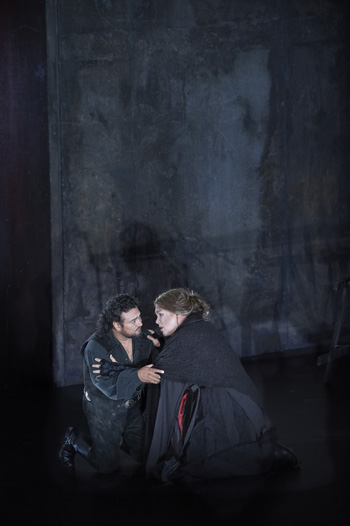
Verdi’s Il Trovatore notoriously has an episodic and highly improbable plot.  It’s also famously difficult to cast.  Creating a compelling production and staffing it with capable singers therefore presents a formidable double challenge.  The current Canadian Opera Company production gets it half right.  The problem is Charles Roubaud’s much travelled production.  There’s not an idea in it.  It’s not surprising that the director’s programme notes run to three short paragraphs.  Roubaud sets each scene in a sort of grey box of towering walls.  Unfortunately each grey box is just different enough that that the curtain comes down at the end of each scene and the stage crew spend what seems like an interminable amount of time setting up the next grey box.  We just aren’t used anymore to sitting quietly through interminable scene changes.  We expect slicker stagecraft and in a modern opera house there’s really no excuse for this 19th century approach.  Within in each grey box the grey clad cast come and go and in between mostly stand around.  Blocking is perfunctory, acting superfluous and old fashioned “park and bark” the order of the day.  It’s the sort of production that might have passed muster thirty years ago but really doesn’t cut it in 2012.
Continue reading

The review – COC Studio Ensemble in concert

(front row, l-r): Ambur Braid and Cameron McPhail; (second row, l-r): Jenna Douglas, Claire de Sévigné and Mireille Asselin; (third row, l-r): Neil Craighead, Owen McCausland and Sasha Djihanian; (fourth row, l-r): Rihab Chaieb and Timothy Cheung. Photo: Chris Hutcheson

So, as promised here are my thoughts on yesterday’s Ensemble Studio recital at the Four Seasons Centre.  It’s always interesting to see the Ensemble Studio together; to see how returning members have developed since last heard and to hear the newcomers.  This is what we got.
Soprano Claire de Sévigné gave us “Chacun le sait” from La fille du régiment.  It’s a good piece for a young singer and shee sang it with spirit and enthusiasm and acted with gusto.  Perfectly idiomatic French too of course.  She has a lovely voice and is clearly one to watch.

Continue reading

Here we go again

Photo credit: Chris Hutcheson.

Today was the first concert of the season in the free concert series at the Four Seasons Centre featuring the very talented artists of the COC’s Ensemble Studio.  I promise that there will be a proper review very soon but right now all I can offer is a treat for that section of my readership who have a thing for cross dressing mezzos.  You know who you are!

An engaging Semele from the COC’s Ensemble Studio

Mireille Asselin and Phillipe Sly

Last night saw the annual main stage performance by the COC’s young artist programme, the Ensemble Studio.  This year it was Handel’s Semele in the production which I saw a couple of weeks ago.  The main roles were cast from the Ensemble Studio with the the exception of the countertenor role of Athamas which was played by Ryan Belongie, an Adler Fellow.  The title role was split with Mireille Asselin singing the first two acts and Ambur Braid coming in for the third act.  This seemed like a sensible solution given the size of the role and the two singers’ strengths. Continue reading

Another lunchtime with Kaija Saariaho

Kaija Saariaho

Today’s concert in the RBA consisted of more works by Saariaho performed by members of the COC orchestra and the Studio Ensemble. Both the the composer and General Director, Alexander Neef, were there. The four works performed were most definitely not “easy listening”. To me they seemed firmly in the tradition of modern continental European composition in the same sort of mould as Henze or Berio. The pieces were all very dense with complex tonality and dissonance and placing great demands on the performers.


Jacqueline Woodley - Photo by Helen Tansey

First up was Changing Light described by the composer as a dialogue between soprano and violin. It’s a setting of a text by Rabbi Jules Harlow and was commissioned in the wake of 9/11. It may be a dialogue but the instrument doesn’t support the singer in any way. The violin is in a world of comples slides while the singer has some very tough intervals and the sustained, loud, high notes that characterize much of Saariaho’s vocal writing. That said in some ways this was the most conventional and accessible piece on the program. The performance by soprano Jacqueline Woodley and violinist Marie Bérard was first rate.

Mireille Asselin

Next came Mirage. This a setting for soprano, piano and cello of an English translation of a text from Mazatec healer and shaman Maria Sabina. It’s a rewriting of a piece originally written for soprano, cello and orchestra. The composer described this version as “more intimate”. It’s an uncompromising piece. Much of the piano part is played directly on the strings (rather than the keys) and the keyboard part is furiously virtuosic. The cello part is no easier with complex slides and atonality. The writing for soprano demands some characteristically difficult singing with something akin to Sprechstimme and some phrases that are whispered into the piano, using the piano as a reflector/amplifier. It’s quite a compelling piece. Again the performance was excellent. Jenna Douglas was on piano with Olga Laktionova on cello and Mireille Asselin singing.

The third piece seemed to me even more demanding. Lonh is a longish setting for soprano with electronic tape of fragments of medieval Occitan poetry by Jaufré Rudel. It requires an array of vocal techniques; singing, semi-singing, modulated speech, whispers, the works really. It’s quite haunting and the electronic tape which combines nature noises, bird sounds and fragments of spoken Occitan is very atmospheric. This was another fine performance by Jacqueline Woodley. We were told that this was composed as a “study” during the process of conceiving L’Amour du Loin so I guess it serves as an introduction to that sound universe.

Rihab Chaieb

The final piece was an early work for mezzo and soprano; From the Grammar of Dreams to texts by Sylvia Plath. It was described as “tenser” by the composer and to my ear sounded most influenced by the fashionable idiom of the 1960s and 1970s. It uses just about every vocal technique in the book and interweaves fragments of two different Plath poems; Paralytic and The Bell Jar. The composer tells us that dreams are “non linear” and that’s certainly reflected in the piece. Rihab Chaieb and Mireille Asselin were the singers and I thought their voices blended really well. The mix of Mireille’s very bright soprano with Rihab’s much darker tone was very pleasing.

I was really impressed with everyone on show today. It’s hard to express in words just how difficult this music is to perform. Here we had young singers and, I think, equally young instrumentalists putting on a truly impressive show. In particular, I was intrigued to see how much Mireille has come on. I first heard her sing a couple of Servilia’s arias from La Clemenza di Tito and my impression was of a perfectly competent light lyric soprano but nothing special. The last couple of times I have heard her she seems to have grown quite a bit musically and her performances today were top notch.

Ensemble Studio – end of season concert

Yesterday lunchtime was the last opportunity to see all the members of the COC Ensemble Studio before the season ends and some of them move on. It’s always interesting to see the Ensemble members as they are growing as singers so fast and, invariably, one hears a new and interesting side of someone that one hadn’t heard before. The programme material ranged from the 16th to the 20th century but it was all Italian and predominantly art song rather than opera. For me, the highlights were Ambur Braid singing a madrigal by Giulio Caccini; I think she’s so much better when she’s being lyrical rather than bravura, and, real eye opener, Rihab Chaieb singing Rossini’s Anzoleta avanti la regata with beautiful control, real feeling and rich, dark mezzo tone. I’ll be seeing Rihab tonight as one of the ugly step sisters in La Cenerentola and Ambur as Amore in Orfeo ed Eurydice next week.

Quilico Awards

Last night we went to the Quilico Awards competition. The prize was set up in honour of Canadian baritone Louis Quilico to support various aspects of vocal competition and performance and it has been competed for and awarded in different ways over the years. This year it was a vocal competition featuring the ten young singers of the COC Ensemble Studio. It was held in the Richard Bradshaw Amphitheatre at the Four Seasons centre and Alexander Neef (COC), David Spears (Opera Hamilton) and John Hess (Queen of Puddings Music Theatre) were the judges. It was a free gig but held at 5.30pm with minimal publicity on a week day so it perhaps wasn’t surprising that the audience was a bit thin. The format was that each singer prepared three arias. S/he sang one of his/her choice then the jury selected one of the other two. The third was held in reserve in case of a tie (which didn’t happen). Liz Upchurch was the accompanist throughout which was rather impressive in itself.

The standard was really very high. I’ve heard all these singers before, either in recital and/or on stage at the Four Seasons Centre. They are all good and getting better. Repertoire was quite varied. There was lots of Mozart (unsurprising since the Ensemble Studio’s last two productions have been Idomeneo and Die Zauberflöte) but we also got Barber, Purcell, Tchaikovsky, Stravinsky, Handel, Verdi, Wagner, Floyd, Smetana, Korngold, Britten and Barber. Quite a variety really.

One of my top picks would have been Met bound Wallis Giunta (mezzo) who sang “Parto, parto” from La Clemenza di Tito which I’ve heard her do before and the very different “Nobles seigneurs, salut!” from Meyerbeer’s Les Huguenots. Wallis’ musicality (as well as technical ability) was very evident in the way she tackled the tricky rhythmic flexibility of the piece. (You can check out what I mean about tricky rhythms here).

The other would have been baritone Adrian Kramer who goes from strength to strength. He gave us “Pierrot’s Tanzlied” from Korngold’s Die tote Stadt and what has rather become his party piece, Sid’s aria “Tickling a trout” from Britten’s Albert Herring. Watch out for this guy. He has a very good voice and wicked comic timing but showed he also has a lyrical side in the Korngold.

Had I been a judge I would have found picking a third winner close to impossible. There was so much to like. So what did the judges decide?

In third place they had tenor Chris Enns (a fine Tamino earlier this season). Last night he gave us Lensky’s aria from Eugene Onegin and “Here I Stand” from Stravinsky’s The Rake’s Progress. I particularly liked the Tchaikovsky which showed off a nicely developing lyrical tenor voice very well.

Second was dramatic soprano Ilieana Montalbetti. Ileana is a bit of an anomaly. The other girls in the programme are your modern lyric, look the part, sort of modern soprano/mezzos (one of them moonlights as a fashion model). Ileana is the one truly dramatic voice and can we say she looks a bit more like the popular image of a dramatic soprano (actually she’s not really that big but…). She gave us “Come in quest’ora bruna” from Simon Boccanegra and “Einsam in trüben Tagen” from Lohengrin. The RBA is not a huge space and it was piano accompaniment so I don’t think she was close to maximum power (I’ve heard her sing much louder!) but the impression of lots of gas in the tank was definitely there along with a good deal of control and attractive tone colour.

The winner was Adrian Kramer. No surprise there.

Fortunately for us we will get to see most of these singers next month on stage in various roles. Ambur Braid is singing Amore in Orfeo ed Euridice, where Simone Osborne is understudying Isabel Bayrakdarian’s Euridice. Rihab Chaleb will sing Tisbe and Ileana will sing Clorinda in La Cenerentola. Ariadne auf Naxos has a slew of Ensemble Studio members in the cast. Simone Osborne sings Naiad, Adrian Kramer is the Wigmaker, Chris Enns is Scaramuchio and Michael Uloth is Truffaldino and it seems like everyone is understudying something!

There are good things in Toronto. How many places can you see ten first rate singers perform for two hours in a beautiful, acoustically excellent setting, for free?