
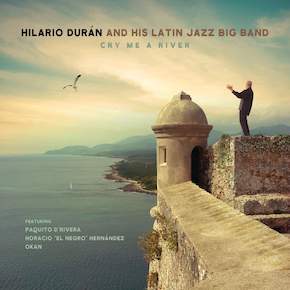
 So one of the fun things about this writing project that I started twelve years ago is the unexpected ways that it has sometimes developed. One gets involved with projects, one meets people and one ends up connected with their other projects that may stray some way from, say, opera or art song. So last night I found myself at a film screening and CD release party for the new CD from Hilario Durán and His Latin Jazz Big Band. It was fascinating. First of all I really liked the music; original compositions and covers arranged for something like eighteen brass, woodwind, guitar/bass and percussion players with Hilario conducting from the piano and guests on some of the tracks including the amazing clarinet and sax player Paquito D’Rivera, vocalist/violinist Elizabeth Rodriguez, drummer Horacio “ElNegro” Hernández and bass player Marc Rogers.
Cry Me A River
Reply
 This new CD recording of Purcell’s Dido and Aeneas sets out to produce a version that might have been heard at court in the early 1680s. This is, of course, one of several theories about the work’s genesis and it’s the one I find most credible. Taking this as a starting point allows music director David Bates a framework in which to consider issues of style and casting.
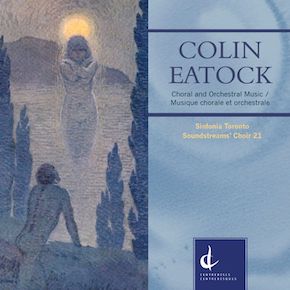 Centrediscs have recently released a CD of music by Toronto composer Colin Eatock. It’s a mix of choral and orchestral works; most of the former for unaccompanied voices. There are ten works on the disc making a generous 67 minutes or so of music.
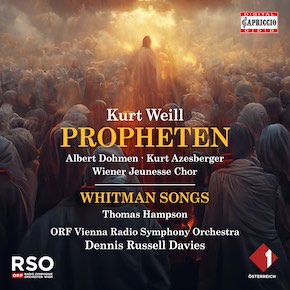 One of the strangest records of Kurt Weill’s music that I have ever listened to has just come my way. There are two pieces involved; Propheten and Four Walt Whitman Songs. Propheten has its roots in Weill’s six hour long, Old Testament inspired, opera The Eternal Road which premiered at the Manhattan Opera House in 1937 with a cast of 245 and which ran for 153 performances before, perhaps unsurprisingly, disappearing for a long,long time. Propheten is a 1998 adaptation of the last act by David Drew using the original German text by Franz Werfel plus biblical quotations and additional orchestration by Noam Sheriff. It basically deals with the sack of Jerusalem by Nebuchadnezzar and comes in at a more digestible 45 minutes.
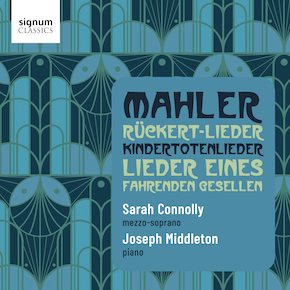 Mezzo-soprano Sarah Connolly and pianist Joseph Middleton have produced a CD with three of Mahler’s best known song cycles; the Rückert-Lieder, Lieder eines fahrenden Gesellen and the Kindertotenlieder. It’s a very fine recording. Both performers are, of course, expert recitalists and they take quite an individual way with these well known pieces. In general they are quite slow (less so in the Rückert songs than the other two sets) but very clearly articulated. The phrasing, by both singer and pianist, is very deliberate and sometimes quite individual. This is most pronounced in the Rückert songs. It’s an interesting approach which I enjoyed.
 I don’t review a lot of full length audio only recordings of mainstream operas. Generally I think video makes more sense but sometimes something comes along that attracts my attention. The recent recording of Handel’s Serse by the English Concert with Harry Bicket was one such. This time it’s the cast that caught my attention. There’s Emily d’Angelo (are we allowed to call her “young” or “emerging” any more?) in the title role but also such fine Handel singers as Lucy Crowe as Romilda and Mary Bevan as Atalanta. As it turns out there’s not a weak link in the cast and while these three turn in fine performances so do Daniela Mack (Amastre), Paula Murrihy (Arsamene), Neal Davies (Ariodata) and William Dazeley (Elviro).
 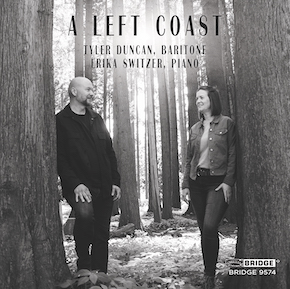 A Left Coast is baritone Tyler Duncan and pianist Erika Switzer’s tribute to British Columbia and its music. Seven composers with birthdates ranging from 1908 to 1985 are featured on the disk. BC is a young country as far as western classical music is concerned though, of course, it has rich artistic traditions stretching far back into the mists of the north west.
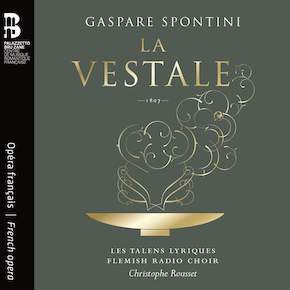 Spontini’s 1807 work La Vestale is the latest French opera to get the Palazzetto Bru Zane treatment. Ir’s extremely interesting as this work has a performance history not unlike the more famous Médée of Charpentier. It’s very much a tragédie lyrique in the same basic style as the works of Gluck, though with some compositional innovations that did not endear the composer to the Paris musical establishment. Indeed, but for the determined patronage of the Empress Josephine it likely would never have made it to the stage. Like Médée it was initially very successful before disappearing from the repertoire in the later 19th century. Also like Médée it was the subject of a mid 20th century revival, notably a 1954 La Scala production (in Italian) by Visconti featuring Maria Callas. Inevitably given the time and place it was given in a style that owed more to verismo than French classicism with a large modern orchestra, conventional (by 1950s standards) tempi and a rather more overblown singing style than was ever heard in early 19th century Paris. If it were revived again for major houses one imagines it would still get essentially the same treatment. Perhaps it will be the next international diva vehicle for Sondra Radvanovsky?
 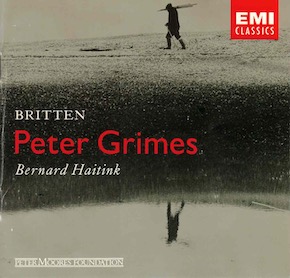 Regular readers will know I’m something of a Peter Grimes completist so I was interested to get my hands on a recording previously unheard by me (one of only two such!). It’s a 1992 recording made in Watford Town Hall and, as far as I know, was not made in conjunction with a stage run. The Grimes is Anthony Rolfe Johnson with Thomas Allen as Balstrode and Felicity Lott as Ellen Orford. There’s also a young Simon Keenleyside as Ned Keene. Bernard Haitink conducts with Orchestra and Chorus of the Royal Opera House.
  operaramblings