What is this anguish that each of us carries inside?

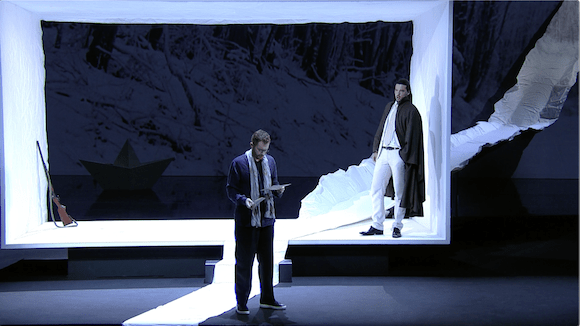
What is this anguish that each of us carries inside?  That’s the central question of Thomas Larcher’s chamber opera Das Jagdgewehr that premiered at the Bregenz Festival in 2018.  It’s based on a 1949 novel by Yasushi Inoue about a hunter, the three women in his life and the poet to whom he sends the women’s letters.  It’s a stark, intense tale of love, death, secrecy, loss and betrayal told in a prologue and eleven scenes over about an hour and a quarter.

1.letter

Continue reading

Brueghelland

ETA 6th December 2019:

Rewatching Le Grand Macabre after four years has rather changed my opinion.  It still seems weird and sometimes hard to watch but I think I see a certain logic in it now that completely escaped me before.  So the End of the World is approaching and all the Powers that Be can do is squabble, exchange scatological insults and get very, very drunk while the one sane (if rather weird) character (Gepopo) can’t find a language to communicate the enormity of what’s happening to them.  Sound vaguely familiar?  (Coincidentally, I’m writing this on the day that Andrew Scheer said that the Federal Government should give more heroin to the addicts in Alberta because otherwise they’ll get in a snit).  Of course, in Ligeti’s version Death gets so drunk that he screws up terminating the space-time continuum but we probably won’t be so lucky.  So yes the fart jokes and the raccoon on bins orchestra is still there but it now seems to me in service of something rather more profound than I previously gave it credit for.  Also, Hannigan is not just brilliant vocally.  It’s also, even by her standards, an amazing physical performance. (Original review under the cut).

gepopoprince

Continue reading

The dream is over but the night not yet

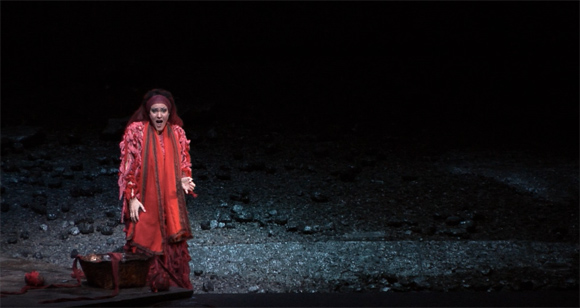
So closes Aribert Reimann’s 2010 opera Medea.  It’s a two hour piece in four “pictures” that premiered at the Wiener Staatsoper in 2010 and the Blu-ray/DVD recording is taken from that initial run.  Actually there’s a good deal more nightmare than dream in this version as, I suppose, there is in just about any version of the Medea story.  This one draws on Franz Grillparzer’s version for the libretto and is entirely concerned with events after Jason and Medea reach Corinth.  It’s unusually sympathetic to Medea herself with Jason and Kreon very much the villains.

Continue reading

The other Khovanshchina

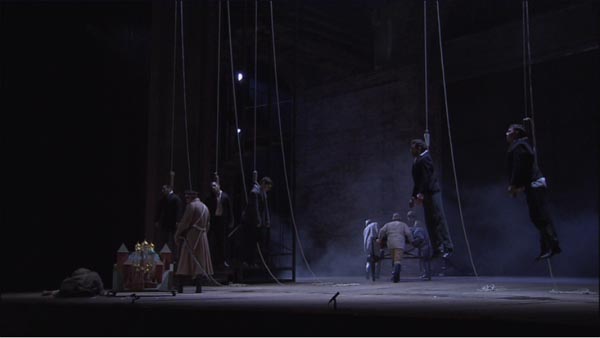
There are only two video recordings of Mussorgsky’s Khovanshchina currently available. The 1989 Vienna recording, which I wrote about yesterday, and a 2007 production from Barcelona’s Gran Teatre del Liceu which I’ve also just had a chance to see.

The two productions make for interesting contrasts on many levels. In Barcelona, music director Michal Boder, while opting to use the Shostakovich orchestration as a basis modifies it in places with elements of the Rimsky-Korsakoff version. He also uses Voronhov’s lower key alternative to the Stravinsky in the final chorus and he makes some cuts; most notably the Susannah scene in Act 3. He also gets quite a different sound from the orchestra. Where Abbado in Vienna is very refined, one might almost say Viennese, Boder is brasher. In places the music almost sounds like Shostakovich with the characteristic braying brass. Admittedly some of this may be due to the quality of the recorded sound. The Vienna recording is rather soft focussed Dolby 2.0 while Barcelona gets very crisp and detailed DTS 5.1 (There’s LPCM stereo too but I didn’t check it out).

Continue reading