Curiously aloof Tristan

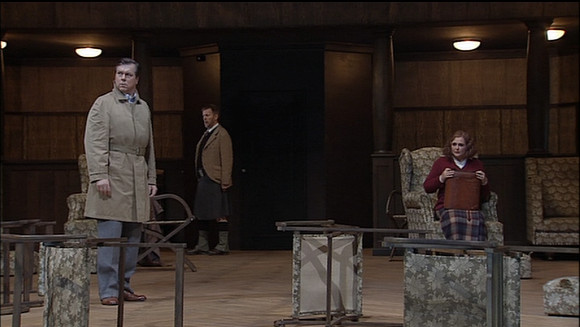
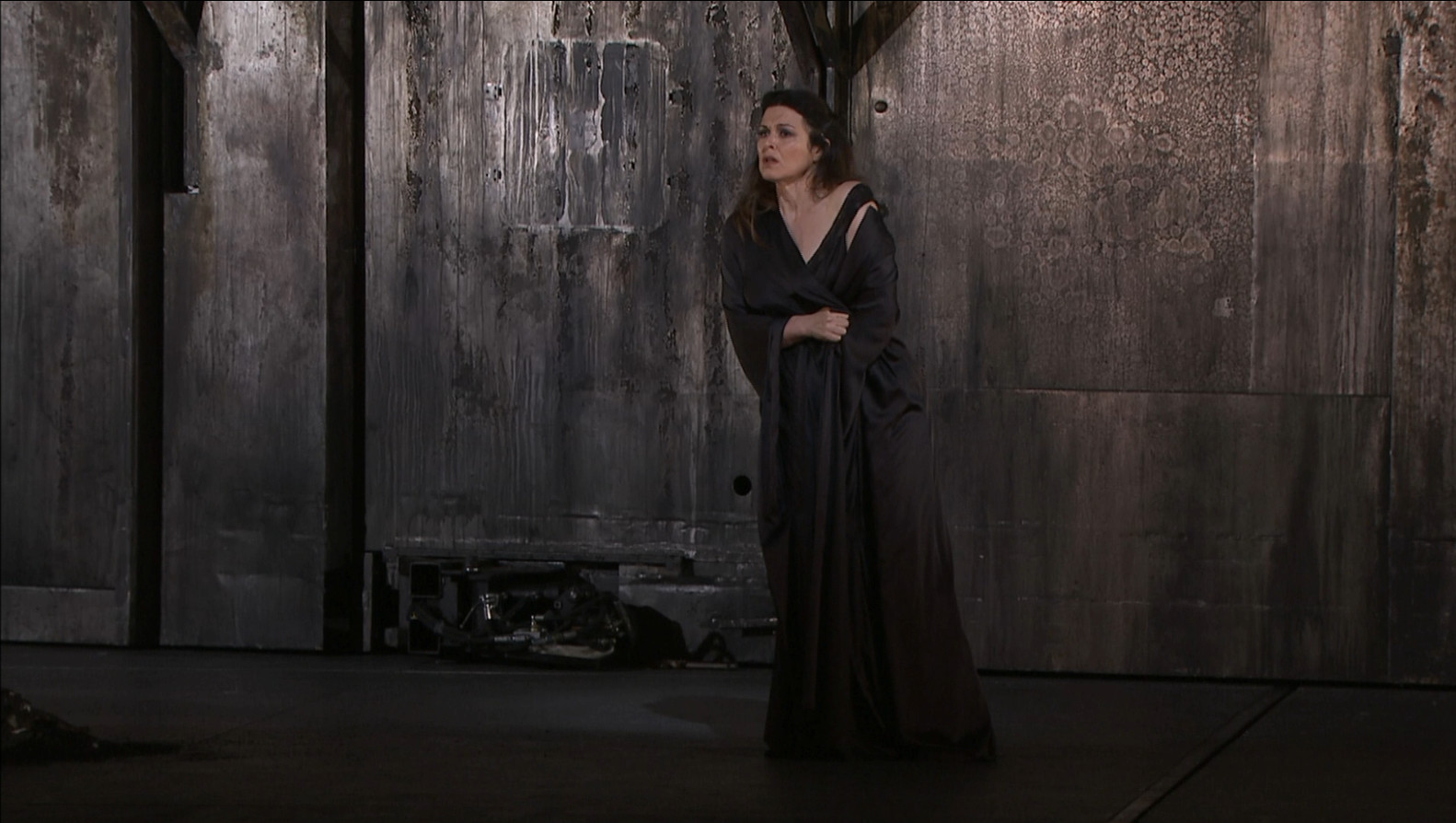
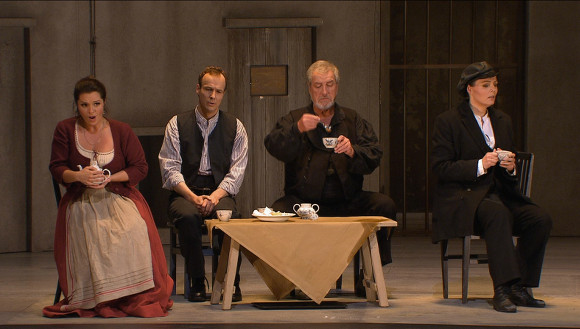
Christoph Marthaler’s 2009 Bayreuth production of Tristan und Isolde is set in a sort of Stalinist brutalist aesthetic populated with stock figures from the 1950s.  Passion is at a minimum and the characters all seem to be trying as hard as possible to be conventional representatives of their roles.  The only one who shows any real human engagement is Kurwenal who comes across almost as a commentator on the action, or even a director.  There’s also some fairly stylized gesturing in a sort of pseudo-Sellars manner.  It’s epitomised by the costumes in Act 2 where Isolde and Brangäne look like dolls dressed as Hausfraus and Tristan wears a hideous blue blazer.  This is all rather reinforced by Michael Beyer’s video direction which uses a lot of close ups but also has a curious stillness about it that seems to amplify the emotional void; if indeed one can amplify a void.  Oddly though, in places this approach really works in that the distance, coupled with very precise blocking, gives space for the music’s essential intensity to come through.  Act 2 Scene 2, perhaps the emotional crux of the piece, is very moving and the So stürben wir, um ungetrennt is quite impressive.

1.chairs Continue reading

300

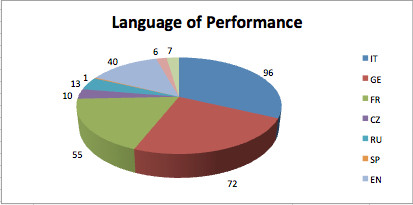
There are now 300 reviews of Blu-ray and DVD recordings in the database.  (70 Blu-ray, the balance DVD)  As I did at 200 I took a look at how they break out.  I’ve pretty much exhausted the opera dvd resources of the Toronto public library system so recent and future reviews are more likely to be of things I’ve chosen to spend money on, bar the odd review copy from record companies.

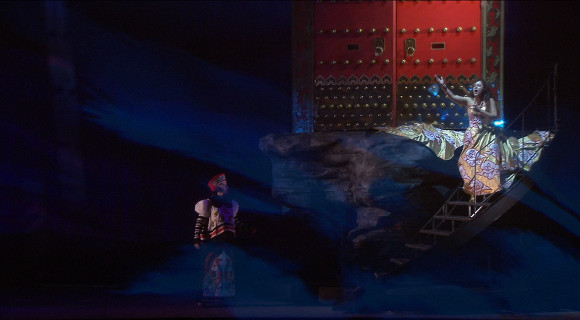
languageThe first thing I looked at was language of performance.  It’s no surprise that Italian (96) and German (72) dominate the list.  French is  a strong third at 55.  English comes in at 40, almost all 20th and 21st century works.  Other (7) is quite interesting as it mostly reflects works in multiple languages such as Tan Dun’s Marco Polo.  “Other” is very much a modern category.  Continue reading

Straightforward Gambler from the Mariinsky

The 2010 recording of Prokofiev’s The Gambler from the Mariinsky Theatre is a bit of a mixed bag.  It’s a complicated opera about obsession and power and it needs a strong production and a director who can get coherent performances out of a large cast to fully succeed.  Temur Chkhiedze doesn’t really manage it.  The production is very straightforward, set in slightly abstracted versions of a hotel, a casino etc and at times it is brought to life by the clever lighting of Gleb Fishtinsky but it doesn’t do enough to establish any real purpose for the piece.  It’s not helped by some very broad acting, especially from Sergei Aleksaskin’s General which is further emphasized by video director Laurent Gentot’s heavy use of close ups.

1.hotel Continue reading

Spectacular Die frau ohne Schatten from the Mariinsky

Richard Strauss’ Die Frau ohne Schatten is a problematic work on many levels.  Hofmannsthal’s complicated and heavily symbolic libretto places considerable demands on both audience and director.  There are ideas about women, marriage and child bearing in the libretto that sit very uncomfortably with modern audiences.  It’s also a beast to cast requiring not just a truly Helden tenor and soprano but a second soprano of almost equal heft who can handle some fairly tricky coloratura.  It’s also long and requires a large orchestra.  In some ways it’s surprising that it gets performed as often as it does although when done well it’s a piece of quite extraordinary beauty and power.

1. Empress Continue reading

First, the sound quality

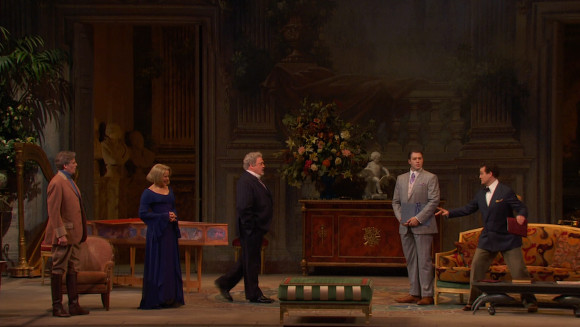
The MetHD broadcast of Strauss’ Capriccio has been issued on Blu-ray.  I enjoyed the original broadcast but found watching it again on disk rather unsatisfying.  The main problem is the production.  It’s a John Cox effort from 1998.  The period is updated from ancien régime France to just after WW1, apparently to make the people more contemporary while allowing an opulent, old style Met “all the things” production.  Peter McClintock’s direction of the revival emphasizes the most obvious comedy (the ballerina falling over with her legs in the air, for example) while doing little or nothing to bring out the sheer cleverness of this opera, about an opera, within an opera.  It all seems very heavy handed, in fact the word that popped into my head several times was “vulgar”.

1.drawingroom Continue reading

Seamen from a distant Eastern shore

Berlioz’ Les Troyens is one of those pieces that really deserves the descriptor “sprawling epic” and, if anyone can make an epic sprawl it’s David McVicar.  This production, recorded at the Royal Opera House in 2012, is typical of McVicar’s more recent work.  It’s visually rather splendid and the action is well orchestrated but it’s short on ideas and long on McVicar visual cliches; acrobats, gore and urchins (but mercifully no animals).  I don’t want to be too hard on McVicar.  This piece is based on the sort of “Ancient History” one used to learn at prep school (British usage) and McVicar pretty much runs with that making no attempt to find deeper meaning, despite superficially translating at least the first two acts to the time of first performance; the era of European colonialism.

1.cassandre Continue reading

Kupfer/Barenboim Ring – 4. Götterdämmerung

I think it’s only with the final instalment of the Kupfer/Barenboim Ring that its true power is apparent.  The first three instalments are very fine but Götterdämmerung is devastating.  All the elements that have been progressively introduced are seamlessly combined.  Add to that extraordinarily intense performances from Siegfried Jerusalem (Siegfried), Philip Kang (Hagen) and, above all, Anne Evans (Brünnhilde) and one has something very special indeed.

1.norns Continue reading

O namenlose Freude

Katharina Thalbach sets her Fidelio, filmed at Zürich in 2008, somewhere in the early 20th century.  Most of the costuming suggests very early but Don Pizzaro’s suit suggests 20s/30s gangster.  Maybe he’s just fashion forward. The story telling is fairly straightforward and there’s no big concept.  There are a few, smallish, touches.  For example, the prisoners seem to be playing basketball with Don Pizarro’s head in the conclusion.  The sets are literal but evocatively lit and rather effective.

1.quartet Continue reading

Kupfer/Barenboim Ring – 3. Siegfried

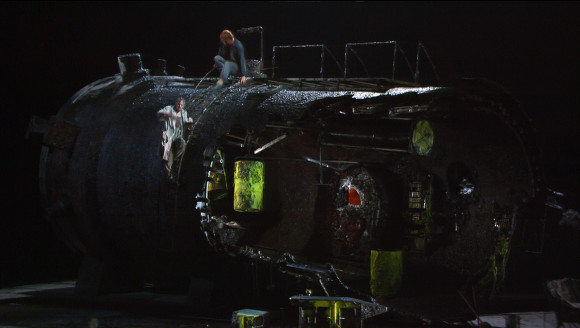
We seem to be in some kind of post apocalyptic wasteland.  Mime’s hut looks like a re-purposed storage tank but the bear and the forest are more or less realistic.  It’s all very dark and there’s quite a lot of use of pyrotechnics.  This is also our first look at Siegfried Jerusalem’s Siegfried and he is very good indeed.  He captures the hero’s youthful vigour and arrogance extremely well.  There is a strong performance too from a rather manic Graham Clark as Mime and John Tomlinson continues as a reckless and wild Wanderer.

1.hut Continue reading

New/old Blu-ray titles

warnerclassics2564636281It appears that Warner Classics are slowly releasing some of their back catalogue of video recordings on Blu-ray.  These appear to be recordings that were previously available in North America on rather low quality Kultur releases.  And by low quality I mean that many of them had serious sound problems as well as annoyances like hard coded English subtitles.  These are mostly older recordings; typically 4:3 format picture drawn from TV broadcasts so there is only so much remastering can do for them but, if the Sellars Theodora is anything to go by, they are a huge improvement.  Several Glyndebourne classics have appeared including the Anja Silja Makroupolos Case and the Haitink Marriage of Figaro.  Pricing is a bit variable but there are some real bargains to be had.