Singing Through the Darkness

So my third Holocaust Remembrance concert was Singing Through the Darkness which played at the Jane Mallett Theatre on Wednesday night.  Unlike the previous two concerts which focussed largely on music in the classical tradition with a bit of folk thrown in this time it was more jazz/musical theatre.

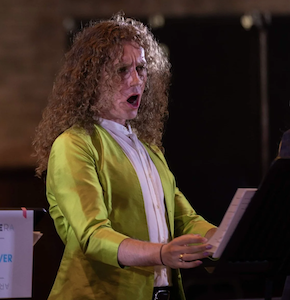
The programme was a very varied mix of music and poetry composed in camps and ghettoes, folk songs remembered from a fractured past, partisan songs and even a bit of Kurt Weill.;  The arrangements were for various combinations of Aviva Chernick, Lenka Lichtenberg, Theresa Tova and Fern Lindzon on vocals with Fern on the piano (and melodica) and, on occasion, Lenka on guitar.  There was even a cameo by Judith Lander.  Ori Dagan mceed. Continue reading

The Likht Ensemble at the Leah Posluns Theatre

It’s January which means Holocaust remembrance and, lest we forget, the Likht Ensemble are touring a programme drawn from the Shoah Songbook which they gave at the Leah Posluns Theatre in North York on Saturday evening.  I have written quite a lot about this ensemble and this project so it’s a challenge to find anything new to say but we can try.  FWIW previous related posts include:

Continue reading

Pictures from the Private Collection of God

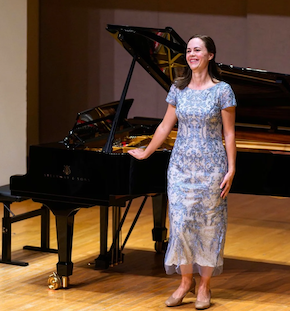
Tuesday’s lunchtime recital in the RBA, the first of 2026, was given by Israeli mezzo-soprano Michal Aloni and pianist Alona Milner.  All the music, most of it Hebrew language art song, was by composers who either emigrated to Palestine/Israel or who were born there.  In their excellent introductions Michal and Alona enumerated three waves or generations of composers:

  • Those who were trained in Europe in the early 20th century who left Germany (or parts adjacent) for obvious reasons after 1933 such as David Zehavi and Paul Ben-Haim.
  • Those who emigrated later; often as children, whose musical formation was in the new state like Yehezkel Braun.
  • Those who were born and/or educated in Israel somewhat later represented here by Stella Lerner and Aharon Harlap.

Continue reading

What might we see at the COC in 2026/27

It’s about the time of year when one starts to think about what might be in the next season at the COC.  The last couple of years the announcement has just been an email drop and there’s really no way of telling when it will happen.  In about a month’s time is likely so if I’m going to make some predictions now is a pretty good time.

Once upon a time there were some pretty good indicators of what the next COC season might look like.  Rumours aside, one could look at:

  • Co-productions with other companies and expect that they would come around sooner or later
  • Ditto commissions of new work
  • A certain regularity in the recurrence of “popular” works.  Madama Butterfly every five years for example.

The trouble is none of this seems to be relevant anymore.  Co-pros and commissions disappear without trace and the regularity patterns seem no longer to apply.  The only real certainty is that three or four shows will be revivals.  All of which makes trying to make predictions a bit daft… which makes me ideally suited to do it.  So here goes… Continue reading

Mr. Dowland’s Dream

So following on from Ruby Hughes’ Dowland heavy album Amidst the Shades we have soprano Clara Brunet and lutenist Bor Zuljan with Mr. Dowland’s Dream.  It’s similar in some ways but very different in others.  For a start Zuljan is playing an orpharion; which sounds a bit like a lute with a reverb pedal.  Mostly he’s using a nine course instrument by Bruce Brook, after a 1617 instrument by Francis Palmer, and sometimes he’s playing an electric orpharion of ten courses by César Arias with magnetic pick ups.  Net result, the sound world is rather different from the Hughes album. Continue reading

Zanetto

Pietro Mascagni is really remembered for only one opera; the one act Cavalleria Rusticana, which was sufficiently successful for its composer to be considered for a while a probable successor to Puccini as the next “great Italian opera composer”.  That didn’t happen of course and the only other of his works to get even occasional stagings are L’amico Fritz. and Iris though he wrote a total of fifteen.  Now there’s a recording of his one act opera Zanetto which was made at a live, semi-staged performance in Berlin in June 2022. Continue reading

Amidst the Shades

Amidst the Shades is a new album from British soprano Ruby Hughes accompanied by Jonas Nordberg on lute and archlute and Mime Yamahiro Brinkmann on viola da gamba.  It’s a very beautiful record starting, as one might expect, with a selection of English song from the 16th and 17th century plus some pieces for solo lute.  There are songs by John Dowland, including the well known Can She Excuse My Wrongs (possibly to a text by Robert Devereux; if so clear who “she” is).  Robert Johnson makes an appearance with three songs including two Shakespeare settings.  John Danyel also features along with instrumental music by Anthony Holborne and Tobias Hume. Continue reading

Best of 2025

So here we go with a round up of what’s been going on and the best things I saw and listened to in 2025.  I’m picking from 165 live performances and over 100 recordings so there was some competition!

Opera

The Toronto opera scene is recovering slowly from the pandemic but there’s still way less going on than pre 2020.  Opera 5 continued their comeback in 2025 and Opera Revue made their eclectic contributions but the indie opera scene is pretty thin.  The ring is pretty much held by the well established; the COC, Opera Atelier, OIC, Tapestry and the student programmes.  It looked like Against the Grain was emerging fro hibernation but that’s been kicked into the long grass now too.

So my favourites:

  • Tapestry Opera’s remount of Luna Pearl Woolf and Royce Vavrek’s Jacqueline in February showed that this work had legs and deserved it’s, by now, multiple appearances around North America.
  • Julien Bilodeau and Michel Marc Bouchard’s La Reine-garçon at the COC in March was a substantial and excellent new Canadian opera in a fine production and performance.
  • The highlight of the year at the COC and likely one of the highlights of the decade at the COC was William Kentridge’s searing production of Berg’s Wozzeck in April.  It was everything one could want from a 20th century classic with some great performances from the likes of Michael Kupfer-Radecky, Ambur Braid, Matt Cairns and Michael Schade backed up by Johannes Debus and the COC orchestra in the finest form I have heard them in.
  • The first site specific performance in a while was the rather weird but very satisfying Queen of the Night Communion staged by Tapestry Opera and Luminato at Metropolitan United Church in June.  There were some unique arrangements of well known pieces, cool staging by Michael Mori and a strong cast headlined by Krisztina Szabó.
  • In July Toronto Summer Music showcased a touring production of Monteverdi’s L’incoronazione di Poppea in a production by Cappella Mediterranea that transcended the limitations of being “semi-staged” to offer a proper period take n the composer’s masterpiece.
  • TSM also gave us the long awaited Toronto appearance of Brian Current and Marie Clements’ MISSING; about murdered and missing Indigenous women and girls.  The powerful performances and evocative use of video transcended the limitations of a semi-staged performance.
  • October’s revival of Robert Carsen’s production of Gluck’s Orfeo and Euridice in October combined Carsen’s minimalist but beautiful production with fine performances to create a very satisfying overall result.

Brooklyn Marshall and Ambur Braid in Wozzeck – Photo: Michael Cooper

Continue reading

Czardas Princess

Toronto Operetta Theatre’s New Year’s offering is Imre Kalman’s Czardas Princess.  It’s lively and tuneful and not overly serious being basically a succession of Austro-Hungarian Empire stereotypes.  To whit Prince Somebody von und zu Wherever-Etcetera is in love with a Hungarian cabaret singer with an unpronounceable name from a pig rearing village with an equally dubious moniker when he’s supposed to be marrying his countess cousin.  All the usual s/he loves, s/he loves me not plus parental disapproval play out until a shocking revelation.  So the Prince gets his girl and his cousin gets a Hungarian count (probably a somewhat richer pig farmer) as a consolation prize.  They all live happily ever after, or at least until 1914.

Continue reading

Upcoming in the New Year

Here’s some of what January has to offer…

Toronto Operetta Theatre is doing Imre Kalman’s The Czardas Princess over the New Year holiday.  It’s st the Jane Mallett Theatre and there are shows on December 30th and January 2nd, 3rd and 4th.

Continue reading