McVicar’s Entführung

I think I’ve got used to David McVicar productions or, at least, what he’s produced in the last ten years or so.  The director’s notes will sound erudite and convey the impression that he’s gained some vital new insight into a well known work.  The actual production on stage will be almost entirely conventional with maybe the odd visual flourish but nothing to start the synapses firing.  This is very much the case with his 2015 production of Die Entführung aus dem Serail from Glyndebourne.  The “big idea” is that Bassa Selim is caught between two worlds; the ‘west” and the “east”.  Well duh!  This is as revelatory as pointing out that Mimi has TB.  This “revelation” is the reason/excuse for presenting the work with dialogues unaltered and uncut.  This is very much a mixed blessing.  Yes, it does allow some character development that’s otherwise missing but on the other hand it emphasises the fact that without some interesting new angle Entführing is basically dramatically a bit feeble.  Is she faithful?  How dare he doubt it?  Please forgive me.  Why should I?  Lather, rinse, repeat.  Enter Osmin.  Hang them.  Impale them. Daggers and poison.  Over and over.

1.baumeister

Continue reading

Opera 5’s Barber of Seville

Opera 5 opened a run of Rossini’s The Barber of Seville at the Factory Theatre last night.  It’s arguably the most conventional thing Opera 5 have done.  It’s a (very) mainstream piece.  There was no accompanying themed food or drink (a glass of Rotsina?).  There was no audience participation.  There weren’t even Aria Umezawa’s characteristically minimalist touches.  What there was a carefully constructed Barber for reduced forces directed by new Artistic Director Jessica Derventzis and conducted by Evan Mitchell.

O5 Barber #2_preview

Continue reading

Queer of the Night

queerofthenightSo you have sung the Queen of the Night exactly 2,327 times; high Fs and all, and you are sick to death of it and the Misogyny it rode in on.  What do you do?  Well, obvs you create a one woman show that teeters between mocking opera stereotypes of women and something much darker.  At least that’s what Teiya Kasahara did as part of Tapestry Opera’s Tap This: A Queerated Opera Series presented in conjunction with Pride.

So our favourite inked butch dyke coloratura comes on in a foofy dress complete with Dollarama coronet and wand and starts to sing the heck out of that aria – you know, the one they sing at weddings.  But then it rapidly morphs into a diatribe; first in German, then in heavily accented English, about the role, how women are portrayed in opera, occasionally veering into how women; sopranos in particular, are seen/treated in the opera world(*) before switching up into dress pants and a wing collared shirt with studs (despite pianist David Eliakis’ increasingly frantic pleas of “no pants”).  Along the way there are jokes, some killer singing and some very sharp reminders of what it’s like to be a strong, athletic, queer woman in a world that expects its sopranos to behave as if they are romantically dying of TB on-stage and off.  It’s a very moving and rather disturbing 45 minutes that I really can’t do full justice to.  It’s a very brave show and  I hope Teiya puts it on again.  More people need to see it.

(*)It’s odd that it should come just after I first encountered Kiri Te Kanawa live for surely few sopranos have been as sexually objectified.  I don’t know how many people remember Bernard Levin’s Times column written after her ROH debut in 1971 but it’s probably the only time the Thunderer was printed using drool.

Judgement

And so to the concluding drama; judgement.  There were a ton of prizes ($270,000 in all) and the “lesser” ones got announced first.  So here’s the list of everybody except the winners of the two main competitions:

  • Best Canadian in aria: Emily D’Angelo
  • Best Canadian in art song: Rihab Chaieb
  • French mélodie: John Brancy
  • German Lied: Julien van Mellaerts
  • Oratorio: Andrew Haji
  • Opera aria: Mario Bagh
  • Pianist: João Araújo
  • People’s choice – aria: Emily D’Angelo
  • People’s choice – art song: Clara Osowski

Jury-1

Continue reading

The aria finals

And so the final act.  First on stage was Emily D’Angelo; the only lady left in the competition.  It was an accomplished and varied set.  She started with a characterful and technically proficient Una voce poco fa followed by an appropriately lyrical Must the winter come so soon?  Coeur sans amour from the Massenet Cendrillon showed off excellent French before a suitably dramatic rendering of the Komponist’s aria from Ariadne.  Pretty much all the mezzo bases covered there and covered very well.

GrandFinale-2

Continue reading

Royal Conservatory 2018/19

hampsonpisaroniThe Royal Conservatory has announced its concert programme for 2018/19.  It’s not massively exciting from a classical vocal point of view although there are a few goodies and the odd surprise in the package.  The most exciting is saved for the very end of the season when Thomas Hampson and son-in-law Luca Pisaroni have a recital at Koerner.  That’s on 30th April 2019.  The most surprising is the season opening gala, also at Koerner, on 2nd October 2018 which features Kathleen Battle.  I’ll be honest, I thought she retired years ago.

Continue reading

CMIM aria final contestants

I missed the aria semis but here are the singers who will feature in the final tomorrow night:

  • Emily D’Angelo (Canada – Italy), mezzo-soprano
  • Andrew Haji (Canada), tenor
  • Konstantin Lee (South Korea), tenor
  • John Brancy (United States), baritone
  • Mario Bahg (South Korea), tenor
  • Mikhail Golovushkin (Russia), bass

GroupPhoto-1-e1528256808925

Belated art song final post

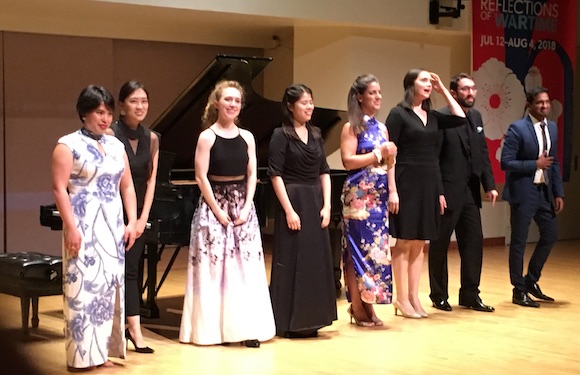
That which had to be done is done.  What follows is a write up from my notes of Sunday’s art song final.  Please bear in mind that I was less than fully emotionally engaged and you may well prefer Gianmarco Segato’s thoughtful review.

Julien van Mellaerts sang first.  He started off in conventional territory with Strauss, Schumann and Wolf; showing good command of the Lieder style, expressiveness and a willingness to vary dynamics.  A pleasing version of Adams’ For You There is No Song was followed by the weird and somewhat chilling Genius Child by Owens; a neat contrast.  The set concluded with Debussy’s Trois ballades de François Villon.  There was some lovely, delicate singing here with some ravishing floating notes.  Overall, as in the previous rounds, very good stuff without, perhaps, having the X factor.

MelodieFinale-3

Continue reading