
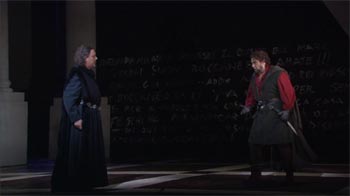
 Simon Boccanegra was the work that persuaded me that maybe I did like Verdi after all. It’s a terrific score and if the plot isn’t without it’s artificialities it’s full of strong characters and strong emotions which Verdi brings to life with fabulous orchestral and vocal writing.
The most recent DVD version to appear is of the 2010 Royal Opera House production that was broadcast live on the BBC. It features Placido Domingo in his baritone incarnation in the title role. There’s a strong supporting cast with Ferrucio Furlanetto as his arch enemy, Fiesco; Jonathan Summers as the villain, Paolo; Joseph Calleja as the young rebel, Gabriele Adorno and Marina Polpavskaya as Boccanegra’s “lost” daughter, Amelia/Maria. 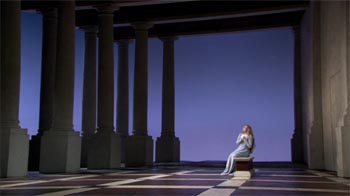 The singing and acting are generally very strong. Placido is, of course, terrific. What more can one say? Furlanetto is a strong foil; excellent in both the prologue and the crucial final scenes. Summers is more than adequate though I might have hoped for more of a frisson when he curses himself. The real star for me is Calleja. He has a gorgeous voice and can float out a lovely pianissimo. His big aria early in the second act is particularly good but he is excellent all through the piece. The one weak link is Poplavskaya’s Amelia. It’s not bad. She acts well and looks the part but one really wishes for more beauty of tone. Pieczonka, in the Met HD broadcast, was much closer to the required vocal quality. Ensemble work throughout is excellent and there are some big set pieces! Antonio Pappano conducts brilliantly. He gets really good playing from the orchestra which is pretty crucial as there are some cruelly exposed woodwind and brass lines. He manages drama and urgency while still giving the singers room to do their thing when they need it. All in all, this is musically very satisfying.
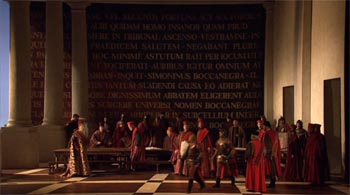 The production, by Elijah Moshinsky, is pretty conventional. It’s a period setting with simple designs that suggest renaissance paintings. There are a few nice touches like the graffiti on the walls in the exterior scenes but mostly the look is just undistracting. There’s nothing beyond the text in the way the story is told either. Blocking is fairly basic and there’s a fair bit of “park and bark”. One senses that Moshinsky’s efforts have gone into character development rather than in trying to make any bold statement.
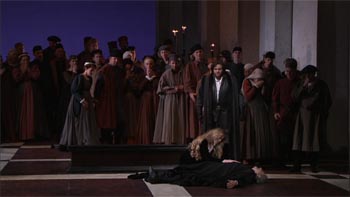 Sue Judd directed for TV and video and it’s a conventional TV view with too many close ups. She needs to watch some of François Roussillon’s recent work. We also get little chats from Pappano between scenes. These probably work OK first time through but I think would get pretty tedious on repeat viewing. There are short bonus features on
 WorshippingWorking with Placido Domingo and Rehearsals with Elijah Moshinsky. The technical quality is very good. It was filmed in HD and the picture is clear and detailed. The DTS 5.1 sound is really excellent; detailed, very spacious and coping very well with the more congested passages. There is also LPCM stereo. This really deserves a Blu-ray release but it’s on EMI who so far seem not to have gone that route(1). There are English, French, Spanish, German and Italian subtitles. The documentation is missing from my library copy but apparently contains a track listing, synopsis and “notes”.
This is definitely worth a look and it will be very interesting to do a detailed “compare and contrast” if I can get my hands on the Sony DVD release of the 2010 Met HD broadcast with Domingo, Morris, Giodarno and Pieczonka.
fn1. EMI was recently sold to Universal; parent of Deutsche Grammophon, and Decca so I suppose anything is possible.

 operaramblings