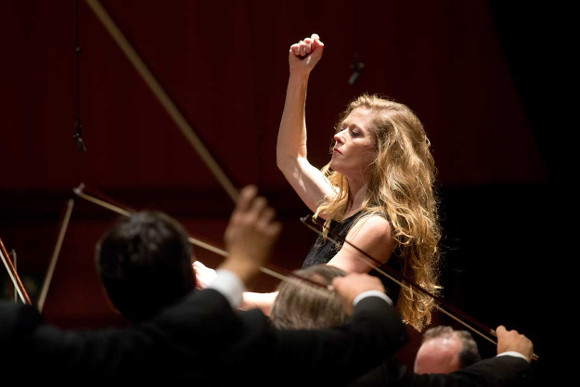
Joel Ivany’s much anticipated “semi-staged” version of Mozart’s Requiem K. 626 finally saw the light yesterday evening at Roy Thomson Hall. There were some interesting ideas but, ultimately, I didn’t think I came away with any new insight into the piece or life or death or anything really(*). I’ll go into the reasons but first I should describe how it was performed. The mass is prefaced by the slow movement from the Clarinet Quintet. The lights go down. The five players enter via the aisles in the audience lower level and take their seats (sadly to applause which we had been asked to refrain from). As the quintet is played (and it was very beautiful) the players are joined by the rest of the orchestra, the choirs, conductor and soloists enter through the audience and from the wings and deposited slips of paper (I think) on two benches at front of stage left and right. Names of the dead? Probably and that’s a nice touch though scarcely original. The quintet concludes. More unwanted applause. At this point the orchestra are seated , more or less conventionally, around the conductor with the choirs around them. There are lots of fancy chairs. The soloists are more or less in conventional position in front of the audience. Everyone, except the mezzo and the soprano, are in black. The very crowded stage is quite dimly lit in bluish tones. As the mass progresses, the soloists interact in various ways. The choirs gesture in rather obvious ways; the text says “king” so we pump our fists, the text talks of “writing” so we make scribbly gestures. At some point the soloists start to rearrange the pieces of paper with the names of the dead in a sort of game of Dearly Departed Patience. The soloists exit through the orchestra. The lights go down. The End.

Continue reading →


 operaramblings